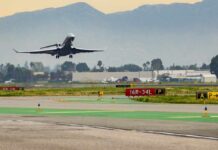


American aviation technology achieved a groundbreaking victory as Garmin’s Emergency Autoland system successfully completed its first real-world operational landing, proving that innovative U.S. engineering can save lives when human pilots face life-threatening emergencies. The system took control of a Beechcraft King Air 200 following a rapid cabin pressurization failure at 23,000 feet, autonomously navigating, communicating with air traffic control, and landing safely with no injuries. This milestone validates the system’s reliability and its potential to significantly advance general aviation safety.
Story Highlights
- Garmin’s Emergency Autoland system executed its first operational emergency landing on December 20, 2025.
- King Air 200 experienced rapid pressurization failure at 23,000 feet over Colorado.
- System autonomously selected airport, communicated with ATC, and landed safely with no injuries.
- Aircraft returned to service within 24 hours, validating American aviation technology reliability.
Historic First for Aviation Safety Technology
On December 20, 2025, a Beechcraft King Air 200 operated by Buffalo River Aviation departed Aspen-Pitkin County Airport bound for Rocky Mountain Metropolitan Airport in Broomfield, Colorado. Twenty minutes into the flight, while climbing through 23,000 feet, the aircraft experienced rapid cabin pressurization failure. The two pilots donned oxygen masks as Garmin’s Emergency Autoland system automatically engaged, taking complete control of the aircraft.
The system demonstrated remarkable capability by selecting Rocky Mountain Metropolitan Airport as the optimal landing destination, factoring in runway length, weather conditions, terrain, and fuel remaining. The aircraft squawked emergency code 7700 and transmitted automated messages to air traffic control declaring the emergency situation and intent to execute an autoland procedure.
LISTEN: Garmin confirmed the first real-world activation of its FAA-certified Emergency Autoland system after a pilot became incapacitated aboard a Beechcraft Super King Air, with the system automatically alerting ATC—marking a major milestone for aviation safety since its… https://t.co/5eNBVGM1gI pic.twitter.com/H1DtzgzzEW
— Breaking911 (@Breaking911) December 22, 2025
American Innovation Delivers Under Pressure
Garmin introduced Emergency Autoland technology in 2019 for smaller piston aircraft, expanding to turboprop installations in 2024. The FAA certified Autothrottle and Autoland systems for select Beechcraft King Air models in August 2025, equipped with G1000 NXi avionics. This represents years of American engineering excellence coming to fruition in a real emergency scenario.
The system’s sophisticated programming handled every aspect of the emergency landing sequence. It navigated autonomously to the selected airport, managed descent profiles, communicated position and intentions to air traffic control, executed the landing approach, applied brakes upon touchdown, and automatically shut down engines after rolling to a complete stop on Runway 30.
Clearing Up Initial Confusion
Early reports suggested pilot incapacitation triggered the autoland system, but Buffalo River Aviation CEO Chris Townsley clarified that both pilots remained conscious and alert throughout the emergency. The crew made a deliberate decision to allow the automated system to handle the landing rather than resume manual control during the pressurization emergency, demonstrating what Townsley called “conservative judgment.”
The FAA has launched an investigation into the activation and emergency procedures, standard protocol for such incidents. No injuries occurred during the event, no passengers were aboard the aircraft, and the King Air returned to operational service on December 21. This quick turnaround demonstrates both the system’s effectiveness and the minimal impact when American technology works as designed.
Implications for General Aviation Independence
This successful deployment validates concerns about pilot safety in general aviation, where medical emergencies or incapacitation can prove fatal. The technology represents a significant advancement for American pilots who value self-reliance and independence in aviation operations. Rather than expanding government oversight or restricting general aviation access, innovative solutions like Emergency Autoland enhance safety while preserving individual liberty to fly.
The aviation community recognizes this milestone as proof that American engineering can solve complex safety challenges without burdensome regulations. Industry specialists note the system performed exactly as designed, potentially accelerating adoption across the general aviation fleet and reducing dependency on costly emergency response services.
Watch the report: Plane makes safe emergency landing with first use of Autoland system
Sources:
- Garmin Autoland safely lands King Air in first real-world emergency landing
- Garmin Emergency Autoland deployed for the first time | Flightradar24 Blog
- Garmin Autoland safely lands King Air in first real-world emergency use – AeroTime
- Garmin Confirms First Real-World Emergency Use of Autoland – AeroMorning