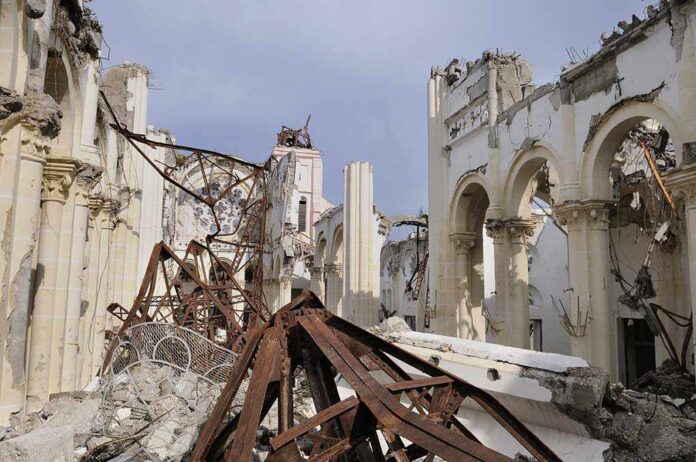
Violence in Suqaylabiyah sits at the intersection of sectarian signaling and local disorder; treat it as a bar fight or as an anti-Christian attack and you will miss the way both dynamics can operate at once—and why communities demand protection when symbols and sanctuaries are hit.
At a Glance
- Senior church leaders in Syria condemned armed attacks in Suqaylabiyah as violence against a Christian community and religious property, urging firm state action.
- State-aligned and some international reporting framed the episode as a dispute that escalated into wider unrest, with security forces restoring order and making arrests.
- The episode prompted churches to scale back Holy Week and Easter observances, a concrete indicator of fear and perceived risk in a predominantly Christian town.
- In Syria’s post-collapse security environment, sectarian identity, local revenge, criminality, and weak policing regularly blur together—competing framings can each capture part of the truth.
What Happened in Suqaylabiyah and Why It Mattered Locally
In late March 2026, Suqaylabiyah—an Orthodox-majority town in Hama governorate—experienced armed violence that, according to multiple church bodies, included gunfire directed at Christian sites and intimidation of residents. A joint statement by the Greek Orthodox, Syriac Orthodox, and Melkite Greek Catholic patriarchs condemned the attacks, rejected the minimization of such incidents as isolated “individual acts,” and called for an investigation and prosecution of perpetrators. Their framing was clear: this was not a neutral neighborhood scuffle but an assault that struck Christian property and community confidence. Other accounts aligned with this view pointed to damage such as gunfire at a Marian statue and assaults on shops and cars.
The social consequence was immediate. Church leaders curtailed Holy Week and Easter celebrations, limiting them largely to prayer inside churches rather than customary public rites—a decision religious authorities do not take lightly and that signals an elevated threat perception among congregants. Regardless of motive, when a town cancels or scales back its most important communal observances, the incident has already migrated from the realm of episodic disorder into that of communal security.
The State’s Version: A Dispute Contained, Calm Restored
Parallel to ecclesial statements, state media and several outlets with access to official sources cast the events differently. SANA reported that the incident began with a dispute or brawl among young men, after which Internal Security Forces intervened, made arrests, and restored calm. The Associated Press likewise described an argument between a resident of Suqaylabiyah and a man from nearby Qalaat al-Madiq that escalated; government forces then brought in reinforcements to calm the violence. The National echoed this sequence, citing security deployments, arrests, and a return to order after the brawl was contained.
As an evidentiary package, the state-aligned narrative is specific on one axis—law-and-order response and arrests—but sparse on another—what, exactly, was targeted and why. It says who intervened and with what result; it says little about the pattern of damage or the symbolism of the places hit. This is not unusual: public-order reporting often emphasizes restoration of calm while minimizing motive, especially when inter-communal tension is a live risk.
Reconciling Two Truths: Sectarian Targeting or Local Escalation?
To read these accounts as mutually exclusive is to misread Syria’s security landscape. In towns like Suqaylabiyah, sectarian identity, local vendettas, opportunistic criminality, and the signaling power of religious symbols overlap. Analysts and monitoring bodies have long observed that incidents affecting Christians and other minorities frequently carry mixed motives: identity matters, but so do security vacuums, perceptions of political affiliation, and local power plays. Under those conditions, a street quarrel can evolve—quickly—into a retaliatory surge that selects targets with communal meaning, such as a church precinct or a Marian statue. When bullets strike a shrine, residents will read the event not as random spillover, but as a message.
This is why evidence that churches altered Easter observances is probative: it captures how those closest to the harm understood the risk. The patriarchal statements articulated that risk and rejected efforts to trivialize it as “individual acts,” aligning their call for justice with practical steps to reduce exposure during the holiest days on the Christian calendar. That is a rational response in an environment where both sectarian and local factors routinely co-produce violence.
What We Know, What We Don’t, and What Would Settle the Dispute
What is on firm ground? That armed men caused injuries and property damage in a predominantly Christian town; that shots were reported at or near Christian religious symbols; that police made several arrests and claimed to have restored order; and that churches curtailed public celebrations in direct response. What is not yet resolved by the publicly available record are the perpetrators’ precise motives, the full response timeline, and whether security units were present earlier but failed to act decisively—allegations voiced by clergy but not matched here by dispatch logs or after-action reports.
The highest-yield clarifications would come from four sources: authenticated CCTV and phone video establishing the sequence of targets; medical and forensic documentation of injuries and ballistic impacts; official incident and dispatch records from Internal Security Forces detailing deployment and arrests; and named-witness testimony from shopkeepers, parish staff, and residents. Together, these would answer the core questions: did the attackers select Christian symbols deliberately; how quickly did authorities arrive and intervene; and did arrests include ringleaders or only immediate participants. Absent that, the interpretive gap remains—and the more acute risk is borne by the community that feels targeted.
I spoke with Vatican News about Israeli settler attacks on the Christian village of Taybeh.
The recent settler attack on Taybeh occurred today. It just keeps getting worse. I hope that one day, I will be interviewed to announce the end of this tragedy.https://t.co/L7uvexb8qV
— Ihab Hassan (@IhabHassane) October 5, 2026
Why This Matters Beyond One Town
Suqaylabiyah is neither the first nor the only case where Christian communities in Syria have felt exposed. Country reporting and rights monitors describe a pattern of sporadic, sometimes targeted incidents against Christians amid a broader crisis of public security; state and nonstate actors alike have perpetrated sectarian violence in recent years. This is not a claim of singular persecution to the exclusion of others—the majority population has suffered grievously—but an observation about vulnerability: when the social meaning of a site is religious, its damage reverberates beyond material loss. The cost is the erosion of civic trust, the retreat of public religious life, and, over time, migration decisions that hollow out pluralism.
The practical implication is unglamorous but non-negotiable: visible, even-handed policing that is trusted by minorities and majorities alike. Where security forces promptly protect religious sites and hold offenders—whatever their sect—accountable, escalation pathways narrow. Where response is delayed, opaque, or framed as “boys being boys,” communities will default to self-protective withdrawal, as they did by restricting Easter rites. In the long run, that retreat is corrosive; it signals that public space cannot be shared safely across lines of belief.
Expert Judgment
Weighing the evidence, the core of the church-led account holds: the community experienced the incident as anti-Christian violence, including damage to religious symbols, and responded accordingly by scaling back Easter. The state’s “dispute contained” narrative explains part of the chain of events—how it began and how order returned—but it does not negate the targeted nature of what was hit once the violence expanded. Both can be true, and in Syria’s current conditions, they often are. The path to preventing a reprise is not rhetorical—whether we name it a brawl or a sectarian attack—but operational: credible protection of all civilians and rapid accountability when sacred spaces come under fire.
Sources:
zerohedge.com, thecradle.co, csw.org.uk, spzh.eu, thenationalnews.com, christiantoday.com, oikoumene.org, copticsolidarity.org, thetablet.co.uk, christianpost.com, catholicworldreport.com, asianews.it