

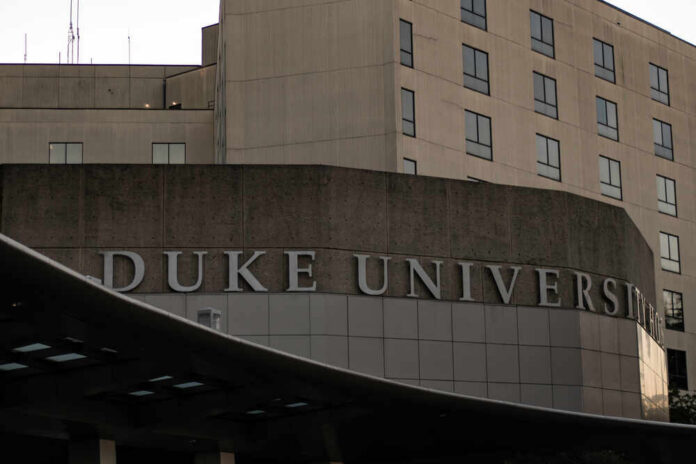
One elite university’s employees quietly poured $1.6 million into Democrat political machines—fueling the very agenda many families say has hijacked higher education.
Story Snapshot
- Duke University employees donated $1,663,118.88 during the 2026 midterm cycle, according to FEC-based reporting.
- About 97.46% ($1,620,859.80) went to Democrat-aligned recipients, versus 2.54% ($42,259.08) to Republican-aligned recipients—roughly a 38:1 gap.
- Top reported recipients included ActBlue ($675,000), Unite the Country PAC ($300,000), and the Democratic National Committee ($165,000).
- Several high-dollar donors were identified in the reporting, including one individual listed at more than $270,000.
FEC-Tracked Donations Show a Lopsided Political Pattern
Federal Election Commission data, as compiled in a Campus Reform analysis and repeated by other outlets, indicates Duke University employees donated $1,663,118.88 to federal candidates and committees in the 2026 midterm cycle. The reported split is stark: $1,620,859.80, or 97.46%, went to Democrat-aligned recipients, while $42,259.08, or 2.54%, went to Republican-aligned recipients. That ratio—about 38 to 1—captures why critics argue campus politics are anything but balanced.
The underlying dataset is public-facing and donation totals can change as the election cycle continues and filings update. No coverage in the provided research includes statements disputing the numbers themselves. What is missing, however, is Duke’s own explanation—whether the institution views this as irrelevant private speech by employees, or as a reputational red flag for an academic culture that claims “diversity” while often struggling to tolerate political diversity.
Where the Money Went—and Why That Matters Politically
The reporting lists major recipients that function as core infrastructure for Democrat fundraising and election operations. ActBlue is cited as receiving $675,000, Unite the Country PAC as receiving $300,000, and the Democratic National Committee as receiving $165,000. Those entities are not campus clubs; they are national vehicles for electoral power. For voters who watched years of inflation, open-border chaos, and bureaucratic overreach, the relevance is straightforward: universities help shape the next generation, and these donations show which political direction influential employees are investing in.
The same reporting also lists large individual donors among Duke employees, including Cynthia Kuhn at more than $270,000, along with other donors in the tens of thousands. The articles do not claim these gifts were coordinated by Duke or directed by administrators, and the sources do not show any internal institutional directive. Still, the data highlights how a relatively small number of high-dollar contributors can amplify one party’s influence—especially when paired with the cultural authority universities hold in credentialing, research, and public “expert” commentary.
Claims of Campus “Neutrality” Collide With Political Reality
Conservative readers are familiar with the rhetorical pattern: universities advertise viewpoint “inclusion,” then treat traditional values as backward and America-first politics as suspect. The provided research does not include independent experts, faculty defenders, or Duke leadership responses; it mainly includes commentary from conservative outlets calling the donation split a symptom of a broader lack of balance in higher education. Without counter-statements, the public is left with an uncomfortable question—whether a campus environment producing a 38:1 funding tilt can realistically foster open debate on constitutional limits, law-and-order, or parental rights.
What We Can Confirm—and What the Coverage Doesn’t Show
The strongest element here is the reliance on FEC-tracked political contributions, a standard source for federal donation reporting. Multiple outlets cited in the research repeat the same totals and the same basic recipient list, which supports internal consistency across the coverage. The weakest element is the lack of direct voices: no statements from Duke, no quotes from the named donors explaining their intentions, and no broader context about how representative these donors are of the overall employee population. The numbers are concrete; the institutional meaning remains unaddressed.
This is why we need school choice!
Outrage! Duke University Employees Donate Over 1.6 Million Dollars to Democrat Party and Campaign Committees https://t.co/i5rzWiHZMf #gatewaypundit via @gatewaypundit
— Tiffany (@Tiffany26075727) March 16, 2026
That gap matters because higher education often asks taxpayers and families for trust—through student loans, grants, and public policy deference—while simultaneously promoting political outcomes that many working Americans reject at the ballot box. With President Trump back in office in 2026, the debate is shifting from complaining about bias to documenting it. If universities want credibility, the simplest step is transparency: acknowledge the political reality shown by the data and recommit to viewpoint fairness, not just ideological conformity under fashionable labels.
Sources:
Duke University Employees Donated $1.6 Million to Democrats