

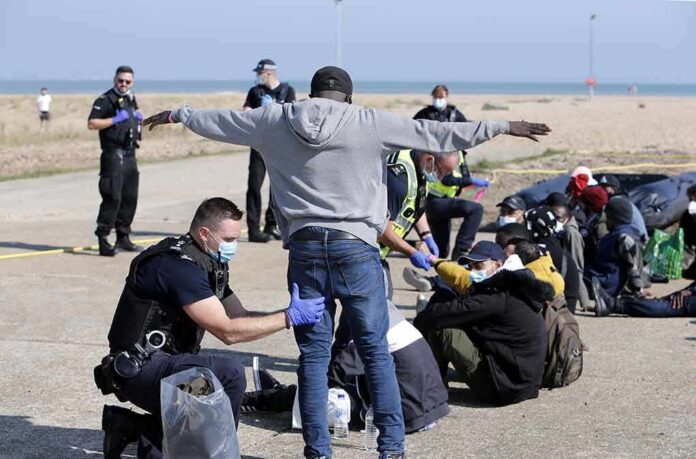
Overcrowding and failed sanitation—not the identity of who crossed the water—turn a beach into a disease vector; in Ceuta, that simple public-health truth explains both the emergency doctors described and the controls authorities rushed to deploy.
At a Glance
- Ceuta’s reception system buckled after a mass arrival, pushing thousands into improvised outdoor living where toilets, clean water, and waste removal were insufficient.
- Local physicians warned of fecal–oral transmission risks and skin and respiratory infections; gastroenteritis cases were confirmed among recent arrivals.
- City leaders acknowledged operational collapse and activated a nine-point plan: intensified cleaning, disinfection, water monitoring, and tuberculosis surveillance.
- Dramatic claims about “fight clubs” lack the corroboration that backs the core public-health picture; the hazard stems from crowding and hygiene gaps, not sensational narratives.
Ceuta’s problem was environmental health failure in a crowded space
When a small territory absorbs a sudden migration surge, the first systems to fail are logistical: places to sleep, places to wash, and places to eliminate waste. Ceuta followed that script. The city’s political leadership said plainly that reception centres had “collapsed,” leaving many to shelter in public areas with inadequate sanitation while transfers and returns were processed. In that setting, the hazard profile is textbook: fecal–oral transmission via contaminated hands, surfaces, and coastal water; skin infestations in close quarters; and elevated risk of respiratory spread in dense sleeping arrangements. The actors change with each border crisis; the mechanism does not.
Local clinicians put specific names to those mechanisms. Doctors in Ceuta described beaches contaminated by urine and faeces and warned of a “sanitary catastrophe” if toilets, washing, and waste removal did not catch up. The medical association flagged risks spanning cholera, tuberculosis, measles, scabies, and infectious diarrhoea—conditions that thrive not because people moved, but because they were then concentrated without hygiene infrastructure. Spain’s National Institute for Health Management confirmed gastroenteritis among recent arrivals, with scabies and impetigo also observed in clinical practice. A preventive-medicine lead at the University Hospital drew the direct line: lacking urinals, toilets, or showers, people were forced into behaviours that contaminate shared environments and put both newcomers and residents at risk.
What the evidence shows—and what it does not
The strongest record is administrative and clinical. On the administrative side, city and health authorities shifted rapidly from alarm to controls, announcing a nine-point public-health and environmental plan that reads like a standard outbreak-prevention checklist: enhanced tuberculosis surveillance, expanded monitoring of drinking and coastal waters, stepped-up cleaning and disinfection, and surge deployment of more than 100 sanitation and environmental workers. Governments do not mobilize that scope of response for optics; they do it because the risk pathway is real and time-sensitive.
On the clinical side, confirmed gastroenteritis provides the concrete anchor that many crises lack, while physician testimony describes the broader syndrome of crowding-related infections that European agencies have catalogued for years in improvised settlements. The warnings about cholera or measles should be read as risk statements—credible given conditions, not proof of a detected outbreak. That distinction matters: alarmist framing collapses risk and reality; expert framing separates them so resources land where they have effect.
Scale, duration, and management: a moving target in any surge
Surge arithmetic is always messy in the first weeks, and Ceuta was no exception. Estimates varied for how many remained in the enclave after the crossing spike; one political leader told European lawmakers that thousands were still present but far fewer than the total who had arrived, and he acknowledged both a continuing humanitarian emergency and disturbances to public order. Wire reporting likewise emphasized that reception capacity had been overtaken even as many people returned to Morocco or were processed onward. These are compatible facts: a system can be “back under control” in the sense of no longer spiralling, while still housing a residual population outdoors that sustains health risk until services catch up.
What about the more dramatic claims—organized “fight clubs” by the water, orchestrated chaos as a durable feature rather than opportunistic disorder? Here the evidentiary scaffolding thins. The record contains visual material and eyewitness accounts of littered beaches and confrontations, but it lacks the specifics—dates, named organizers, charge sheets—that distinguish a viral trope from a pattern. In contrast, the sanitation failure is overdetermined by converging sources: elected officials, medical associations, hospital leads, and the documented policy response. The prudent reading centers the latter and treats the former as unproven until incident logs say otherwise.
How these outbreaks actually happen: mechanism, not myth
The misconception that migrants “bring” epidemics persists, but European and global public-health guidance has long drawn a sharper picture: the risk rides on conditions created after arrival—crowding, limited toilets and handwashing, interrupted vaccination, and delayed clinical screening—rather than on the mere fact of movement. In such environments, pathogens that are already endemic in surrounding populations or in transit corridors find easy transmission chains. That is why the fastest life-saving interventions are boring: latrines at adequate ratios, reliable water chlorination, soap at distribution points, temporary shower blocks, and waste collection schedules that keep pace with daily load. The nine-point plan in Ceuta tracks exactly to those basics because the biology leaves little alternative.
Respiratory surveillance, especially for tuberculosis, fits the same logic. TB spreads via prolonged close airspace contact; improvised dormitories magnify risk. Enhanced screening and prompt linkage to treatment protect both migrants and residents. Likewise for measles, a virus that punishes delayed vaccination in crowded settings. None of this is speculative; it is the unglamorous craft of field epidemiology applied to a coastal city under stress.
Politics at the waterline: why narratives diverge
Border crises compress complicated dynamics—court rulings, Morocco–Spain diplomacy, smuggling incentives—into a single visual: a fence, a beach, a crowd. In that compression, two narratives compete. One emphasizes humanitarian strain and administrative overload; the other emphasizes public order and deterrence. Ceuta contained both. Officials cited human-trafficking networks in explaining the suddenness of the surge, and European border authorities cautioned that a definitive causal account would take time. Meanwhile, city leaders and clinicians focused on what they could measure: collapsed centres, overflowing beaches, and preventable health hazards. Both streams can be true at once; only one determines whether people get sick tomorrow morning.
For residents, the stakes are practical: can I safely use the water and the beach; will my clinic waiting room be overwhelmed; is there a plan that reduces risk without dehumanizing people who slept outside last night. For migrants, the stakes are existential: can I avoid infection, access care, and retain dignity in a setting not built for me. Sensational language—“invasion,” “fight clubs”—turns those shared stakes into caricature and makes it easier to dismiss legitimate concerns as xenophobia. Sticking to verifiable conditions and mechanisms keeps the conversation in the realm where solutions live.
What effective management looks like the next time this happens
Ceuta will not be the last Mediterranean node to face a surge. The playbook that limits harm is stable across contexts, and it is specific. First, surge sanitation: mobile toilets at humanitarian ratios, greywater and solid-waste removal on fixed schedules, and interim shower capacity sized to headcount. Second, water safety: continuous chlorination verification and targeted coastal-water sampling to guide beach closures and reopenings. Third, clinical triage and surveillance: on-site fever and rash screening, syndromic logs for gastrointestinal illness, TB symptom checks with rapid referral, and immediate measles catch-up for unvaccinated children. Fourth, information: plain-language hygiene guidance posted and repeated in the dominant languages in camp and in the city—because risk communication is an intervention, not an afterthought. Ceuta’s nine-point plan moved along this arc; the faster those steps arrive in future surges, the shorter the window for transmission.
Bottom line
The durable truth in Ceuta is not the headline that traveled farthest online; it is the uncontroversial chain from crowding to contamination to illness, and from there to a predictable bundle of municipal countermeasures. The city’s leaders admitted operational collapse; clinicians mapped the risks; a public-health plan followed. That is the spine of the story. Treat the rest as claims awaiting records. In border crises, biology takes the first turn. When policy meets it quickly—with toilets, water, soap, waste trucks, and surveillance—panic narratives have less room to grow, and fewer people get sick.
Sources:
thegatewaypundit.com, thestar.com.my, instagram.com, elobservador.com.uy, express.co.uk, bbc.com