

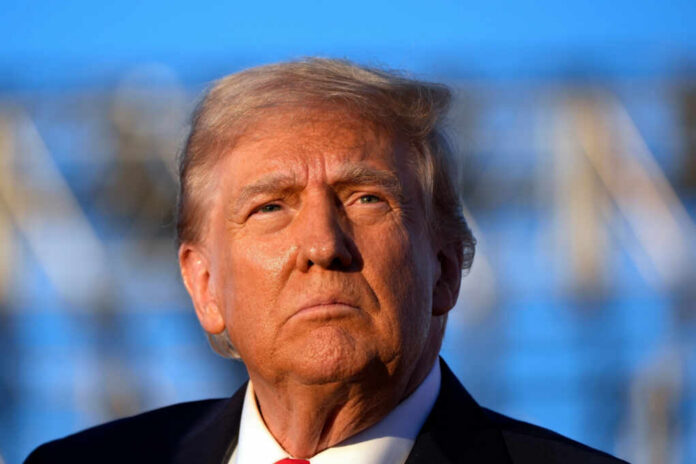
Greenland’s government is telling President Trump “no thank you” after a high-profile hospital ship offer—raising fresh questions about who’s really in charge of Arctic cooperation when diplomacy is conducted by viral posts.
Quick Take
- President Trump said the U.S. was sending a “great hospital boat” to Greenland, posting “It’s on the way!!!” alongside an AI-generated image of the USNS Mercy.
- Greenland Prime Minister Jens-Frederik Nielsen rejected the offer publicly, citing Greenland’s free public healthcare and calling for respectful, direct dialogue.
- Open-source tracking cited in reporting indicated no U.S. hospital ship was en route as of Feb. 23, undercutting the claim that a vessel was already heading north.
- The dispute lands amid renewed tension over Greenland’s strategic value and Trump’s long-running interest in the Arctic territory.
Trump’s Hospital Ship Offer Meets Immediate Pushback
President Donald Trump announced on Feb. 22 that the United States would send what he called a “great hospital boat” to Greenland, describing the mission as help for “many people who are sick, and not being taken care of there.” Trump linked the initiative to Louisiana Gov. Jeff Landry, whom Trump had previously tapped for a Greenland-focused role. Within a day, Greenland’s Prime Minister Jens-Frederik Nielsen publicly rejected the offer.
https://youtu.be/7XwXJrRAh_M?si=f5jck3O3qi1YlyuB
Nielsen’s response centered on sovereignty and basic facts about Greenland’s services. Greenland provides free public healthcare, which Nielsen cited as a direct reason the premise of the U.S. offer did not fit local reality. He also objected to the method—public statements instead of direct coordination—saying dialogue requires respect. That framing matters because it treats the episode not as a simple humanitarian misunderstanding, but as a test of whether Greenland is consulted.
What the Ship-Tracking Questions Mean for Credibility
Reporting following Trump’s post noted a practical problem: there was no confirmed movement of U.S. hospital ships toward Greenland at the time Greenland’s leadership responded. The post’s visual—an AI-generated image of the USNS Mercy—added to the confusion, because it suggested a concrete deployment while the available tracking information did not match the claim that a ship was already “on the way.” The gap between rhetoric and logistics shaped the blowback.
The timeline around the announcement also included a real medical event: Denmark’s Arctic Command evacuated a U.S. submarine crew member who needed medical attention earlier on Feb. 22. That rescue underscores a point conservatives often emphasize: allies cooperate best through operational channels and clear chain-of-command communication, not viral diplomacy. If the hospital ship offer was intended as goodwill after the evacuation, Greenland’s leadership signaled it still expects formal consultation.
Greenland’s Strategic Value Keeps Turning Humanitarian Gestures Political
Greenland sits at the center of Arctic security, mineral access, and emerging shipping routes, and that reality keeps dragging even “help” narratives into geopolitics. Trump’s interest in Greenland stretches back to 2019, when he publicly floated buying the island, prompting a sharp rejection from Denmark and a canceled state visit. By early 2026, the broader backdrop included intensified Danish and European attention to Greenland’s defense posture amid renewed acquisition chatter.
Trump reiterated at Davos in late January 2026 that the U.S. needs Greenland for security, while disavowing force, according to the reporting. Denmark, meanwhile, treated the recurring public pressure as part of modern politics. Danish Defense Minister Troels Lund Poulsen described Trump’s constant posting about Greenland as a “new normal.” That comment reads like an attempt to normalize tension, but it also signals that Danish officials expect periodic flare-ups that can complicate practical cooperation.
The Larger Lesson: Respectful Diplomacy Protects National Interests
Greenland’s “no” does not automatically prove bad intent on either side, but it does show how quickly optics can overwhelm substance when leaders speak past each other in public. From a limited-government, America-first viewpoint, the U.S. has every reason to pursue stable Arctic partnerships that secure U.S. interests without turning allies into political props. Nielsen’s insistence on respect and direct dialogue is a reminder that even friendly moves can be rejected if they ignore local authority.
As of Feb. 23, the reporting indicated no hospital ship was verifiably positioned to execute Trump’s claim, leaving the story in an awkward limbo: a dramatic announcement, a blunt rejection, and unanswered questions about what planning—if any—was underway. Until there is confirmation of an actual deployment request, an agreed-upon mission, or a formal diplomatic exchange, the safest conclusion is that the episode will fuel more friction than relief in a strategically sensitive region.
Sources:
Greenland’s Prime Minister Says Arctic Nation Won’t ‘Welcome’ Donald Trump’s ‘Great Hospital Boat’