
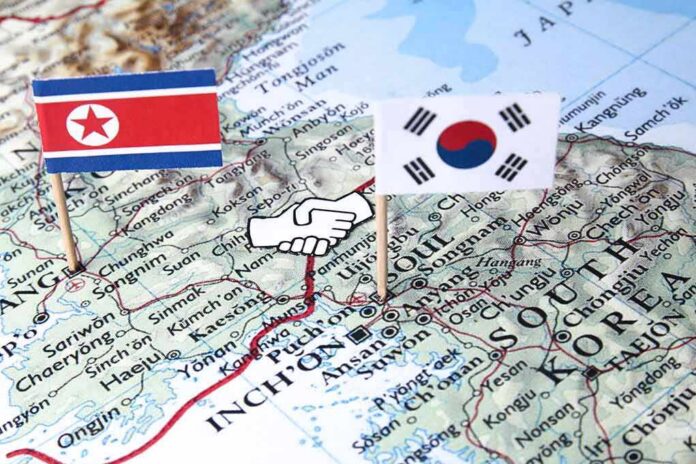
On the Korean Peninsula, the most stabilizing act available is also the least theatrical: lock the armistice’s fragile ceasefire into a durable peace framework through direct talks that reduce miscalculation and cap nuclear risk — a project South Korea’s leadership has now put plainly on the table.
The Short Version
- Seoul has proposed direct, four-party discussions (the two Koreas, the United States, and China) to replace the 1953 armistice with a peace regime and to constrain North Korea’s advancing nuclear program.
- Pyongyang has publicly dismissed dialogue offers, accusing Seoul of clinging to a confrontational line through its U.S. alliance — a predictable hurdle for any talks-first strategy.
- At home, conservatives deride re-engagement as naive and press for harder deterrence options; the strategic divide inside South Korea is real and durable.
- Korean security debates repeatedly fuse contested incidents with domestic politics; the 2024–2026 drone saga and subsequent conviction of an ex-president underscore how escalation narratives can boomerang internally.
What Seoul is actually proposing — and why it matters
South Korea’s government has moved beyond vague overtures to a concrete proposition: begin “discussions among the parties involved to end the long-standing war,” explicitly including the United States and China alongside the two Koreas, and pair that with practical steps to halt the growth of the North’s nuclear capabilities. The concept tracks with well-studied pathways for a Korean peace regime — not a single treaty as panacea, but a layered framework of declarations, rules, institutions, and verification that incrementally replace the armistice’s tripwires with stable mechanisms for crisis management. In practice, that means separating political normalization from hard security measures in sequenced phases, with guardrails that keep deterrence credible while giving diplomacy oxygen.
This is not utopianism in new packaging. It is an attempt to correct a structural flaw: the armistice froze the war without resolving its political engine. Seven decades later, command-and-control alerts, artillery in range of a capital, and nuclear salvos in North Korean doctrine make an accident or misread signal the most likely trigger for catastrophe. A peace-building process cannot abolish that risk overnight, but it can reduce it by installing predictable channels, codifying de-escalation steps, and creating verification routines that shrink the space for miscalculation.
The hardest constraint: North Korea’s stated disinterest in talks
Any initiative founders if the other side refuses to show up. Pyongyang has publicly said it has no interest in Seoul’s proposals or in resuming dialogue, framing South Korea’s alignment with the United States as inherently “confrontational”. That posture is familiar bargaining behavior; the North habitually rejects engagement until it can extract better terms or demonstrate leverage through tests and brinkmanship. Yet public refusal raises the bar for Seoul’s strategy: without at least a freeze-for-freeze style starting point — calibrated reciprocal steps that halt nuclear qualitative advances and large-scale exercises — talks may never graduate from concept to calendar.
That impasse is not an argument against proposing a peace regime; it is a reason to design the opening bid to be resilient to initial rejection. The sequencing matters. Begin with verifiable, low-cost confidence-building steps that are reversible if violated, backed by a sanctions enforcement posture that keeps pressure on prohibited activities even as political channels open. Align with Washington and coordinate with Beijing so the four-party geometry functions as leverage, not as a veto factory. When the North tests, as it will, built-in snapback clauses and graduated penalties preserve deterrence without annulling the process.
Domestic headwinds: the enduring peace-versus-deterrence divide
Inside South Korea, the line of contestation is clear. Conservative voices cast engagement-first as “too dovish and weak,” argue that aid and dialogue in the face of provocations reward bad behavior, and have floated options from redeploying U.S. tactical nuclear weapons to exploring a NATO-style nuclear-sharing arrangement or even a domestic nuclear pathway. Prominent figures emphasize sustaining and, if needed, amplifying deterrence until nuclear provocations end. None of this is fringe; it reflects a strategic culture shaped by direct exposure to artillery and the North’s serial violations. Even analysts who disagree with the prescriptions concede the premise that North Korea must not be recognized as a nuclear weapons state — a point of rare cross-factional consensus.
There is, however, a practical reckoning embedded in the conservative critique. If Pyongyang is treated as permanently recalcitrant, the policy menu narrows to a ladder of pressure that has failed to arrest its nuclear progression. If, conversely, Seoul over-prices the virtue of dialogue, it invites exploitation. The work, then, is in the architecture: deter and defend credibly while creating bounded diplomatic rooms where limited trade-offs — freezes, test moratoria, intrusive monitoring — can actually transact. That is the center of gravity where a peace regime, as an institutional framework rather than a single grand bargain, has purchase.
The drone episode as cautionary tale: why de-escalation machinery is not “soft”
Security on the peninsula does not unravel only at the Demilitarized Zone; it can fracture in courtrooms and campaign rallies. The 2024–2026 drone affair — culminating in the conviction and 30-year sentence of a former South Korean president for using a covert operation to stoke tensions as pretext for emergency rule — illustrates how escalation narratives can be domestically manufactured and then ricochet through institutions. For years, analysts have warned that ambiguous cross-border incidents are tinder for political conflagration, exploited by hawks on both sides to validate maximalist responses. A functioning peace regime installs cooling valves for precisely these moments: hotlines that actually work, third-party technical fact-finding on incidents, pre-agreed investigation protocols, and time-bound escalatory pauses while evidence is assessed.
Seen that way, mechanisms for incident management are not gifts to Pyongyang; they are sovereign tools to keep Seoul’s decision-making anchored in verified reality, not manipulated spectacle. They also deny the North a favorite tactic — leveraging ambiguity to drive wedges in allied politics.
How a peace regime could be structured without sacrificing deterrence
The literature on Korean peace-building converges on a multi-track, staged approach. Politically, begin with a declaration that the parties intend to replace the armistice with a peace arrangement; militarily, codify no-first-use zones for specific categories (artillery exercises near the Military Demarcation Line, UAV flights across agreed corridors), backed by real-time notification and inspection rights; diplomatically, stand up a permanent four-party contact group housed in a neutral venue; legally, map the transition from Armistice Commission bodies to new joint mechanisms with defined mandates and dispute-resolution rules. Each tranche is conditioned on compliance, with sanctions relief and economic steps gated behind verifiable milestones. The end state is not trust — it is managed distrust.
Deterrence remains the floor. U.S.–ROK extended deterrence consultations continue; missile defenses and conventional readiness are maintained; allied exercises proceed but are modularized to allow tapering or reshaping during delicate phases. This duality is not incoherent; it is the only posture that has historically elicited even temporary restraint from Pyongyang while protecting Seoul’s inhabitants and markets from sudden shocks.
What to make of Pyongyang’s rejection and the street-level backlash
North Korea’s initial “no” is priced into any serious design. It tests whether Seoul and Washington can keep alliance cohesion while offering a narrow, credible off-ramp. The more interesting variable is political time at home. Street protests that paint engagement as capitulation, and social-media narratives that brand elected leaders as proxies for foreign ideologies, are not policy arguments; they are pressure tactics. They matter insofar as they shorten a government’s runway to attempt a complex strategy. The antidote is disciplined transparency: define the objectives, the red lines, the reversible concessions, and the triggers for pause or snapback. When citizens can see the tripwires, they are more likely to tolerate the inevitable provocations along the way.
If Pyongyang eventually re-engages — historically, it often does when leverage peaks then ebbs — the opening bid should be modest and testable: a verifiable freeze on fissile material production at known sites in exchange for limited, reversible measures, coupled with incident-management protocols to prevent a single flare-up from collapsing the process. If it does not, Seoul will at least have built international alignment around a good-faith, well-specified path — strengthening the legitimacy of sustained pressure.
The bottom line
Ending the Korean War is not a slogan; it is a systems project. South Korea’s call for direct, four-party talks to replace the armistice with a peace regime is the right organizing idea precisely because it treats peace as infrastructure, not sentiment. Pyongyang’s rejection and domestic skepticism do not invalidate the effort; they define its engineering constraints. Build a framework that lowers miscalculation risk, caps nuclear danger where possible, and preserves a hard deterrent if the other side cheats — and keep the sequence, verification, and reversibility tight. That is not softness. It is statecraft calibrated to a nuclear-adjacent fault line where the cost of improvisation is unacceptably high.
Sources:
bbc.com, apnews.com, bloomberg.com, english.aawsat.com, koreaherald.com, koreatimes.co.kr, whbl.com, washingtonpost.com, upi.com