

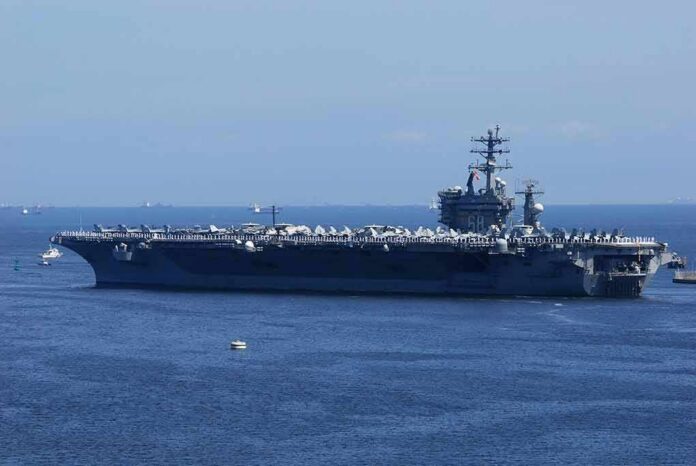
The fight over “weakness” on the USS Abraham Lincoln isn’t about tuna or tortillas; it is a collision between two durable military norms—stoicism and stewardship—playing out under the strain of an unusually long, logistics-constrained deployment.
The Short Version
- Marine veteran Joey Jones condemned Lincoln sailors’ public complaints about food and morale as weakness; Navy leadership simultaneously rejected claims of systemic deprivation.
- Independent reporting and family accounts describe a record-length deployment with equipment and habitability stressors that predictably drive down morale.
- The facts best supported by named officials: nutritional standards were met; the deployment was exceptionally long; and mental health strain rose with operational tempo.
- The core tension is cultural and managerial, not culinary: extended, uncertain deployments amplify stress unless leaders communicate, provision, and rotate effectively.
What happened and why the argument resonated
Joey Jones—a Marine combat veteran who lost both legs in Afghanistan—reacted on air to reports that sailors aboard the USS Abraham Lincoln were short on staples and fed up with repetitive, unappealing meals. He framed the issue starkly, contrasting his combat hardship with what he cast as entitlement: “How weak are you?” That formulation traveled because it taps a long-standing military ethic: the mission comes first; discomfort is part of the job. Simultaneously, the Navy’s top leadership publicly rejected the most inflammatory claims of deprivation, stating crews received fully portioned, nutritionally balanced meals and had not fallen short of menu standards during the deployment. The effect was to legitimize Jones’ skepticism on one narrow axis—nutrition—while leaving other, more consequential stressors unaddressed in that same breath.
Against that, families and reporters documented a different texture of experience: nearly nine months at sea with extended stretches between ports; recurring complaints about plumbing, laundry outages, and monotonous or unappealing food; frayed morale and rising mental health concerns consistent with repeated 12- to 16-hour days and minimal downtime. The strongest official facts and the lived narratives can both be true: calories can pencil out on a menu while habitability, tempo, and uncertainty grind people down.
Mechanism: how long deployments and thin logistics create morale friction
Morale is not a single-variable function of toughness. Decades of research and fleet experience converge on a more prosaic reality: family separation, long work hours, uncertainty about end dates, and perceived unfairness or poor management are reliable stress multipliers. When those factors co-occur—as they do in extended carrier operations—fatigue, cynicism, and attrition rise even when basic needs are technically met. For carriers, the mechanism is structural. The air wing drives a grueling flight schedule; maintenance consumes what little off-watch time remains; and the ship becomes, for months, a closed ecosystem. Under those conditions, even small degradations—broken heads, backed-up laundry, monotonous food—loom large because they signal to crews that recovery and dignity are optional, not planned-for.
Leadership posture matters as much as provisioning. If crews see clear rotation plans, honest communication about why a mission is extended, and a visible pipeline of relief, morale can survive long tours. When timelines slip, port calls vanish, and the message is “endure,” trust thins. Nutritional compliance, which the Chief of Naval Operations emphasized as intact for this deployment, is necessary; it is not sufficient to sustain motivation across months of high-tempo, low-variance work.
The factual record: what holds up and what is contested
Three claims are well anchored by named officials. First, the Navy denied systemic food shortages aboard deployed ships this spring, asserting meals remained fully portioned and balanced and that menu requirements were met during the Lincoln’s deployment. Second, the deployment length was atypical—coverage placed it at roughly nine months with long stretches at sea, a profile families and journalists tied directly to morale strain. Third, commanders and public affairs statements acknowledged mental health concerns while portraying the crew as resilient and supported by onboard resources.
On the other side, many of the most vivid allegations—rotten food, half-cup rice portions, weeks without laundry—arrive via families and some crew speaking without names or through intermediaries. Those specifics are inherently harder to validate at scale and, by themselves, do not prove systemic failure. Still, their consistency across outlets and the match between their themes and what research predicts for long, uncertain deployments should keep them in analytical play, even as investigators and ship logs would be needed to convert anecdotes into findings. In short: Jones’ categorical dismissal outruns what the record can currently sustain; equally, a thesis of institutional starvation or abandonment outruns the official provisioning data on offer.
The cultural fight underneath the sound bite
Jones’ critique has power because it polices a boundary the military has long prized: complaining in public is disloyal; suffering in private is honorable. But that code emerged in an era when deployments were shorter, replenishment schedules were predictable, and trust in command timelines was sturdier. When tempo rises and certainty falls, leaders who treat complaints as weakness risk mistaking feedback for fragility and morale problems for malingering. Cable commentary tends to elevate confrontational framing—“weak” versus “warrior”—while broadcast reporting tends to foreground families and conditions. That media split converts a personnel-management problem into a culture-war referendum over what counts as “real” hardship, which helps no one on the mess decks.
Where reasonable disagreement actually lives
The legitimate dispute is not over whether sailors “should be tough”—they are—but whether command met its stewardship obligations across four domains: predictable rotation or well-communicated extension; credible habitability and maintenance during surge tempo; provisioning that meets standards and remains acceptable over months without ports; and accessible, de-stigmatized mental health support tuned for flight-deck hours. On nutrition, the Navy’s claim of compliance is specific and testable; it deserves weight, pending documentary verification. On morale and habitability, the confluence of an unusually long deployment and repeated, thematically convergent accounts makes dismissal premature; credible inspection reports, supply logs, and command climate surveys would settle what is systemic versus episodic.
What it means going forward
Two practical implications follow. First, the Navy can blunt future controversies by publishing, post-deployment, a redacted packet of provisioning logs, galley audits, and habitability work orders for extended tours. That transparency shifts the debate from cable clips to ledgers. Second, leaders should treat long deployments as human-systems engineering problems, not character tests: shorten uncertainty, rotate relief earlier, harden shipboard services most likely to cascade into distrust (heads, laundry, mail, reliable Wi‑Fi windows), and empower commanding officers to explain tradeoffs crisply when plans change. Those moves do not pamper a force; they preserve it.
The ethic of stoicism is still valuable; it keeps crews focused when conditions are genuinely austere. But stewardship is the ethic that keeps forces ready for the next watch. On the Lincoln, the evidence supports a simple conclusion: calories likely met the standard; morale did not. Calling that reality “weakness” confuses endurance with silence, and in the long run, silence is the greater risk to readiness.
Amazing how @FoxNews didn't bother to send ANYONE to the USS Abraham Lincoln, and instead chose to have host Joey Jones insult our troops… but Pamela Brown from @CNN actually boarded the carrier to show the conditions aboard & debunk the lies spread by Trump & Hegseth. pic.twitter.com/wg9Y4zYCur
— Cheeks McFreaks (@CheekyMcFreaks) August 18, 2026
Assessment of the sources
The Navy Times report anchors the nutritional-compliance claim to a named senior official and dated forum, making it the strongest single source for that narrow point. CBS’ on-record package provides the clearest synthesis of deployment length, family concerns, and official posture on crew resilience and resources. For mechanism and historical pattern, RAND’s work remains the most durable frame: deployment stress is a function of tempo, separation, uncertainty, and management—precisely the variables in dispute here.
Sources:
yahoo.com, youtube.com, snopes.com