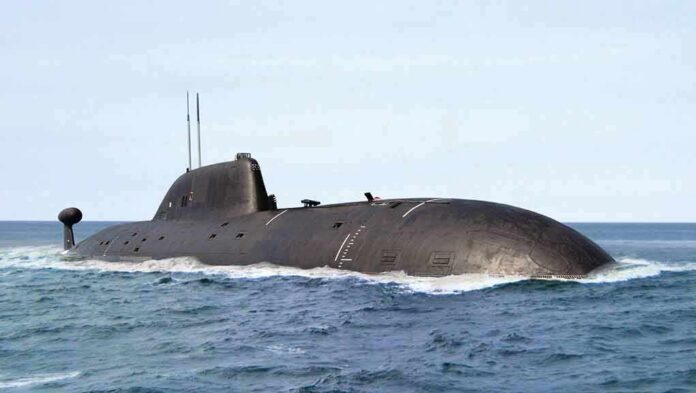
One submarine embodied both the zenith and the vulnerability of Cold War naval engineering: the Soviet Union’s titanium-hulled K-278 Komsomolets, a record-setting deep diver that burned and sank on April 7, 1989, carrying a nuclear reactor and two nuclear warheads to the seabed of the Norwegian Sea.
At a Glance
- A fire broke out aboard K-278 on April 7, 1989, during its return from patrol; the submarine later sank in the Norwegian Sea.
- The wreck lies at extreme depth with its reactor and two nuclear warheads still aboard.
- The initiating event was an electrical fire in the aft compartments; no enemy action was involved.
- The disaster killed more than forty sailors and triggered long-running technical and environmental scrutiny.
The boat that pushed the envelope—and paid for it
K-278 was unique: the only Project 685 “Mike”-class submarine ever built, designed around a titanium pressure hull that allowed dives far deeper than the steel-hulled attack boats fielded by either superpower. In trials, it reached depths that rewrote the envelope for manned military submarines, a feat made possible by titanium’s strength-to-weight advantages and corrosion resistance. But extreme capability is not immunity to cascading failure. On April 7, 1989, while returning to base, a fire ignited in the aft engineering spaces; the blaze outpaced shipboard containment, damaged systems essential to buoyancy and propulsion, and ultimately forced the crew to abandon a submarine engineered to dive beyond 1,000 meters but not to survive uncontrolled compartmental fires at sea-level pressure for long. The loss was not combat; it was an engineering and damage-control catastrophe underway on the transit home.
Even in outline, the event sequence is stark. Multiple contemporaneous and retrospective accounts place the fire’s origin in the seventh compartment among electrical equipment, with a short circuit commonly identified as the initiator. Fire, smoke, and heat compromised cables and controls, then spread; attempts to isolate the compartment and surface the boat were overtaken by system failures. By day’s end, K-278 slipped beneath the Norwegian Sea, taking a large fraction of her crew with her—reported variously as 41 or 42 lives lost, a discrepancy that reflects whether a later rescue-related death is included in the tally.
What went to the bottom—and why that matters
The wreck carries a nuclear reactor and two nuclear-tipped torpedoes. That inventory has anchored three decades of attention because the boat rests at roughly 1.7 kilometers depth in cold, high-pressure water: an environment that both slows corrosion and complicates any intervention. Independent reporting and technical assessments have treated the presence of the reactor and the pair of warheads as settled fact; their condition has been the subject of periodic multinational expeditions using minisubmersibles and samplers to evaluate structural integrity and any releases from the hull or reactor plant.
Two distinct risks have been monitored ever since: releases from the reactor and any leakage from weapons components. Norwegian and Russian teams—sometimes jointly, sometimes in parallel—have measured radionuclides near the wreck, and the findings have oscillated between routine background and episodic spikes close to hull penetrations, consistent with localized seepage rather than broad environmental contamination. The point endures: the site is an engineered nuclear system rusting in salt water under 160 atmospheres; vigilance is prudent policy, and it has largely been practice.
Mechanics of failure: how a fire kills a deep-diving submarine
Submarines are dense networks of cables, hydraulics, and high-energy machinery threaded through pressure-tight compartments. Fire is the adversary that exploits that density. Electrical short circuits can arc and ignite insulation; smoldering turns to flame as oxygen feeds and heat migrates through conduits; smoke knocks out crew long before flame does. The K-278 fire began in an aft compartment dense with electrical equipment, where heat and combustion products likely compromised control runs and air systems. Once fire control loses the race—because of inaccessible ignition points, failed suppression, or cascading electrical failures—the margin between damaged control and lost buoyancy gets thin. Surfacing a damaged submarine under manual control while coordinating compartment isolation, emergency ventilation, and navigation in heavy seas is among the hardest evolutions any crew can attempt. K-278’s crew fought, surfaced, and still lost the boat hours later; the sea finished what the fire began.
It is important to separate three ideas that often get conflated in popular retellings. First, design excellence in crush depth and speed does not insulate a platform from mundane hazards like electrical fires. Second, damage control is a race against coupling—how quickly a local failure spreads to systems that propagate it: power, air, hydraulics. Third, rescue conditions at the surface can be lethal in their own right; hypothermia, smoke inhalation, and rough seas kill even when the hull is no longer the immediate threat. These are the mechanics of why the casualty count was high despite a surface interval before sinking.
How a secretive navy handled a very public loss
For a service built on secrecy, the Soviet and then Russian response to K-278 was atypical in scope. Prosecutors opened a case within days; internal inquiries ran for years. More revealing, Russian authorities solicited outside scientific assistance at levels unusual for a nuclear submarine accident, deploying remote sensors and minisubmersibles, sharing data with Norwegian counterparts, and returning to the site for follow-on measurements. That posture reflected both the technical complexity of a reactor-and-warhead wreck at abyssal depth and the reality that the West already knew where the boat lay; data-sharing could shape the narrative better than silence could.
Over time, the story’s center of gravity moved from the accident itself to stewardship of the wreck. Norwegian defense research institutes and allied agencies produced analyses of radionuclide behavior at the site, assessing the most plausible release pathways and their environmental significance. Their conclusions, to date, point to a manageable but nontrivial risk: localized anomalies near the hull, tempered by dilution in an energetic water column and by the containment properties—imperfect but not absent—of reactor structures and weapons casings at depth.
What to learn—and what to watch
K-278’s legacy is larger than the question of whether titanium beats steel. It is about system coupling and failure containment. A platform optimized for one extreme—depth—can still be undone by a hazard that attacks across subsystems: fire. The accident sharpened attention inside navies to insulation materials, cable routing, suppression systems, and crew training for electrical casualties. It also fertilized a culture of joint environmental monitoring in the North Atlantic that, while born of tragedy, has served as a proving ground for deep-ocean radiological science.
Three threads still matter. First, the human ledger: whether one counts 41 or 42 dead, the loss sits among the darker Cold War sea tragedies, a reminder that the most advanced machines demand the most disciplined margins. Second, stewardship: as the wreck ages, periodic assessments should continue, with transparent publication of methods and results; localized spikes near the hull do not equal systemic contamination, but neither do they justify complacency. Third, doctrine: navies must keep treating fire as a first-tier existential risk, designing for isolation, redundancy, and survivability against exactly the kind of aft-compartment ignition that doomed K-278.
Sources:
en.wikipedia.org, bbc.com, ru.wikipedia.org, nautil.us, bellona.org, es.wikipedia.org, themoscowtimes.com, fr.wikipedia.org, ffi.no, kudos.dfo.no