Once governments start calling drug cartels “narcoterrorists,” they do more than change the vocabulary—they convert a policing problem into a war paradigm, with all the legal, military, and human consequences that follow.
Key Points
- Executive Order 14157 pushed drug cartels into the U.S. terrorism framework, enabling both sanctions and military-style operations.
- Eight major cartels were designated Foreign Terrorist Organizations (FTOs) and Specially Designated Global Terrorists (SDGTs), unlocking sweeping asset freezes and “material support” prosecutions.
- The “narcoterrorist” framing has justified lethal maritime strikes and covert action, but drug availability in the U.S. has not declined, raising doubts about strategic efficacy.
- International law experts and civil liberties advocates argue cartel violence is serious crime, not terrorism, and warn that the new regime blurs core legal distinctions and risks war crimes allegations.
- Designating cartels as terrorists is part of a broader global trend of stretching counterterrorism tools to reach criminal networks, a move that carries profound costs for law, diplomacy, and civilians.
From Organized Crime to “Narcoterrorism”: What Changed in 2025
For decades, the U.S. treated drug cartels as powerful criminal enterprises: targets for law enforcement, intelligence, and cooperative policing with affected states. That architecture shifted sharply on January 20, 2025, when President Donald Trump signed Executive Order 14157, declaring that cartels “function as quasi-governmental entities” that threaten U.S. national security and regional stability. The order did two decisive things. First, it directed their designation as Foreign Terrorist Organizations under Section 219 of the Immigration and Nationality Act, the same statutory framework historically used for groups like al‑Qaeda and ISIS. Second, it invoked emergency economic powers to treat cartels and their leaders as Specially Designated Global Terrorists under Executive Order 13224, pulling them into the core U.S. terrorism sanctions program.
By February 20, 2025, eight major Latin American organizations—including the Sinaloa Cartel, Cartel Jalisco Nueva Generación (CJNG), Cartel del Golfo, Cartel del Noreste (a Zetas successor), Cárteles Unidos, La Nueva Familia Michoacana, MS‑13, and Tren de Aragua—were formally designated both as FTOs and SDGTs. In legal terms, they now sat on the same lists as ideologically driven terror groups. In operational terms, that dual designation unlocked an array of tools: mandatory financial blocking in the U.S. system, criminal penalties for “material support,” immigration exclusions on terrorism grounds, and access to counterterrorism authorities for the military and intelligence community.
How Terrorism Law Turns Drug Enforcement into War Making
FTO status radically alters the legal landscape. Under U.S. law, providing “material support” to a designated terrorist organization—money, services, transportation, even certain forms of association—is itself a serious felony, often carrying up to 20 years in prison and million‑dollar fines. Coupled with SDGT sanctions, designation allows the Treasury’s Office of Foreign Assets Control to freeze any cartel property or interests that touch U.S. jurisdiction and to penalize third parties who facilitate transactions. The result is a deliberately extraterritorial regime: banks, shippers, and intermediaries worldwide face U.S. legal exposure if they are drawn into cartel networks.
Executive Order 14157 goes further. By framing cartels as quasi‑states and invoking a national emergency tied to terrorism, it lays groundwork for military involvement under counterterrorism authorities. Analyses of the order emphasize that, with cartels now officially labeled terrorists, the U.S. armed forces can more readily “support or even lead operations against them,” including covert action and direct strikes ordinarily reserved for recognized armed conflicts. That is not a mere theoretical option. Since late 2025, the U.S. has conducted lethal maritime operations against suspected drug‑smuggling vessels in the Caribbean and Pacific, publicly justified as action against “narco‑terrorists.”
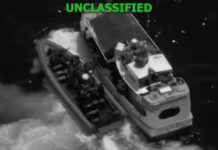
Those operations, described under labels such as Operation Southern Spear, involved dozens of strikes on fast boats and freighters, killing scores of suspected traffickers at sea. In at least one case, a second missile was reportedly fired at surviving crew members on a Venezuelan speedboat after they were already in the water, following a “kill everybody” directive attributed to the U.S. defense leadership. International humanitarian law specialists have characterized such orders as violating the Laws of Armed Conflict and the U.S. War Crimes Act, because once combatants are hors de combat—out of the fight—they are protected from deliberate lethal targeting.
Operation Pacific Viper: A Showcase of the New Paradigm
The maritime campaign is not limited to covert special operations. The Department of Homeland Security announced in June 2026 that Operation Pacific Viper, a U.S. Coast Guard mission launched in August 2025, had seized over 225,000 pounds of cocaine in the Eastern Pacific—equivalent to more than 93 million potential individual doses. On its face, this is a large, impressive interdiction. But what makes Pacific Viper a hallmark of the new “narcoterrorism” frame is not the tonnage; it is the charges and rhetoric attached to the people on board.
Under the post‑designation regime, crew members on intercepted vessels are no longer treated simply as drug traffickers. DHS officials and Coast Guard commanders have labeled them “narco‑terrorists,” and federal prosecutors have begun charging them under terrorism statutes rather than traditional narcotics laws. Secretary Mark Wayne Mullen has described the Coast Guard as a “defense force against narco‑terrorists,” language that aligns the service with war fighting rather than policing and embeds counter‑cartel operations in the broader U.S. counterterrorism strategy. Admiral Kevin Lunday’s declaration that “We own the sea” underscores this martial posture.
This militarization has institutional costs. Operation Pacific Viper navigated four DHS shutdowns totaling 115 days—the longest in the department’s history—during which the Pentagon quietly funded Coast Guard fuel to keep interdictions running. Congress ultimately approved a $2 billion emergency supplement, some of it to reimburse Defense Department outlays. The shutdown illustrates how political brinkmanship collides with an aggressively escalated enforcement model: the state claims a war‑like emergency but cannot consistently fund its own “front line.”
Has Narco‑Terror Framing Made Americans Safer?
The core strategic claim behind EO 14157 is that treating cartels as terrorists will “protect our nation” and provide “additional tools” to dismantle these organizations and reduce violence and drug flow. It is a testable proposition. On the enforcement side, there is no doubt that the designations expanded options. The U.S. has filed federal indictments charging alleged cartel leaders with narco‑terrorism and material support to terrorism—charges impossible before the FTO listing. The case against Carlos Alberto Pis Poretta (“Carlitos Rugrats”), a Sinaloa faction lieutenant, is emblematic: he faces narcoterrorism counts premised on the Sinaloa cartel’s FTO status.
Yet the evidence that these tools translate into greater safety is weak. Empirical reporting and internal government assessments indicate that, despite high‑profile seizures and kills, drug availability in the U.S. continued to rise through 2026. Sinaloa itself fractured into violent factions after leadership captures, with homicide rates in its home territory reportedly spiking by several hundred percent, producing thousands of deaths without dismantling the underlying trade. A senior Justice Department official summarized the reality bluntly: “All this strategy is doing is killing people and the same amount of drugs is getting into the US. You didn’t save anybody.”
Research on terrorist listings more broadly suggests such designations can alter organizational behavior, but the effects are mixed and highly context‑dependent. They may deter some financial flows and constrain international travel; they rarely eliminate entrenched, diversified criminal networks whose core business depends on demand in consumer states. The U.S. experience with Pablo Escobar and later with fragmented Colombian and Mexican groups underscores a recurring pattern: killing or capturing leaders generates temporary disruption and violent succession struggles but does not erase the illicit markets that sustain the organizations.
Law, Legitimacy, and the Boundary Between Crime and War
The most serious critique of the “narcoterrorist” label is not semantic; it is legal. Under 8 U.S.C. §1189 and related definitions, an FTO is typically an organization that uses violence to influence government policy or intimidate civilian populations for political purposes. Legal scholars argue that most cartel violence, however brutal, serves commercial objectives—protecting routes, intimidating rivals, enforcing debts—rather than political change. On that view, cartels are paradigmatic organized crime: sophisticated, violent, sometimes locally dominant, but not terrorist in the doctrinal sense.
Analyses from institutions such as the Brennan Center and Cato Institute warn that conflating crime and terrorism erodes a distinction long recognized by the Executive Branch itself. That distinction matters. Ordinary criminal law is built on individualized guilt, proportionality, and due process. Counterterrorism frameworks, especially when linked to armed conflict, permit status‑based targeting, preventive detention, secrecy, and expanded surveillance. Crossing the boundary by fiat—through an Executive Order that declares cartels quasi‑states and terrorists—risks importing war rules into domains where they do not legally fit.
International law experts go further. The United Nations Charter allows states to use force in self‑defense against “armed attacks” by other states or, in limited circumstances, non‑state actors. UN‑linked scholars and human rights lawyers contend that drug cartel activities, though lethal, do not constitute armed attacks against the United States in the sense required to trigger self‑defense rights. Nor does current international law permit unilateral extraterritorial military campaigns against organized crime in another sovereign’s territory without its consent. Maritime strikes and covert raids justified solely on cartel status therefore sit on shaky legal ground.
The allegations of a “kill everybody” order in maritime operations illustrate the practical danger of this doctrinal stretch. Once the U.S. treats smuggling crews as enemy combatants in an armed conflict, commanders may feel entitled to apply targeting rules that are in fact inapplicable, because no recognized armed conflict exists. That disconnect invites accusations of war crimes and damages U.S. legitimacy, not only among adversaries but among allies who depend on clear distinctions between war fighting and policing.
Collateral Effects: Migrants, Businesses, and Foreign Governments
FTO and SDGT designations do not stop at the cartels themselves. They ripple through immigration, civil liability, and foreign relations. Under the terrorism framework, illegal entry by a known cartel member can be treated as a terrorism‑related offense, enabling expedited removal and harsher criminal charges. Civil liberties advocates caution that, in practice, this can blur into treating migrants and residents coerced into paying “taxes” or smuggling under duress as “material supporters” of terrorism, an outcome that defies common‑sense legislative intent.
The sanctions side creates “secondary sanctions” risks for businesses and nonprofits that operate in cartel‑affected territories or unwittingly interact with cartel‑linked entities. Companies may face investigations or lawsuits under the Anti‑Terrorism Act on theories that they “should have known” about a connection to a designated cartel. This expands legal exposure dramatically, potentially chilling legitimate commerce and humanitarian activity in regions that most need lawful economic alternatives to criminal revenue. It also hands plaintiffs’ lawyers and regulators a powerful, if blunt, instrument.
Diplomatically, the war‑making frame has strained relations with partner states, particularly Mexico. Mexican administrations have consistently opposed direct U.S. military action on their soil against cartels, viewing such interventions as sovereignty violations and political liabilities. Episodes in which U.S. agents or special operations forces operate near or within foreign territory, or raids implicate third‑country personnel—as in the capture of Nicolás Maduro with casualties among Cuban operatives—compound this friction. Even cooperative presidents face domestic backlash if perceived as allowing foreign counterterror troops to conduct missions unilaterally.
A Global Trend with Deep Consequences
The U.S. move to treat cartels as terrorists fits a broader pattern. Comparative studies show that at least 60 countries maintain terrorist designation lists, and the number of entities labeled has steadily grown, often driven by national threat perceptions and policy diffusion rather than clear doctrinal boundaries. In recent years, Washington has added not only cartels but also gangs and hybrid criminal‑political groups from Haiti, Ecuador, and elsewhere to its FTO rolls. Commentators at institutions like the International Centre for Counter‑Terrorism have described this as a shift away from U.S.‑led global counterterrorism focused on ideological extremists toward a more amorphous campaign against “violent non‑state actors” of many stripes.
Designating criminal organizations as terrorist groups undeniably “puts new tools in play,” as RAND analysts have argued. It brings intelligence, sanctions, military support, and extraterritorial jurisdiction to bear on networks that inflict enormous harm. But tools are not neutral. When states expand counterterrorism frameworks into the realm of drugs and gangs, they do more than fight crime more aggressively; they redraw the boundary between war and peace, between crime control and national defense. That boundary exists for reasons rooted in law, ethics, and experience. Blurring it in the name of “narcoterrorism” may deliver short‑term enforcement wins, but the long‑term costs—to legal norms, civilian protection, and strategic clarity—are substantial.
Sources:
reason.com, state.gov, nytimes.com, whitecase.com, dlapiper.com, jilc.syr.edu, en.wikipedia.org, aljazeera.com, cato.org, whitehouse.gov, brennancenter.org, en.unav.edu, sites.duke.edu, justsecurity.org, tlblog.org, quo-vademus.org, opiniojuris.org, international-review.icrc.org, ctc.westpoint.edu, journals.sagepub.com, globalinitiative.net