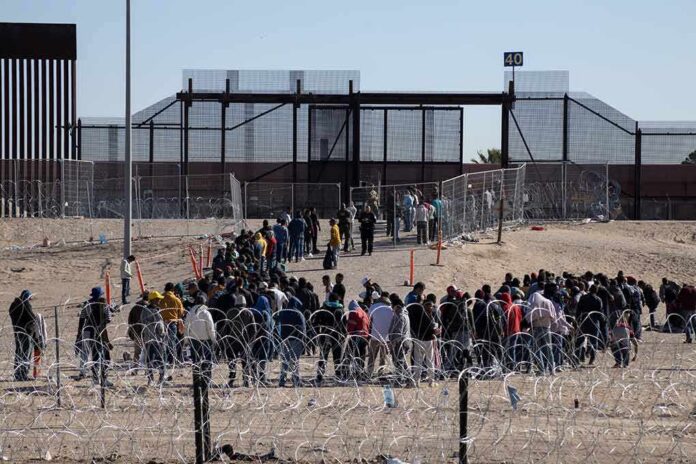
Debating who “built the wall” at Rafah misses the point: aid access into Gaza has depended on a multi-authority system in which Israeli decisions, Egyptian controls, and UN-run logistics interlock — and when any one link clamps down, civilians pay.
At a Glance
- UN documentation shows repeated Israeli-imposed suspensions and restrictions that materially reduced humanitarian movement into and within Gaza.
- The Rafah route operates through Egyptian territory and infrastructure, but cargoes have also been subject to Israeli coordination and security inspection requirements.
- Egypt has built and reinforced border barriers around Rafah, especially after October 2023, shaping the physical environment of access.
- Celebrity eyewitness accounts can focus attention, but shipment-level records and formal coordination orders are the reliable way to assign responsibility for specific delays.
How the Rafah Aid System Actually Works
Rafah is a logistics corridor, not a single gate. Aid typically stages at Egyptian Red Crescent warehouses in North Sinai; manifests are compiled and shared in advance; trucks queue for clearance; and, at various periods, loads have been routed to Nitzana — inside Israel — for security screening before returning to cross into Gaza via Rafah. Each step has a different gatekeeper. Egypt manages the physical crossing on its side and the staging yards. UN agencies and the Egyptian Red Crescent organize consignments and drivers. Israeli authorities have, at multiple points in the current conflict, required prior manifest approval and conducted security checks on the Egyptian and Israeli sides before entry. When any of these actors halts a stage — closing a gate, pausing screenings, or denying convoy coordination — trucks do not move.
This multi-node structure explains a recurring public confusion: people encounter a wall or a closed gate at Rafah and infer singular control. In reality, one authority can own the concrete while another controls the paperwork or the go/no-go for movements. For analysts and policymakers, the only credible way to assign responsibility for a given delay is to reconstruct the chain — which truck, which manifest line item, which clearance, which road segment — and match it to the relevant authority at that stage.
What the Documentary Record Establishes — And What It Doesn’t
The documentary record does establish that Israeli authorities have restricted humanitarian movements into and within Gaza. UN OCHA reported “severe humanitarian access restrictions,” including denials of planned missions and delays imposed by Israeli authorities as the operating environment deteriorated in 2024. On 28 February 2026, according to a UN situation report, Israeli authorities closed all crossings into Gaza and suspended the entry of aid, fuel, and commercial supplies, as well as the coordination of humanitarian movements and medical evacuations — a sweeping decision with immediate operational effects. Earlier in the war, OCHA documented periods when Rafah remained closed while thousands of tons of relief sat in trucks on the Egyptian side, and when aid convoys were sent first to Nitzana for Israeli security checks before being allowed through Rafah.
At the same time, the record also shows the Egyptian state shaping conditions at the border. Reuters and the New York Times documented Egyptian construction of reinforced barriers and a buffer zone near Rafah during the war — including a concrete wall extending underground — commissioned by the Egyptian army, according to sources interviewed by the Times. Those structures do not, on their own, prove that Egypt caused a particular aid delay; they do establish that Egypt controls the physical envelope on its side and has tightened it over time.
Hamilton’s Eyewitness Account: Useful Spur, Not Forensic Proof
When a public figure visits Rafah and decries an “open-air prison,” it galvanizes attention; it does not resolve attribution. The Associated Press reported that during his visit, Lewis Hamilton heard drivers describe waits exceeding 12 hours and cited aid volumes falling well short of a touted 600-trucks-per-day benchmark, while secondary coverage quoted him saying essential cargoes were turned back for “crazy reasons”. Those impressions are consistent with the UN’s broader picture of constrained access, but they do not identify which authority rejected which consignment or why. Without truck manifests, rejection notices, and coordination logs, eyewitness indignation remains a prompt for inquiry rather than conclusive evidence.
Where Hamilton’s remarks align with the durable record is in pointing at systemic bottlenecks rather than a single wall. The UN’s access reporting, especially the February–March 2026 suspension, documents Israeli decisions with immediate cross-system impact. Conversely, physical barriers and staging controls on the Egyptian side have also shaped the tempo of movements — not least because all aid by that route must begin on Egyptian soil. The lesson is methodological: focus on the parts list of the corridor and the authority matrix at each part; resist collapsing outcomes into one actor simply because a camera shot makes that actor most visible.
Where the Real Disagreement Lies
Advocates who emphasize Israeli responsibility point to formal decisions — mission denials, convoy coordination holds, crossing closures — that sit squarely with Israeli authorities and have been logged in UN reporting. Those who foreground Egyptian responsibility cite Cairo’s control of Rafah, its buffer zone, and its reinforced walls, arguing that Egypt can open or close its side and shape terms of passage. Both lines carry truth at different nodes of the system. The strongest counter-claim to a simple Israel-only narrative is not that Israel is absent from Rafah — UN sources are clear about Israeli screening and manifest prerogatives — but that Egypt simultaneously exercises sovereign control over the crossing’s physical side and has built infrastructure that hardens that control.
What neither side can substantiate without granular records is the attribution of a given rejected pallet or a day’s total throughput. Claims about agreed daily truck targets — such as the 600-truck figure referenced in reporting — require the underlying ceasefire text and a validated daily count to be probative. Absent that, they are plausibility markers, not dispositive proof. Serious analysis should therefore prioritize shipment-level data and coordination orders over rhetoric, however forceful.
Lewis Hamilton raised alarm after visiting the Rafah border crossing, where he saw trucks carrying food for Gaza lined up. Hamilton said Israel regularly blocks or delays aid trucks and that one driver told him he’d already been waiting more than 12 hours. pic.twitter.com/4IHjWVqwkr
— geopoliticssa (@Geo_politicsSA) November 14, 2026
Implications for Policy and Reporting
For policymakers, the prescription is straightforward. First, require transparent publication of convoy coordination holds and denials by authority, with reasons and timestamps. Second, maintain a shared, auditable ledger of manifests, inspections, and crossing times across Egyptian, Israeli, UN, and Red Crescent systems. Third, distinguish between entry permission, internal movement, and last-mile distribution — three different problems too often conflated in argument and coverage. The UN access reports provide a framework for this, but operationalizing it demands cooperation from all gatekeepers and willpower to publish uncomfortable data.
Sources:
container.ochaopt.org, apnews.com, ochaopt.org, un.org, menafn.com, en.wikipedia.org, timesofisrael.com, westernjournal.com, seattletimes.com