
Another “state of emergency” in blue-state America is testing whether sweeping executive powers are being used for real safety—or just reinforcing a culture of dependency and control. With New York and New Jersey declaring statewide and regional emergencies over a fast-moving post-Christmas winter storm, executive orders unlock broad powers over travel, trucking, and resource deployment. While state leaders emphasize safety, conservatives are watching closely to ensure temporary measures do not become a pretext for long-term government overreach.
Story Highlights
- New York and New Jersey have declared statewide and regional emergencies over a fast-moving post-Christmas winter storm.
- Executive orders unlock broad powers over travel, trucking, and resource deployment across more than half of New York’s counties and all of New Jersey.
- Holiday travelers and truckers face major disruptions as commercial vehicles are restricted on key interstates.
- Conservatives are watching closely to ensure temporary safety measures do not become a pretext for long-term government overreach.
Winter Storm Prompts Sweeping Emergency Powers In New York And New Jersey
Acting Governor Tahesha Way in New Jersey and Governor Kathy Hochul in New York both reached for the same powerful lever on December 26: formal state-of-emergency declarations ahead of a heavy winter storm across the Northeast. The system is bringing between four and twelve inches of snow, mixed ice, and treacherous travel from New York City and Long Island through the Mid-Hudson region and across all twenty-one counties in New Jersey. The legal status immediately expands what state agencies can do and how quickly they can do it.
In New Jersey, the emergency took effect statewide at 1 p.m., just as many families were packing up from Christmas visits and pointing their cars toward the interstates. Officials followed up by 3 p.m. with commercial vehicle restrictions on major arteries like I-78, I-80, I-280, I-287, and Route 440, limiting tractor-trailers and other large rigs that keep store shelves stocked. For truckers and small businesses already squeezed by years of inflation and regulation, another forced slowdown feels painfully familiar.
NYC: State of Emergency was declared due to incoming snow storm in areas including NYC.
Due to a further northeast shift of mix precipitation, forecast snowfall totals around NYC and northeast NJ have been lowered. pic.twitter.com/KyDVVSZnba
— Oliya Scootercaster 🛴 (@ScooterCasterNY) December 27, 2025
Post-Christmas Timing Hits Families, Commuters, And Truckers Hard
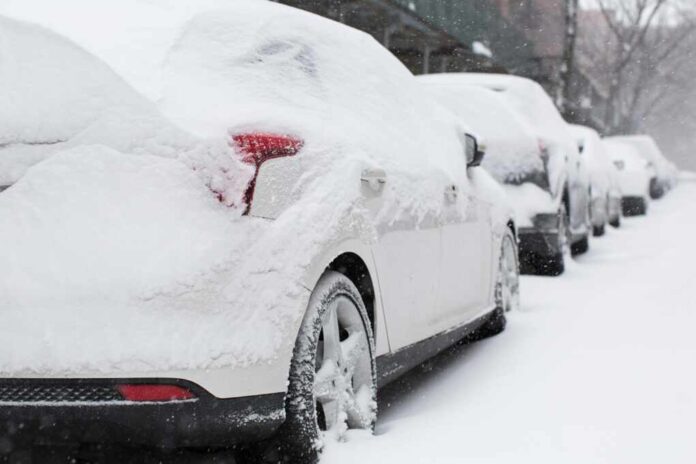
The storm’s timing is as disruptive as the snowfall totals. Forecasts called for heaviest snow from Friday evening into Saturday morning, right in the window when holiday travelers were racing to get home and small businesses were trying to salvage a few strong shopping days before year’s end. Peak snowfall rates between half an inch and more than two inches per hour around New York City meant roads could deteriorate quickly, even with plows and salt trucks deployed in advance across both states.
By Saturday morning, parts of the New York City metro area had already crossed four inches of accumulation, with higher totals in bands north and west of the city. Sub-freezing air kept ice on roads and sidewalks, especially away from the immediate coast, increasing the risk of spinouts, pileups, and falls. State transportation crews and private contractors were activated earlier in the week, but many residents still faced the familiar choice between braving bad roads or putting work and family plans on hold while the government urged people to stay home.
Emergency Declarations Unlock Broad Authority—And Renew Concerns About Overreach
On paper, these emergency declarations are about clearing red tape so snowplows can roll, utility crews can move, and first responders can access extra help. Governors gain the power to fast-track contracts, redirect personnel, and coordinate closely with local authorities across dozens of counties at once. For conservatives who endured years of pandemic-era abuses, however, the phrase “state of emergency” now carries a very different weight. Many remember how temporary measures morphed into long-term restrictions on worship, work, and basic movement.
That history raises fair questions whenever a weather event triggers broad executive action. Snowstorms are a fact of life in the Northeast, not an unpredictable shock. Officials have known for days that this system was coming, with winter storm warnings, travel advisories, and accumulation forecasts of three to eight inches widely broadcast. When routine seasonal hazards repeatedly prompt high-level emergency declarations, it blurs the line between genuine crisis management and reflexive expansion of government control over daily life, travel, and commerce.
Safety, Preparedness, And The Balance Between Personal Responsibility And State Power
State leaders emphasize safety, pointing to past storms where rapid accumulation and poor visibility turned highways into parking lots and left drivers stranded. For many residents, especially seniors and those in rural or hilly areas, pre-positioned plows and clear communication are welcome. But a conservative view asks a parallel question: are officials empowering citizens with clear information so they can choose wisely, or defaulting to blanket restrictions that treat everyone like a ward of the state? The difference matters for a free society.
Truck restrictions on major routes illustrate this tension. Heavy rigs can be dangerous on steep, icy roads, and no one wants to see jackknifed trailers blocking emergency vehicles. At the same time, blanket bans slow deliveries of food, medicine, and fuel at a time when households are already feeling the pinch from years of elevated prices. Small trucking firms and independent drivers shoulder much of that burden, often without relief, while governors gain camera time for “decisive action” that may or may not be finely targeted.
Blue-State Emergency Culture Versus A Constitutional, Limited-Government Mindset
These winter declarations also play into a broader pattern that conservative readers have watched for years. In deep-blue states like New York and New Jersey, the default response to challenge—weather, public health, or political controversy—is often an expanded executive order, a new restriction, or another “temporary” control regime. Each episode on its own may appear reasonable; together, they normalize a culture where citizens wait on governors’ proclamations instead of relying first on their own judgment, local knowledge, and community networks.
For families who remember watching President Trump emphasize energy independence, deregulation, and personal responsibility, the contrast is obvious. Washington today is no longer pushing radical climate rules or nationwide COVID mandates, but state-level leaders still have wide leeway to shape everyday life. As this storm passes and roads clear, conservatives will be watching New York and New Jersey not just for how fast the snow melts, but for how quickly emergency powers are rolled back—and whether “crisis mode” remains the exception, not the blueprint for governing.
Watch the report: State of Emergency Declared In New York and New Jersey As Snow Starts To Stick The Northeast
Sources:
- Winter storm warning for NYC and tri-state area: live updates on heavy snow and impacts
- Governor Hochul declares State of Emergency and provides update on statewide winter storm response
- Winter weather hits Northeast as new storm system moves through region