
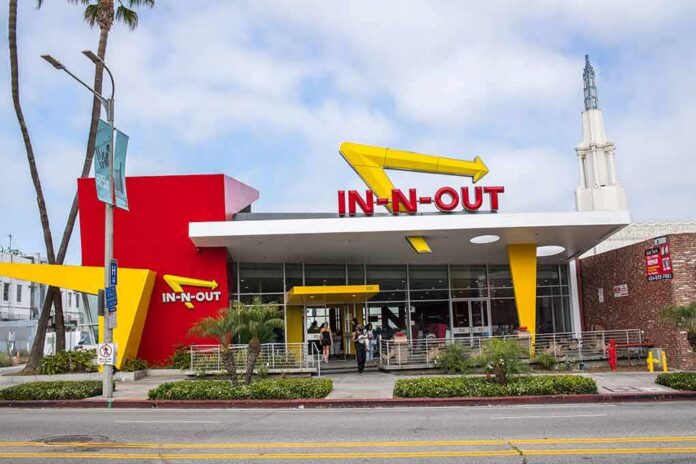
The central fact in the Twin Falls In-N-Out shooting is not a tidy “hero stops gunman” story; it is that a chaotic, fast-moving attack left multiple people dead, the suspected shooter dead nearby, and the first hours of reporting full of uncertainty about who fired what, when, and why.
Intro Header
- The public-safety phase ended quickly, but the forensic story did not.
- Authorities confirmed the suspected shooter was dead and said there was no ongoing threat.
- Early video showed an armed man near the scene, but the record does not establish a civilian shootout.
- The biggest unresolved question is the mechanism of the gunman’s death, not whether panic and gunfire occurred.
What the First Reports Actually Establish
The most solid ground in this case is narrow but important. Police and city officials said three people were killed and multiple others were injured in a shooting at the Twin Falls In-N-Out, and they later said the suspected shooter was dead and that the threat to the community was over. That combination tells you the incident had already moved from active violence to secured scene by the time officials briefed the public. It does not, by itself, explain how the shooter died, who fired the final shots, or whether anyone outside law enforcement intervened.
That distinction matters because early coverage in mass shootings often mixes three different things into one narrative: the existence of gunfire, the presence of an armed person in video, and the cause of the suspect’s death. Here, those elements were reported in the same breath, which is precisely how a disputed “civilian stopped the shooter” story can take shape before the record supports it. The supplied reporting confirms panic, casualties, an armed figure in footage, and a dead suspect; it does not document a civilian exchange of gunfire.
The Difference Between an Armed Bystander and a Proven Intervention
The public record supplied here does something subtle but crucial: it leaves room for confusion without actually resolving it. ABC7 said video showed a man with a gun, but it was unclear whether he was the shooter or another armed individual. NBC-style coverage likewise described a man holding an assault-type weapon near the scene, while noting that authorities were still trying to determine the suspect’s identity. Those are not trivial details. They mean an armed person was visible, but visibility is not evidence of engagement, and presence is not proof of intervention.
To establish a civilian rescue narrative, you would want a much tighter chain: who the armed person was, where he stood, whether he fired, at whom, and whether those shots changed the outcome. None of that appears in the supplied sources. No report names the armed civilian. No report says, on the record, that the armed civilian exchanged gunfire with the suspect. No report provides a ballistic or medical finding tying the suspect’s death to a non-police shooter. The result is a classic evidence gap: enough ambiguity to encourage speculation, not enough specificity to justify certainty.
Why the Casualty Count Matters More Than It Looks
The shifting numbers in the first cycle of coverage are not a side issue; they are a warning about the reliability of precise causal claims made too early. The supplied record contains multiple casualty counts, including three dead and two injured, three dead and five injured, and four dead when the suspect is included. That kind of variance is normal in the immediate aftermath of a mass shooting, when victims are still being located, transported, or counted across multiple facilities. But it also means any confident reconstruction of who confronted whom should be treated with discipline, not enthusiasm.
Police were, in effect, managing two problems at once: the tactical scene and the public-information vacuum. They told the community the threat was over, they asked people to avoid the area, and they withheld the shooter’s identity and motive while investigators interviewed witnesses. That is standard crisis practice. It is also exactly the sort of information environment in which a dramatic bystander narrative can outrun the facts, especially when short video clips circulate faster than detectives can reconstruct the sequence of fire.
The One Witness Account That Keeps the Story Alive
The strongest pro-intervention material in the package comes from a witness interview summarized by KTVB. In that account, Eddie Lane Cohen described seeing a man in the drive-through firing a handgun at the shooter and believed the intervention may have distracted the gunman. That is a serious claim, and it is the closest thing in the supplied material to a civilian-engagement narrative. But it remains, in the evidence available here, a witness account rather than a corroborated reconstruction. It is not anchored by police confirmation, forensic findings, or a named participant willing to stand behind the full sequence on the record.
That is why the responsible reading is restrained. A witness can be sincere and still be wrong about timing, distance, or who fired first in a chaotic scene. A clip can show a man with a gun and still not tell you whether he was the shooter, an armed bystander, or someone reacting after the fact. The available reporting supports the possibility of a civilian presence with a weapon. It does not prove that a civilian killed the gunman, saved lives, or even definitely exchanged fire.
🇺🇸 A shooting near an In-N-Out Burger on Blue Lakes Boulevard in Twin Falls, #Idaho, has left 3 people dead and 2 injured, per the Twin Falls Police Department (via NBC).
It happened around 3 p.m. Saturday (Aug 1) in a busy commercial area near the Twin Falls Visitor Center. pic.twitter.com/lCBjj5aUjZ
— Pisklauren (@pisklauren) August 2, 2026
What the Record Supports, and What It Does Not
The record supports a limited but defensible conclusion: Twin Falls experienced a deadly, high-velocity shooting in a public commercial area; police rapidly secured the scene; and video showed at least one armed person near the restaurant while the suspected shooter ended up dead. That is enough to understand the gravity of the event and the intensity of the early confusion. It is not enough to elevate the story into a settled claim of civilian heroism.
What is missing is the connective tissue. The authorities did not, in the supplied sources, explain the death mechanism. They did not identify the armed person in the video. They did not publish a shot-by-shot timeline. And they did not offer ballistic evidence tying the suspect’s death to a bystander. In a case like this, those omissions are decisive. Without them, the most accurate description is not that a civilian heroically stopped the attacker; it is that an armed person may have been present during a deadly shooting, but the available public record does not yet prove how the gunman was neutralized.
Sources:
redstate.com, abc7.com, youtube.com, news.cgtn.com, aol.com