

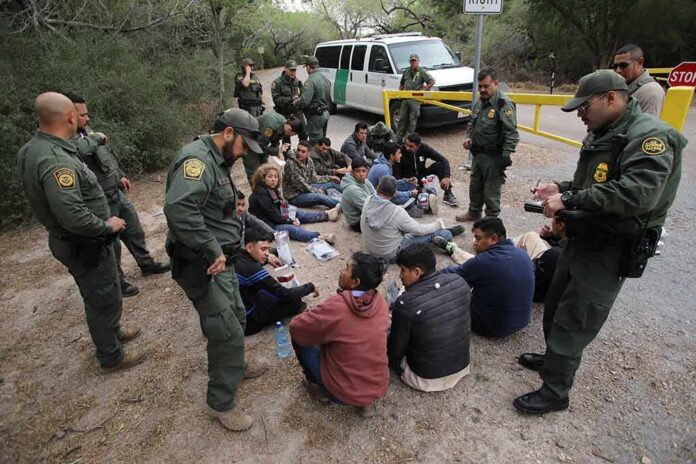
Where governments turn to large, fast-to-open sites to end hotel use for asylum seekers, the friction is less about immigration in the abstract than about siting at scale: clustering hundreds of single adult men next to everyday civic infrastructure—schools, play areas, GP surgeries—compresses legitimate safeguarding optics, transport, and services questions into one neighborhood at once.
At a Glance
- Former military bases have become a standard “contingency” backstop for UK asylum accommodation; ministers frame them as managed, temporary alternatives to hotels, subject to assessments and planning processes.
- Local leaders object most sharply when proposed sites sit within easy reach of primary schools and nurseries, arguing this contradicts government sensitivity principles and concentrates risk and disruption in small places.
- Government policy protects school access for children, but its accommodation-allocation rules do not prioritise keeping adults near a particular school; central siting choices are driven by capacity and speed, not school catchments.
- The durable tension: central government seeks large capacity and uniform practice; local communities react to the visible clustering of adult males and the rapid load on local services, especially where sites abut family spaces.
What is actually being proposed and why former bases keep appearing
Successive administrations have leaned on large, non-detained sites—ex‑MoD bases, barracks, and similar—to house people who have applied for asylum. The stated rationale is straightforward: end reliance on hotels, cut costs, and run accommodation that is “managed” and scalable while claims are processed. The Home Office’s factsheets describe several former military sites already in use or under consideration, and emphasise that new uses are subject to assessments, planning permissions, and approvals before any final decision. In practice, these installations bring hard infrastructure—perimeter, kitchens, blocks, on‑site services—that can be repurposed faster than disaggregated flats or new build.
This central logic sits within a broader policy architecture that treats these places as temporary, non‑detained accommodation where residents can come and go. It is bureaucratically legible: contracts with a small number of providers, standard operating procedures, and site-level rules, instead of hundreds of disparate landlords. That administrative simplicity, however, is exactly what loads consequence onto the host community; a bureaucratic advantage converts into a concentrated local impact.
Why “near schools” has become the flashpoint
The school‑adjacency argument endures because it is legible to any parent: proximity changes how a neighborhood feels. In North Yorkshire, the leader of the unitary council, Cllr Carl Les, flagged that Linton‑on‑Ouse Primary School and a pre‑school nursery sit “very close” to the former RAF base proposed for large-scale single‑male accommodation, pressing ministers on the mismatch with the government’s own sensitivity talk. The critique is not a statistical assertion of increased crime; it is a safeguarding and optics claim—how many adult men, how close, how quickly, and what visible management exists on day one.
Government counter-arguments tend to return to system goals (closing hotels), assurances that no final decision is taken before required assessments, and the promise of on‑site self‑sufficiency to minimise local pressure. That frame addresses national throughput; it does not resolve the local question of whether placing a large, male‑only population within a short walk of primary-age settings comports with community norms of risk management.
The policy baselines that matter: school access, allocation rules, and siting discretion
Two policy baselines clarify—rather than decide—the dispute. First, children’s access to education is protected: local authorities must not require proof of immigration status before a school application; asylum‑seeking children are entitled to school-based education like their peers. Specialist guidance for schools pushes rapid enrolment and regular attendance as desirable for children’s welfare and integration. These are child-centred guardrails; they do not speak to adult‑only sites.
Second, the Home Office’s accommodation allocation policy is explicit that requests to site a family in a particular area because a child attends a school there should normally be refused; there are exceptions for exam-year continuity and special educational needs, but the baseline norm is mobility, not anchoring. That norm tells you how central government balances throughput against locality: standardisation first, with limited, child‑specific carve‑outs. Read together, the policies protect children’s school access nationally while keeping the state free to place adults wherever capacity exists.
Scale and concentration: the real mechanism of community impact
When opposition surfaces, it is rarely about asylum per se; it is about volume, visibility, and pace. Central government and its contractors can, in weeks, shift from zero to several hundred residents at one fence line. BBC reporting has described plans across multiple MoD sites—Bicester, Barnham, and Linton‑on‑Ouse—with combined capacities in the low thousands if planning proceeds. Sites already in use, such as Wethersfield and Crowborough, illustrate the operational model and its optics: large, male‑only cohorts, bused services, security presence, and a perimeter that reads to locals as semi‑institutional. None of that is unlawful; all of it signals change.
The consequences are operational, not hypothetical. Transport: if a site is self‑sufficient on paper but residents are free to move, public bus stops, footpaths, and high streets absorb the footfall. Services: GP lists, emergency departments, and advice agencies see demand spikes before funding formulas catch up. Policing: patterns of calls change—sometimes simply because more people are present, sometimes because congregations in small centres elicit more complaints. Schools themselves may not gain or lose pupils if the site is adult‑only, yet playground gates become the symbolic line where residents judge whether the placement “fits.”
Is siting near schools a breach of government rules—or a clash of interpretations?
There is no single statute barring adult asylum accommodation “near schools.” Rather, the record shows a planning and assessment process where “sensitive” receptors—schools, play areas, community hubs—should inform mitigations or design choices. Local leaders read that as a practical prohibition on adjacency; central government reads it as a factor to be managed within an overall siting decision that serves a national end. The government’s own factsheets underscore process—assessments, permissions, approvals—rather than bright-line bans, which explains why proposals can surface for bases a short walk from primary settings while officials still assert compliance with guidance.
From a governance perspective, that is a textbook centre–local collision. The centre optimises for capacity, speed, and uniformity; the locality optimises for context, pacing, and cumulative impact. Without a binding spatial rule—say, a fixed standoff distance from schools—the argument devolves into whether mitigations (staggered move‑ins, on‑site amenities, footpath design, engagement officers, funding for wardens) are sufficient substitutes for distance.
What would a responsible siting standard look like?
A defensible standard for large, adult‑only asylum sites near family infrastructure would rest on three pillars. First, capacity phasing: ramp occupancy in predictable tranches tied to demonstrable delivery of off‑site mitigations (transport headroom, primary care slots, community liaison staffing). Second, safeguarding by design: movement desire‑lines mapped and engineered—lighting, CCTV where proportionate, safe-route signage—to reduce avoidable congregation at school gates without restricting liberty. Third, accountability on timeframes: publish the assessments the factsheets promise and set expiry or review points so “temporary” retains substance. These are not acts of generosity; they are the minimum conditions for social permission in host communities.
On children’s needs, the rules are already settled: rapid enrolment and attendance for those who arrive as pupils, and admissions free from immigration‑status hurdles. The adult‑only site question is distinct. Where the cohort is single men, the policy trade-offs are about concentration, not classroom integration. A siting rule of thumb—avoid direct adjacency to primary‑age settings unless clear, published justifications and mitigations exist—would align the centre’s throughput aims with the locality’s safeguarding expectations.
The likely trajectory from here
Expect governments to keep using large contingency sites because the alternatives—thousands of dispersed private lettings or new-build stock—are slower and more expensive in the short run. Expect local pushback to persist and to be sharpest where proposals sit within a short walk of schools and playgrounds. Expect the policy documents to continue protecting children’s school access while preserving central discretion to place adults at scale where capacity exists. And expect the politics to turn on process credibility: when ministers say “temporary” and “self‑sufficient,” communities will judge them against the visibility of buses, security staff, and the line of foot traffic past the school railings.
The centre can close that trust gap. Publish the siting assessments up front, phase occupancy against measurable mitigations, and adopt a clear presumption against primary‑school adjacency for single‑male sites absent compelling, transparent reasons. That is not capitulation; it is the price of governing large systems fairly in small places.
Sources:
eadt.co.uk, lancashire.gov.uk, dera.ioe.ac.uk, ed.gov, gov.uk, data.parliament.uk