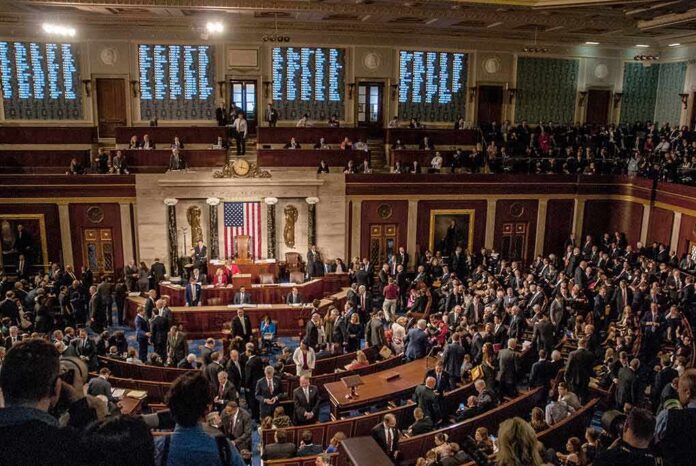
The real story is not that the Senate went on break; it is that Senate leadership used the old recess-appointment playbook to keep the chamber technically alive, which preserves the Senate’s constitutional gatekeeping and denies a president the clean opening to fill jobs unilaterally.
Key Points
- Pro forma sessions are a long-standing Senate device designed to prevent a true recess from forming.
- The Constitution’s recess-appointment power only matters when the Senate is actually unavailable in the constitutional sense.
- The public record here supports the procedural effect strongly; it does not fully document the exact 11-session schedule alleged in the framing.
- What looks, in partisan language, like sabotage is in institutional terms a routine assertion of Senate control over appointments.
Why Pro Forma Sessions Matter More Than the Rhetoric Around Them
Pro forma sessions are one of Washington’s most durable procedural paradoxes: everyone knows they are largely ceremonial, yet they can have real constitutional consequences. Their purpose is to keep the Senate from slipping into the kind of recess that would let a president make temporary appointments without Senate confirmation. AP explains that recess appointments are available only when the Senate is actually in recess, and that the chamber often uses pro forma sessions during long breaks to avoid crossing that threshold. The Supreme Court’s 2014 NLRB v. Noel Canning framework, as summarized in several explainers, reinforced that modern understanding.
That is why the argument over John Thune’s scheduling is not really about vacation, and not even primarily about personalities. It is about who controls the appointment process when the Senate wants to slow-roll or block executive branch staffing. In practical terms, a pro forma session is the Senate saying, “We are not gone enough for you to act alone.” The chamber opens, gavels in, does no business, and leaves behind a paper record that it has remained in session. That paper record is enough to matter.
The Constitutional Mechanics Behind the Fight
The Recess Appointments Clause gives presidents a limited power to fill vacancies temporarily, but the power is conditional, not open-ended. The condition is the Senate’s absence; if the chamber is in session, or deemed to be in session for constitutional purposes, the shortcut disappears. Modern summaries of the law emphasize the same point: the Senate can preserve its role by preventing a qualifying recess, and the courts have not treated a string of pro forma meetings as a meaningless gesture when the chamber retains the capacity to conduct business.
That is the core of the dispute. Supporters of the tactic frame it as routine institutional maintenance: the Senate is protecting advice-and-consent power, not surrendering it. Critics frame it as a procedural trap laid to frustrate a president’s staffing choices. Both descriptions can be true at once. The legal logic is straightforward, but the political meaning is loaded. A chamber that can prevent recess appointments by keeping its calendar technically open has a powerful veto over executive speed, even when it lacks the votes to control the nominations themselves.
What the Reporting Does and Does Not Prove
The supplied reporting supports the broader procedural claim very well: Senate Republicans and Democrats alike have used pro forma sessions as a method to block recess appointments, and the maneuver is not novel. AP and CBS describe it as a standard practice during lengthy breaks, while other explainers note that the Supreme Court has effectively blessed the Senate’s ability to structure its schedule so a true recess never materializes. CBS and AP also show that the underlying fight over Trump nominees is real, with stalled confirmations and pressure on leadership making the recess issue politically live rather than theoretical.
What the record here does not cleanly establish is the most aggressive version of the allegation: that Thune personally engineered exactly 11 pro forma sessions for the explicit purpose of “blocking Trump” in the language of the viral framing. The research package contains a schedule and procedural descriptions, but not the underlying Senate resolution, complete floor transcript, or a direct Thune statement matching that accusation. That distinction matters. The tactic is plainly capable of blocking recess appointments; the supplied sources do not fully document the precise count, authorship, or subjective motive behind the specific schedule as alleged.
@LeaderJohnThune Gateway Pundit:
Turncoat John Thune Sends Senate Home for 37 Days — But Schedules 11 Pro Forma Sessions to BLOCK Trump from Making Recess AppointmentsWe don't understand, Senator. You know what the Dems have planned for America. You can't be ok with that.
— J. Malone (@Hope4UScitizens) August 10, 2026
The Political Reality: This Is a Routine Tactic in a Highly Partisan Moment
The strongest way to understand the episode is to strip away the rhetorical varnish. Pro forma sessions are not a bespoke invention for one president or one Congress. They are part of the Senate’s broader arsenal for preserving its institutional prerogatives, especially when the White House is trying to move nominees through an obstructive or overextended confirmation process. Fox, AP, CBS, and multiple explainers all describe the same mechanics: if the chamber never reaches a true recess long enough to trigger the constitutional window, there is no recess-appointment opportunity to exploit.
That does not make the politics trivial. It makes them predictable. When a president wants rapid staffing and the Senate wants leverage, the chamber can slow the clock, keep itself technically in session, and force the White House back into confirmation politics. That is why the dispute attracts partisan outrage on both sides: one camp sees obstruction, the other sees constitutional discipline. But the constitutional discipline is the sturdier reading of the evidence. The supplied material shows a familiar Senate maneuver, used in a contemporary fight over nominees, not a legal aberration invented out of thin air.
What It Means for Presidential Power Going Forward
The long-term lesson is that recess appointments are no longer a reliable escape hatch for modern presidents unless the Senate cooperates, blunders, or chooses to be absent in a constitutionally meaningful way. After Noel Canning, the practical ceiling on unilateral appointments rose sharply; pro forma sessions became the Senate’s insurance policy against surprise executive action. The result is a system that favors delay, bargaining, and institutional self-help over fast presidential staffing. That is especially consequential when administrations are trying to fill senior posts under time pressure.
So the charge that Thune “blocked Trump” captures the political effect, but not the whole constitutional truth. The more accurate description is colder and more important: the Senate used a standard procedural device to keep the president from reaching a recess-appointment window. In Washington, that distinction is everything. It separates an act that is unlawful from one that is merely hardball. The evidence in this package points to hardball.
Sources:
thegatewaypundit.com, arnoldporter.com, politico.com, axios.com, foxnews.com, cbsnews.com, goodauthority.org, time.com, youtube.com, en.wikipedia.org, facebook.com