What matters here is not festival glamour or celebrity billing; it is the fragility of big crowd events when a single dispute spills into the audience and turns ordinary glass into a public hazard. In this case, police say a confrontation at Splash House escalated into bottles being thrown, injuring nine people and sending seven to hospital.
Key Points
- Police said the incident began as a dispute and then escalated into bottles thrown into the crowd.
- Nine people were injured; two were treated on scene and seven were transported to a local hospital.
- The event took place during the After Hours portion at the Palm Springs Air Museum, following The Chainsmokers set.
- The public record supports the core police account, but it does not yet identify who threw the bottles or explain what triggered the confrontation.
How the Incident Unfolded
According to the Palm Springs Police Department as reported contemporaneously by KESQ and reprinted by other outlets, officers were alerted at about 1:37 a.m., then responded around 1:40 a.m. to an assault report at the Palm Springs Air Museum during Splash House’s After Hours event. Police said the disturbance involved an unspecified number of people and that bottles were thrown into the crowd, injuring nine partygoers who were not involved in the original dispute.
The injury tally is concrete and unusually specific for an early incident report: two people were treated on scene, while seven others were taken to a nearby hospital with minor injuries, including cuts from broken glass. That detail matters because it distinguishes the immediate medical burden from the larger social image of “chaos” that tends to cling to festival incidents. The police account describes a contained but serious crowd injury event, not a mass-casualty emergency.
Why the Venue Context Matters
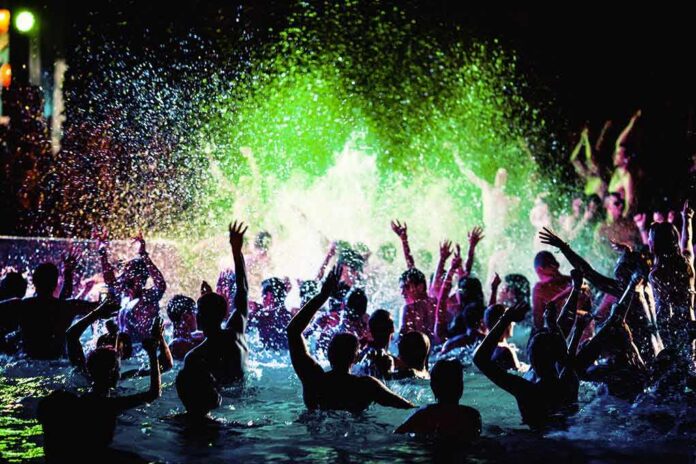
Splash House is not a single-stage concert; it is a roving pool-party festival spread across Palm Springs hotels, with the Air Museum used for the nighttime after-hours component. That structure helps explain why the incident drew such quick attention: a dense crowd, an alcohol-adjacent nightlife setting, and a late-night transfer from performance to social release create the conditions in which a dispute can flare and spread before security fully stabilizes the scene.
The reporting specifically places the event after The Chainsmokers set, which is important because it anchors the timeline and rules out the vague, inflated kind of festival anecdote that often circulates without context. The incident did not happen in the abstract; it happened during a scheduled after-hours segment at a known venue, within a festival whose own public materials describe a tightly programmed weekend of pool parties and nighttime shows.
What the Public Record Confirms — and What It Does Not
The strongest fact in the record is straightforward: police said bottles were thrown into the crowd and nine people were injured. There is no meaningful counter-evidence in the available material disputing that core claim. The record also supports the police timeline, the location, and the split between people involved in the dispute and bystanders injured during the escalation.
What remains unresolved is equally important. The available reporting does not identify a suspect, name an arrestee, or supply a charging document. It does not explain what sparked the confrontation, whether the bottle throwing was retaliatory or spontaneous, or whether any security or operational lapse contributed to the outcome. In other words, the event itself is established; the deeper causal story is not yet public.
How to Read Festival Violence Without Losing the Evidence
Incidents like this are frequently overread in the first 24 hours. A headline about a glamorous pool party “in chaos” can easily harden into a broad cultural narrative about unruliness, decadence, or festival mismanagement, but those themes are secondary to the actual investigative question: who started the altercation, who used force, and why did glass end up in the crowd? The available record answers the first layer only. It confirms injury and response; it does not yet adjudicate intent.
That is why the measured reading is the correct one. Police summary, as relayed by local media, is enough to establish a bottle-throwing assault with nine injuries and an emergency response, but it is not the final evidentiary word. The next meaningful documents would be the incident report, witness statements, venue security video, and any hospital summaries that can verify the mechanism and scope of injury. Until then, the proper stance is clear: the core account is supported, while the motive, attribution, and operational backstory remain open.
What This Says About Splash House and Similar Events
Festival operators build their reputations on curation, control, and atmosphere; one late-night confrontation reminds us that crowd management is always the hidden architecture beneath the experience. When a venue combines music, alcohol, dense foot traffic, and a compressed late-night window, the margin for error is thin. That does not mean every festival is unsafe. It does mean that even a single dispute can create injuries disproportionate to the original spark, especially when broken glass enters a moving crowd.
For Palm Springs, the practical lesson is less about branding than about incident transparency. The public already has the broad outline: nine injured, seven hospitalized, police on scene, bottles thrown, no reported suspect yet. What will matter next is whether investigators publish enough detail to show how the event was contained, whether anyone is charged, and whether the festival’s security plan performed as intended. That is the difference between a memorable headline and a credible post-incident record.
Sources:
nypost.com, fox5ny.com, en.wikipedia.org, local12.com