
The deeper argument beneath the viral shouting is not about personalities; it is about whether broadcast news fulfilled its core function during the pandemic: disciplined skepticism toward power, especially when fear and uncertainty made authoritative narratives seductive.
At a Glance
- Robert F. Kennedy Jr. confronted CNN’s Dana Bash on-air, accusing CNN of “press malpractice” and acting as “cheerleaders” for COVID lockdowns rather than skeptical watchdogs.
- His case centers on editorial choices—death-count chyrons, framing of dissent, and a posture of deference to public-health authorities—as having amplified fear and narrowed debate.
- The specific exchange is uncontested in published reporting; what remains unproven is the broader charge that CNN systemically misled the public.
- This clash sits inside a recurring genre: political figures alleging media bias versus anchors policing misinformation, with the underlying question—how skeptical should crisis reporting be—often lost in the theatrics.
What Happened: The Confrontation and Its Claims
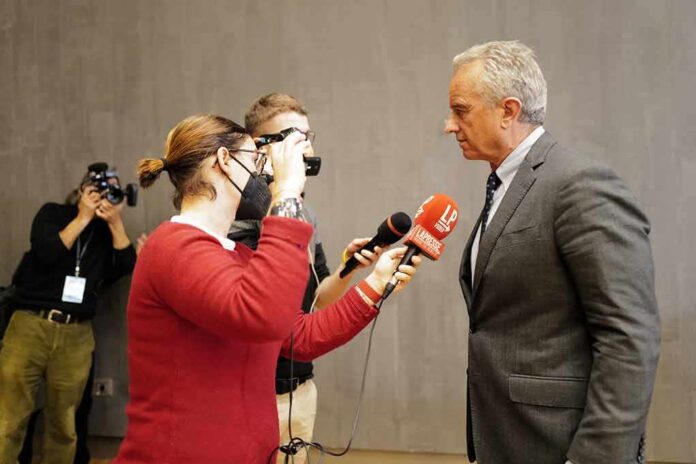
In a lengthy, contentious segment on CNN’s State of the Union, Health and Human Services Secretary Robert F. Kennedy Jr. accused anchor Dana Bash and CNN of failing the watchdog role during COVID. He called the network “part of the problem,” charged “press malpractice,” and argued that its COVID-era framing—frequent death-toll graphics and dismissive treatment of dissent—tilted coverage toward fear and conformity rather than inquiry. Multiple outlets summarized the exchange similarly, emphasizing Kennedy’s central critique: CNN was insufficiently skeptical of official claims and too willing to marginalize countervailing voices.
Kennedy also tethered his media critique to policy substance. He argued that lockdowns—adopted by governors but, in his telling, legitimated by federal guidance—were the most damaging policy choice of the period, shuttering millions of businesses and constricting civil liberties, and that CNN validated those steps rather than interrogating their premises and tradeoffs. He described Bash and colleague Jake Tapper as “cheerleaders” for lockdowns, a pointed allegation about editorial stance rather than personal animus.
The Editorial Question: Skepticism Under Crisis
Strip away the heat and the core question is sober: what does journalistic skepticism look like when a pathogen is spreading, decision-makers are improvising, and evidence is incomplete? Skepticism, properly understood, is not reflexive contrarianism; it is disciplined testing of claims—what’s known, what’s uncertain, how robust the methods are, and what the alternatives might cost. In emergency coverage, that testing often collides with the pressure to simplify: a single chyron, a time-boxed segment, a need to communicate risk quickly. The resulting blend can default to institutional voice—agency heads, marquee experts, official dashboards—which keeps the audience oriented but can also narrow the aperture on legitimate debate.
Kennedy’s charge targets that narrowing: he contends CNN’s editorial choices privileged authority over contestation and framed dissent as misinformation rather than as hypotheses to be examined under the same evidentiary light. The Independent’s summary of the interview quotes his contention that the network lacked “furious skepticism toward authority” and “beat up on people who were dissenting.” That is not a quibble about tone; it is an indictment of process—how questions were asked, which studies were deemed dispositive, which caveats made air, and whether status served as a proxy for proof.
How We Got Here: The Pandemic Coverage Playbook
American television news has a well-established crisis mode: emphasize public guidance, foreground official briefings, and use visualizations—case curves, death tallies, hospital capacity—to anchor the story. That playbook conveys urgency and orients viewers, but it also creates selection effects. Officials and consensus-adjacent experts are overrepresented; dissenters with weaker institutional affiliations face higher bars to airtime. In a novel-disease context, those asymmetries harden quickly into narrative grooves. When guidance changes—as it did repeatedly during COVID—coverage tends to track the new line without always reconstructing the prior rationale or error bounds on which the earlier guidance rested.
Within that structure, a network’s self-conception matters. CNN brands itself as fact-forward accountability journalism; its anchors demand sourcing and call out unsupported claims in real time. During the Kennedy interview, that posture manifested as aggressive pushback on his vaccine and lockdown assertions. Kennedy, for his part, reframed the exchange as an audit of CNN’s own framing choices: the death-focused chyrons, the boundaries set around which experts counted as credible, and the treatment of heterodox arguments as per se misinformation. Published summaries of the segment capture that divergence of roles: an anchor enforcing evidentiary standards versus a guest accusing the gatekeeping itself of bias.
What’s Contested, and What Isn’t
Several facts are not in dispute in the coverage: the exchange happened; Kennedy accused CNN and its anchors of press malpractice and of cheerleading lockdowns; and the segment devolved into a sharper, personal back-and-forth than a standard Q&A. Those are straightforward event facts with multiple corroborating write-ups.
What remains contested or unproven is the larger claim that CNN systematically misled viewers about COVID. Demonstrating a systemic pattern would require a content analysis across months of programming: transcript sampling, chyron archives, guest rosters, correction logs, and comparisons against contemporaneous data and evolving guidance. None of the reporting around the exchange constitutes that kind of audit; it reports the clash, not a network-wide adjudication. In other words, the confrontation is well documented; the broader verdict on systemic malpractice is not established by the material at hand.
Lockdowns, Lives, and Tradeoffs: What Skepticism Would Probe
An expert audit of crisis journalism would interrogate three domains. First, risk communication: were the visual cues—especially cumulative death counters—informative or fear-amplifying, and did they contextualize risk by age, comorbidities, and setting? Second, policy proportionality: did coverage present alternative mitigation strategies and their modeled outcomes alongside lockdown rationales, or did it adopt “lockdown vs. death” as an implicit binary? Third, epistemic humility: when evidence shifted—on masking, on school transmission dynamics, on vaccine breakthrough infections—did segments make the uncertainty and rationale for updates explicit, or did narrative momentum pull viewers along without rebuilding the inference chain?
Kennedy’s criticism maps to all three: he argues CNN’s emphasis on death tolls amplified fear; that debate around school closures, business restrictions, and churches received narrow treatment; and that dissenters—clinicians or researchers who challenged the dominant line—were framed as bad actors rather than as participants in a still-developing science. The Independent’s account of his charge that CNN punished dissenters aligns with that framing, even as it stops short of validating his empirical claims about outcomes.
Why This Clash Keeps Repeating
There is a structural reason these segments recur. Television supply meets audience demand at the intersection of conflict and clarity: viewers want firm answers during crises, and conflict generates attention. Anchors therefore police evidentiary lines in the moment; guests who dispute the lines reframe the conversation as a legitimacy fight—who decides which evidence counts. That genre dynamic rewards sharp language—“press malpractice,” “misinformation”—at the expense of the painstaking, longitudinal scrutiny required to adjudicate coverage quality. The Kennedy-Bash exchange fits that pattern precisely: viral heat, thin on resolution about the underlying media-ethics claim.
How to Actually Evaluate the Charge
Turning a confrontation into knowledge requires method. A credible review would: sample CNN’s COVID coverage across key inflection points; code chyrons for framing (alarmist vs. contextual); map guest diversity across viewpoints and affiliations; track on-air corrections or updates; and benchmark all of it against contemporaneous uncertainty in the evidence base and revisions by agencies like CDC and WHO. Without that, judgments risk cherry-picking—on both sides. The fact that the published reporting documents the exchange faithfully but does not execute such an audit means the event is clear, while the larger editorial indictment remains an open empirical question.
The Takeaway for Viewers
For an intelligent viewer, the productive lesson is not who “won” a televised clash but how to watch crisis coverage with rigor. Ask what the counterfactual would be if the dominant claim is wrong; listen for uncertainty bands and assumptions; note whether dissenting evidence is engaged at its strongest point or dismissed via labels. Demand receipts for quantitative claims and clear sourcing hierarchies: data set, method, and limitations. Those habits neither capitulate to contrarianism nor defer to authority; they operationalize skepticism—exactly the standard Kennedy says was missing and that serious journalism aspires to meet during the next crisis.
Sources:
thegatewaypundit.com, nypost.com