

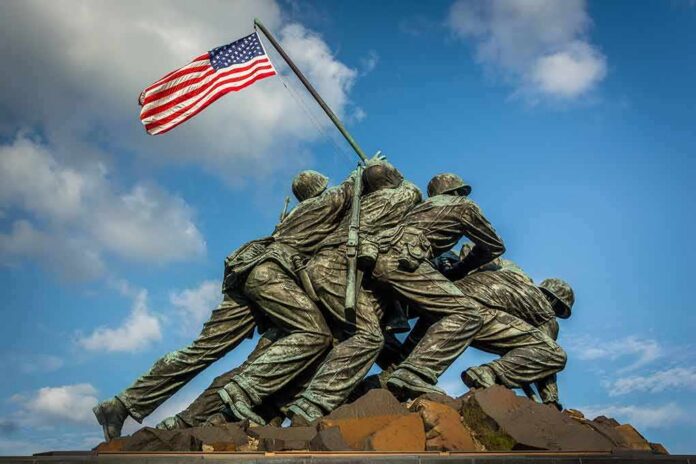
When a war memorial is attacked, the harm is not just to stone; it is to a shared narrative of service and sacrifice that communities steward across generations, which is why the Quantico Iwo Jima vandalism moved swiftly from a police response to felony charges and a broader conversation about protecting veterans’ monuments.
At a Glance
- Police say they arrested Miguel Alonso Maldonado Soriano at the scene as he struck the Quantico Iwo Jima statue with a sledgehammer; he faces multiple felony counts.
- The limestone memorial sustained extensive damage, including the decapitation of one Marine figure; repair costs are expected to reach hundreds of thousands of dollars.
- DHS publicly addressed the case after reports identified the suspect and his immigration status; the criminal process and any federal involvement are distinct tracks.
- Federal law provides specific protections for veterans’ memorials, with penalties that can reach up to 10 years’ imprisonment when willful injury is proved.
What Happened: A sledgehammer attack and an immediate arrest
Late in the evening, officers with Prince William County Police responded to calls about an attack on the Iwo Jima memorial just outside Marine Corps Base Quantico. According to the department’s account and local reporting, they arrived around 10:13 p.m. and found a man actively striking the monument with a sledgehammer. The suspect, identified as 27-year-old Miguel Alonso Maldonado Soriano of Stafford, Virginia, was detained without incident and arrested at the scene. Police and subsequent coverage state that he faces felony destruction of property and related charges including trespass with intent to damage property and felony injury to a monument.
The damage was visible and severe. The statue, a limestone depiction of the iconic flag-raising on Mount Suribachi that served as the scale model for the larger Marine Corps War Memorial in Arlington, suffered the loss of the head of one of the Marines and additional structural harm. Law enforcement and museum officials have described the restoration challenge as significant and costly, with estimates in the hundreds of thousands of dollars to perform specialized stone repair and reintegration that preserves visual continuity and patina.
Why this memorial resonates: Material damage, symbolic stakes
Veterans’ monuments are not generic public art. They anchor civic ritual—reenlistments, promotions, retirements—and embody a memory culture built around service. The Quantico piece has particular provenance: the sculptor Felix de Weldon developed it from Joe Rosenthal’s 1945 photograph, producing a limestone model that informed the larger bronze in Arlington. When a memorial like this is struck, communities respond not just as property owners but as custodians of a canon. That is why police, museum leadership, and veterans’ families spoke in terms of loss and obligation, and why the restoration problem is framed in conservation terms rather than simple replacement—matching stone, adhesives, and finish so that, as with the Washington Monument’s visible stone shift, the repair does not become the most conspicuous feature.
Those conservation choices are expensive because they must reconcile structural integrity with visual fidelity. Conservators sequence emergency stabilization, fragment cataloging, and reattachment strategies before they address surface finishing and patina harmonization. Even small discontinuities telegraph from a distance; closing that gap—the difference between a “fixed” object and a restored monument—consumes the dollars the public rarely sees until after the fact. Comparable federal cases have used repair estimates to establish felony thresholds in property-depredation prosecutions, and the methods for calculating restoration costs draw on established technical guidance for heritage damage assessment.
The legal framework: From local felonies to potential federal overlays
Criminal exposure in cases like this can arise at multiple levels. Locally, felony destruction-of-property statutes turn largely on willfulness and dollar thresholds; prosecutors use expert repair estimates to demonstrate that the damage exceeds statutory cutoffs. At the federal level, two bodies of law often matter. First, the general depredation statute, 18 U.S.C. § 1361, makes it a federal crime to willfully injure federal property when damage exceeds $1,000, a threshold commonly established through contractor or agency estimates in court filings. Second, Congress enacted the Veterans’ Memorial Preservation and Recognition Act to address precisely this category of harm; it criminalizes willful injury or destruction of public monuments commemorating military service, with penalties that can reach 10 years where aggravating factors are met.
Jurisdiction does not automatically shift to federal court simply because a memorial honors the military; much depends on ownership, location, and prosecutorial discretion. In Quantico, local authorities moved first and filed multiple felony counts grounded in Virginia law. If federal authorities were to engage—particularly if federal property interests or statutory protections are implicated—they would evaluate venue, evidentiary posture, and whether dual sovereignty concerns counsel coordinated or successive prosecutions. None of that changes the core reality: the same repair invoices that matter to conservators often become the linchpin of felony charging decisions.
Immigration status and the parallel policy debate
After the arrest, the Department of Homeland Security publicly addressed the case in response to reporting that identified the suspect and his immigration status. DHS statements and subsequent coverage described the individual as a Mexican national without lawful status at the time, a framing that moved the event into a policy argument over border enforcement and immigration benefits even as the criminal case proceeded on its own track. It is common for high-salience vandalism of veterans’ monuments to become a proxy fight over national cohesion and political accountability; this incident fits that pattern. The criminal docket will adjudicate intent and culpability. Immigration questions, where applicable, are handled administratively and in separate courts with different burdens and remedies. Keeping those tracks conceptually distinct helps the public evaluate outcomes without conflating legal standards.
For law enforcement and the courts, motive can be relevant to sentencing but is not an element needed to establish the core property offenses. The record to date centers on direct observation—officers on scene, a recovered sledgehammer, and the condition of the memorial—rather than on any articulated ideological motive. That evidentiary shape is typical for monument-defacement cases that are interrupted in progress and charged immediately.
Restoration, prevention, and stewardship going forward
The hard work after the headlines is restoration under conservation discipline. Limestone, unlike bronze, is vulnerable to granular loss at impact sites and to differential weathering along new joins; reattaching a severed head requires doweling or pinning with compatible, nonreactive materials, micro-injection grouts to close fissures, and careful color and texture matching so the repair does not telegraph in bright daylight. Those choices also affect long-term maintenance budgets. Municipalities that plan with recurring preservation cycles—routine inspection, cleaning, and protective coatings for metals; condition assessments and joint monitoring for stone—spend far less over decades than those that fund only emergencies. Industry data and public-sector experience both point the same way: deferred care multiplies costs when crisis strikes.
Prevention is also about site design and response speed. Lighting, sight lines, and vehicle standoff reduce opportunity; community presence and predictable patrols increase deterrence. When incidents do occur, rapid stabilization by trained teams preserves fragments and surface information that lowers total restoration cost. For veteran-focused sites, partnerships between local governments, base commands, and museum professionals can formalize these playbooks so that the first 24 hours—often decisive for conservation outcomes—are not improvised.
The bottom line
In Quantico, police say they stopped an ongoing attack, arrested a suspect at the scene, and brought multiple felony charges. The memorial suffered conspicuous, costly damage, and conservators now face a technically demanding restoration. Federal law is built to treat willful injury to veterans’ monuments as more than routine vandalism, and policymakers routinely read these cases as signals about social cohesion and enforcement priorities. The court process will do its work; the community still has another: to restore, to harden, and to keep telling the story the monument was built to carry.
Sources:
washingtontimes.com, dhs.gov, stripes.com, militarytimes.com, princewilliamtimes.com, nbcwashington.com, arch.org.tw, oxmaint.com, justice.gov, phmc.state.pa.us