

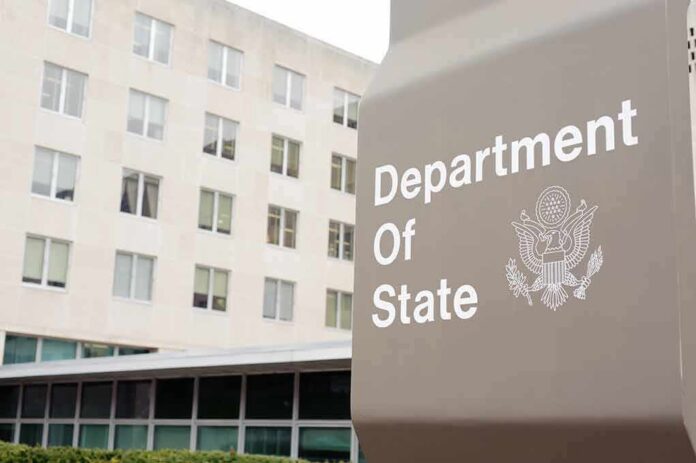
Off-duty conduct can end a public-facing government job overnight; Britt McHenry’s exit from the State Department after a courtside altercation shows how quickly a viral moment can collide with the federal standard that employees safeguard the agency’s credibility even when they are not on the clock.
At a Glance
- Video from the Washington Wizards’ home opener showed McHenry throwing the remains of a drink at another spectator during a verbal dispute; she left her State Department post the next day.
- Multiple reports said she resigned or was compelled to resign; the department declined comment on personnel matters.
- The incident unfolded at Capital One Arena on October 21, 2026; separation reports surfaced October 22–23.
- Federal rules allow discipline for off-duty misconduct when there is a “nexus” to the job—especially in public communications roles.
What happened and what changed
During the Washington Wizards’ home opener at Capital One Arena on October 21, 2026, video reported by multiple outlets showed State Department press adviser Britt McHenry in a verbal confrontation with nearby spectators. As the exchange escalated, McHenry tossed the remains of a drink toward another attendee. The following day, reporting indicated she was out of her State Department role, with characterizations ranging from fired, forced to resign, or resigned; the State Department, consistent with policy, declined to comment on internal personnel actions.
The sequencing is straightforward and well-attested. The arena incident was captured and circulated widely, including descriptions of a tossed drink and a visibly heated exchange. Within roughly 24 hours, media reports connected the viral altercation to McHenry’s separation from government service. Page Six reported she was compelled to resign, while Front Office Sports coverage relayed her own statement that she had signed a resignation letter; other outlets used “fired” or “let go,” underscoring how public accounts often compress distinct HR outcomes into a single headline verb.
How agencies assess off-duty conduct
Federal agencies do not need an employee to be on duty, in uniform, or using government property for conduct to become a work matter. The legal test is the nexus—a demonstrated connection between the off-duty conduct and the efficiency of the service. The Merit Systems Protection Board (MSPB) has long held that an agency can establish nexus by showing one of three conditions: the conduct harmed job performance, undermined management’s trust and confidence in the employee’s performance, or interfered with the agency’s mission.
For communications roles—press advisers, spokespeople, and public liaisons—the link is often more direct. The job requires credibility with media and stakeholders, disciplined judgment in public settings, and the avoidance of conduct that invites reasonable doubt about temperament or judgment. DOJ guidance distills this principle plainly: off-duty conduct can warrant discipline when it undermines the employee’s job responsibilities or the agency’s mission, consistent with 5 U.S.C. § 7513(a). Courts have recognized that agencies may rely on loss of confidence—particularly for confidential or policy roles—when that loss itself impairs effective service.
Why the Wizards incident became a workplace problem
Three features of this incident matter for applying the nexus standard. First, visibility: a widely shared video transformed a localized argument into a reputational event for a federal press adviser. Second, role alignment: the core competency of a press adviser is composure under provocation; a recorded outburst invites doubts about that competency. Third, proximity in time: the incident and the separation occurred within a day, which—while not dispositive of cause—often signals a managerial conclusion that confidence has been compromised in a role where immediacy and perception are integral.
None of this requires a criminal charge, a police report, or a formal adjudication. The nexus test is not criminal-law proof beyond a reasonable doubt; it is an employment standard about the efficiency of the service. The MSPB and federal courts have repeatedly affirmed that an agency may act where misconduct reasonably leads to a loss of trust or risks impairing the mission, especially in sensitive or high-visibility positions.
Terminology: fired, forced to resign, resigned—what the labels mean
Headlines tend to flatten HR nuance, but the distinctions carry legal and administrative implications. A removal is a unilateral agency action; a resignation may be voluntary or, in practice, requested. “Forced to resign” or “compelled to resign” describes the informal zone where an employee is presented with a choice: resign now or face an adverse action. Reporting on McHenry’s departure spans this spectrum, with Page Six citing a source that she was compelled to resign and other outlets describing her as “fired” or “let go.” Front Office Sports reported she said she signed a resignation letter, which, at minimum, confirms separation by resignation rather than a formal removal.
For readers parsing accountability, the labels change the paperwork more than the rationale. Whether a resignation or a removal, the underlying managerial judgment is the same: continued service in a communications role was untenable after a viral public altercation that included a thrown drink. The State Department’s refusal to discuss personnel matters is standard practice and does not alter the public record of the event itself or the reported sequence of separation.
Precedent and practice in public-facing roles
Agencies regularly discipline employees in visible assignments for conduct that, if captured on video, calls their professional judgment into question. The MSPB’s nexus framework evolved for exactly these cases—balancing employee rights with the government’s obligation to maintain effective, trustworthy service. In precedents addressing off-duty altercations, agencies have prevailed where they show a reasonable loss of confidence or adverse mission impact—particularly when the role depends on public trust, external engagement, or message discipline. For appointees and policy-adjacent advisers, the bar is often higher: a credible loss of confidence alone can justify separation, given the premium those roles place on judgment and representation of the institution.
That backdrop explains why a drink thrown at a sporting event can be disqualifying even absent complex factual disputes about who said what first. In communications work, perception is part of performance; the public artifact of the behavior becomes the job problem. A 30-second clip, fairly or not, can be all the evidence needed for a manager to conclude that the adviser can no longer credibly front the agency.
Britt McHenry resigns State Department post after Wizards game altercation pic.twitter.com/eLHuo923XH
— Wire Report NBA (@WireReportNBA) October 24, 2026
What this episode tells us about modern reputational risk
Two structural realities now shape public service employment. First, the ubiquity of cameras means off-duty moments often have on-duty consequences. Second, the federal nexus standard focuses on effectiveness and trust, not intent or provocation; the question is whether the conduct, as seen and reasonably interpreted, undermines the employee’s ability to do the job. In McHenry’s case, the visible act of throwing a drink during a heated exchange, the speed of public amplification, and the nature of her press advisory role made separation a predictable managerial outcome under established federal principles.
Bottom line
Britt McHenry left her State Department post immediately after a widely circulated video showed her throwing a drink at another spectator during the Wizards’ home opener. Multiple outlets tied the separation to the altercation, with varying HR labels; the State Department adhered to its policy of declining comment on internal personnel matters. Under long-standing federal standards governing off-duty conduct, that chain of events—and the centrality of public trust to a communications role—provides a clear rationale for the outcome. In public service, judgment is the job. When a viral scene calls that judgment into doubt, the job rarely survives the clip.
Sources:
washingtontimes.com, washingtonsun.com, balleralert.com, pagesix.com, yahoo.com, wjno.iheart.com, mspb.gov, justice.gov, opm.gov, caselaw.findlaw.com