

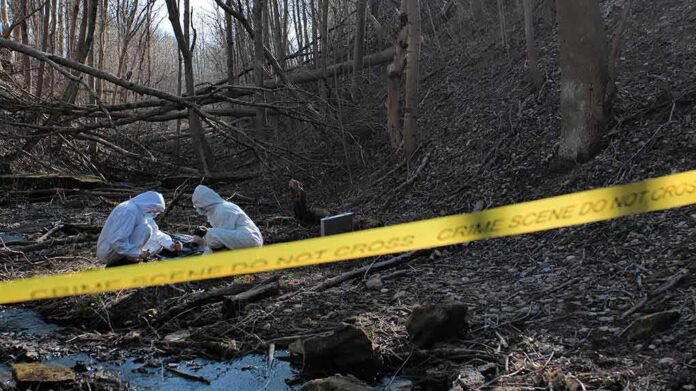
In high-stakes homicide prosecutions, the public often meets the case through a headline-grabbing quote or a single striking detail; the truth, and any eventual verdict, rests on how a chain of circumstantial facts holds up under law and science.
At a Glance
- Prosecutors say surveillance, post-incident behavior, and the defendant’s own statements form a cohesive circumstantial case pointing to guilt.
- A grand jury returned a second-degree murder indictment, signaling probable cause but not proof beyond a reasonable doubt.
- Publicized jailhouse remarks—especially religiously framed ones—draw attention, but their admissibility and probative value are far from assured.
- The strongest unresolved questions concern forensic confirmation, weapon recovery, and the defendant’s mental state at the time.
What the prosecution says it can prove—and why that matters
The backbone of the state’s case is cumulative, not singular. Charging documents and court reporting describe surveillance showing Sayed Mohassib walking toward the Shore Parkway Greenway before the attack and fleeing afterward; confronted with the video, he allegedly acknowledged he was the person on camera. The same filings detail what prosecutors characterize as flight and concealment: a return to his residence, a brief interval, and then discarding items down a garbage chute while dressed only in underwear—conduct the state frames as consciousness of guilt. Reports from the courtroom also attribute to the complaint an admission that he brought a knife to the location and later got rid of the blade and bloody clothing; investigators reportedly observed blood in his apartment that screened presumptively positive. None of this is exotic evidence in homicide work; each element—approach, egress, weapon possession, discard, cleanup—can look ambiguous alone, but together they establish a narrative prosecutors trust a jury to credit.
On top of that record, the Brooklyn District Attorney announced a grand jury indictment for second-degree murder. An indictment means a panel of citizens found probable cause that a felony occurred and that the defendant committed it; in plain terms, the case met a threshold to move toward trial. That is not a verdict, and it is not a preview of everything the jury will see—grand juries hear a subset of the evidence under relaxed rules—but it is an institutional marker that the state’s theory is not speculative.
Where the case is strongest—and where it is not
As presented publicly, the case’s strength lies in sequence and behavior: documented proximity to the scene in the relevant window, rapid post-event disposal and cleaning activity, and statements consistent with weapon possession before the encounter. Those are classic bricks in a circumstantial wall, and juries convict on such walls all the time when the mortar—timing, forensics, credibility—sets. The most conspicuous gaps are also familiar: reporting to date does not cite an eyewitness to the stabbing itself; it references a presumptive blood test without published confirmatory lab results; and it does not disclose a full chain of custody or definitive DNA linking any recovered knife or clothing to the victim. Those are not fatal omissions this early, but they are the precise questions that trial discovery and expert testimony must answer for a verdict to be truly secure.
Intent—the centerpiece of second-degree murder—remains where most serious trials are won or lost. Approaching the path, flight, and concealment can allow a jury to infer intent to kill or at least intent to cause serious physical injury; they do not, by themselves, reveal what was in the defendant’s mind. The prosecution does not need a motive, but it does need to clear the statutory mens rea. Until forensic timing, wound-pathology analysis, and the defendant’s mental-state evidence are vetted in court, intent sits as an open, litigable issue.
How to weigh the jailhouse quote and the “blackout” claim
The most viral line associated with this case is not a lab result or a timestamp; it is a tabloid jailhouse quote—“Allah told me to”—paired with a reported assertion that he did not know the victim and that she “was just there.” Separately, earlier coverage attributes to him a statement that he blacked out and woke covered in blood. These are incompatible narratives: a divine-command justification versus dissociation or amnesia. They are also, at this stage, extra-judicial. A jailhouse remark to a reporter is not a sworn confession, may never be admitted at trial, and—if admitted—would be weighed against other evidence and any psychiatric evaluations. Treat it as a media artifact until the court determines its status. The more probative record, if it materializes, will come from recorded interviews, Miranda-compliant statements, and expert assessments of competency and criminal responsibility.
There is a further reason for restraint with sensational admissions: wrongful-conviction data show how fragile confession evidence can be when separated from corroboration. National Registry of Exonerations reports repeatedly document false or contaminated confessions among homicide exonerations—a caution that argues for privileging forensics, chains of custody, and internally consistent timelines over any lone quote that lights up a headline.
The forensic center of gravity: what will decide this case
If you want to understand where this prosecution is headed, watch four tracks. First, timeline forensics: synchronized surveillance, 911 logs, and digital location data that bound the attack window and the defendant’s movements before and after. Second, biological results: whether presumptive stains in the apartment or on discarded items confirm as blood, whether they type to the victim and/or the defendant, and how cleanly lab analysts can testify the samples were handled from collection through testing. Third, weapon consistency: whether a knife was recovered, whether its dimensions and characteristics match the wound-pathology reports, and whether trace evidence on the blade coheres with the rest of the record. Fourth, mental-state evaluations: court-ordered psychiatric assessments, prior hospitalizations, and expert opinions on capacity to form intent or potential insanity defenses. Collectively, these determine whether the circumstantial wall stands at trial height.
Two practical notes often misunderstood outside the courtroom: a presumptive positive for blood is a screening tool, not a destination—it must be confirmed and attributed. And surveillance without a view of the stabbing can still be powerful if identity, timing, and continuity are established by multiple cameras and corroborated by independent data points. Defense counsel will press every weak joint—gaps in footage, inconsistencies in timestamps, contamination risks, and alternative explanations for behavior such as panic or psychosis. That is the adversarial system doing its job.
An ex-NYPD officer is charged with second-degree murder after reportedly admitting to killing a Brooklyn jogger he didn't know. A case pointing to severe mental illness and vetting failures, or something that calls for the harshest possible sentence?
— Arooba Malik (@batvikida) November 23, 2026
The institutional subplot—and keeping it separate from the verdict
Parallel to the criminal case, public agencies face scrutiny: how a man with a brief, troubled stint in the NYPD and a short-lived Marine Corps experience ended up employed in a school, and whether any interagency warnings were shared. City officials and school leaders have already promised reviews of hiring and vetting practices. That accountability work has real civic value; it is not, however, evidence of guilt or innocence in the homicide. Keep the channels distinct: employment decisions are governed by risk management and policy; criminal liability is governed by statutes, rules of evidence, and burdens of proof.
What a fair assessment looks like from here
The case against Sayed Mohassib, as publicly described, is coherent and trial-worthy: surveillance bracketing the crime, admissions about weapon possession and disposal, and post-incident conduct prosecutors argue evinces guilt, now buttressed by a grand jury indictment. The unresolved core is evidentiary confirmation—DNA, weapon recovery, and a tested account of his mental state—and the legal translation of those facts into the specific intent required for second-degree murder. Juries routinely convict on circumstantial mosaics when the tiles align; they also acquit when key pieces do not lock or when reasonable doubt arises from mental-state defenses. The difference will be made not by a viral line but by whether the state’s science, timelines, and chains of custody survive cross-examination. That is as it should be.
Sources:
nypost.com, kdrv.com, localnews8.com, pix11.com, brooklyn.news12.com, lavocedinewyork.com, nbcnewyork.com, abc7ny.com, hindustantimes.com, ie.headtopics.com