
When immigration enforcement moves from jailhouse transfers to the jet bridge, it stops being invisible process and becomes public policy in motion — and that is why the Sea-Tac detentions drew instant outrage and attention: they crystallized how ICE now exercises its authority in passenger-facing spaces.
At a Glance
- ICE officers detained at least one passenger in the jet bridge during boarding for Alaska Flight 1306 at Seattle-Tacoma International Airport, with airport and airline officials confirming the operation occurred without their prior notice.
- Video captured masked agents physically restraining a traveler, delaying the Los Angeles–bound flight and prompting condemnation from Washington leaders and airport authorities.
- ICE identified one detained traveler, Jasmine Nicolini Alvarez, as a targeted overstay case with a 2019 self-deport authorization; she was taken to the Northwest ICE Processing Center in Tacoma.
- The incident fits a broader shift toward “mobile” immigration enforcement at airports and other public venues, where the lawfulness turns on individualized records and arrest authority rather than the location itself.
What happened on the Sea-Tac jet bridge
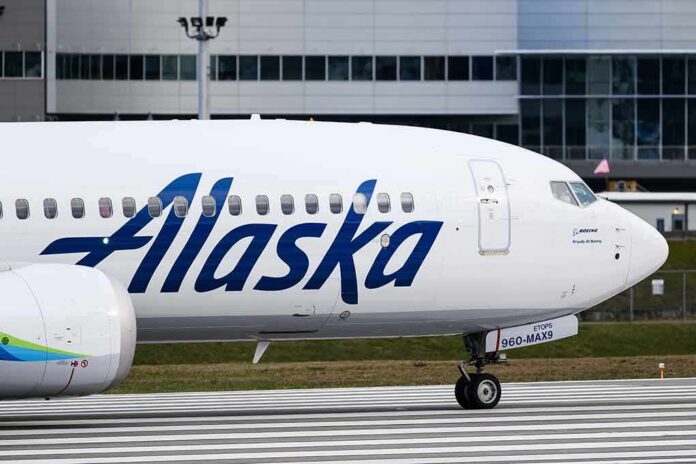
During boarding for Alaska Airlines Flight 1306 from Seattle to Los Angeles, ICE officers executed an enforcement action on the jet bridge. Alaska Airlines confirmed a law-enforcement incident during boarding; the Port of Seattle, which operates the airport, said ICE conducted the operation without notifying or involving the port’s police. The timing — roughly 8 a.m. — and the location — the enclosed walkway between gate and aircraft — were consistent across reports from airport authorities and the carrier. Video taken by passengers showed masked officers restraining at least one traveler and moving them off the aircraft approach, and the flight’s departure was delayed as a result. The Port described the scene as distressing and said it was reviewing what occurred with the airline and federal counterparts.
Public officials reacted quickly. Washington’s governor and port leaders denounced the method and setting of the arrests, arguing that masked, plainclothes officers acting without coordination jeopardized safety and eroded trust in airport operations. Alaska Airlines stated it had no advance knowledge of the enforcement action and was assessing whether protocols had been followed. The Port said immigration enforcement at SEA occurs without its participation or forewarning, underscoring the authority federal officers possess to access secure areas but also the coordination gap exposed by a visible, forceful detention at the gate.
Who was detained and why ICE says it acted
Subsequent reporting identified one of the travelers as Jasmine Nicolini Alvarez, an Argentinian national whom ICE described as a targeted subject based on a visa overstay and failure to depart under a 2019 self-removal authorization. She was transported to the Northwest ICE Processing Center in Tacoma following the airport encounter, according to local coverage that cited ICE’s rationale and detention location. Alvarez’s husband stated she has no criminal history and that the couple had weighed, and set aside, pursuing immigration relief. That portrait captures a category of modern airport arrests: noncitizens with unresolved civil immigration violations whose travel places them in settings where officers can locate and detain them.
Accounts diverged on whether a second person was taken into custody on the same jet bridge. The Port of Seattle referenced two passengers involved; other contemporaneous reports and bystander video focused on at least one detention. That discrepancy matters for narrative clarity more than for the central, uncontested point: ICE ran an operation at the gate, physically detained a traveler, and removed them from the boarding stream.
How airport immigration arrests work — and why they’re happening
There is no categorical legal bar that keeps immigration officers out of airports. The governing questions are narrower and more technical: whether officers have statutory authority for an administrative immigration arrest; whether they possess an appropriate warrant or, if proceeding without one, probable cause paired with circumstances that justify arrest before a warrant can be obtained; and whether use-of-force and access protocols for secure areas are followed. In recent years, enforcement has visibly shifted from predictable custodial pickups toward “mobile” encounters — at courthouses, transit hubs, worksites, and, increasingly, domestic gates — where people with final orders, visa overstays, or pending cases can be located through travel and identity data. Analysts and oversight bodies have documented changing arrest patterns across administrations, with ICE activity falling and then rising again post-2021, underscoring a system whose footprint expands and contracts with policy priorities.
Operationally, these arrests are administrative, not criminal. They rely on immigration records — entries, overstays, removal orders, and compliance histories — rather than proof of a new crime. Airports offer both opportunity and complexity: passengers are present, identities are verified repeatedly, and secure access is controlled; but visibility is high, the setting is crowded, and any use of force unfolds in front of travelers and crews. That combination explains why a gate-side detention, even when authorized, can trigger safety concerns from airlines and airport authorities and political backlash from elected officials.
Protocol, coordination, and the passenger experience
Airport operations are choreography: airline agents, TSA screeners, airport police, and federal partners each have defined roles. When one actor conducts a high-stakes intervention without notice, the choreography breaks. The Port of Seattle and Alaska Airlines both said they had no advance warning of ICE’s plan and began reviewing whether established protocols — access permissions, identification requirements for agents, and deconfliction steps meant to preserve safety and order — were observed. The consequences were immediate: a delayed departure, shaken crew members, and passengers thrust into the role of eyewitnesses to a forcible takedown in a narrow, crowded space. Those effects, more than the legal theory, shape how the public receives the event.
For travelers with unresolved immigration status, the lesson is pragmatic. Domestic air travel is not a shield. Identity checks, reservation data, and interagency information flows can make airports focal points for targeted arrests of people with prior removal orders or overstays. The particulars of any individual case will turn on records in government files and the discretion of officers, but the venue choice alters the stakes: a misstep by any party becomes instantly visible to hundreds of bystanders and — via their phones — to millions more.
Washington governor, union denounce ICE arrests of travelers at Seattle airport https://t.co/UqQxbY6psq
— Reuters (@Reuters) November 22, 2026
What this signals for policy and practice
Sea-Tac’s jet-bridge detentions reflect an enforcement posture that prioritizes mobility and visibility over predictability. For ICE, gate-side operations can efficiently locate specific subjects; for airports and airlines, they can disrupt safety culture and passenger confidence; for elected leaders, they become symbols of an administration’s immigration strategy in one of the most public civic rooms in America. None of that implies airports are off-limits to federal officers. It does mean that when enforcement enters passenger space, the quality of coordination, the restraint of tactics, and the precision of targeting determine whether the public sees diligent law enforcement or institutional overreach. The Sea-Tac episode made that judgment unavoidable — not because the law changed, but because the venue did.
Sources:
cbsnews.com, seattletimes.com, kark.com, yahoo.com, usnow.us, cbsaustin.com, fox10phoenix.com, yakimaherald.com, kfoxtv.com