

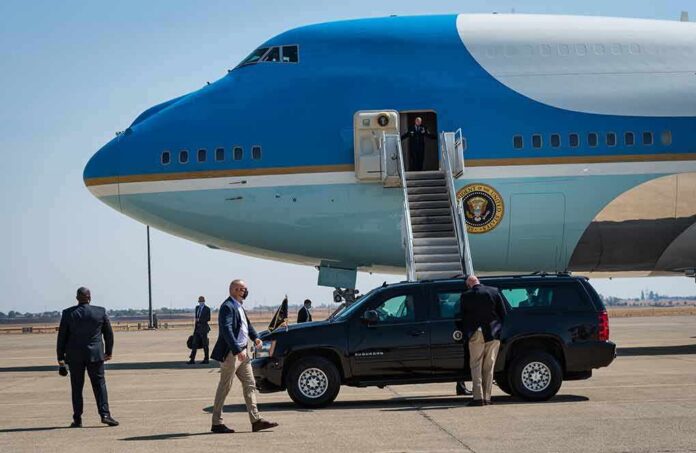
Three leaders arriving in one city is choreography; what matters is the agenda they chose to share a room for: nuclear risk management, war spillovers, and the rules of economic interdependence when trust is thin and leverage is the coin of the realm.
At a Glance
- President Trump traveled from Manila to Shenzhen for the APEC Economic Leaders’ Meeting, where a Trump–Xi–Putin session was planned on the sidelines.
- The White House and Beijing publicly confirmed a trilateral meeting, with November 19 identified by multiple outlets as the target date.
- Stated topics included nuclear issues and regional wars alongside trade and technology frictions.
- The summit context matters: APEC is economic, but leaders routinely use its margins for hard-power diplomacy.
What happened and why it mattered
President Trump departed Manila for southern China to attend the APEC Economic Leaders’ Meeting in Shenzhen and to hold talks involving China’s Xi Jinping and Russia’s Vladimir Putin. The White House said leaders planned an unprecedented trilateral session; Chinese officials signaled Xi’s participation, and reporting coalesced around November 19 for the meeting window on APEC’s margins. Trump himself previewed the agenda, saying he expected to meet Xi and Putin and intended to raise denuclearization among other security issues. The basic stakes were clear: three nuclear powers with divergent interests testing whether conversation could arrest escalation and frame the next phase of competition.
Readers sometimes mistake scheduled diplomacy for guaranteed outcomes; this was never promised as a deal-making summit. U.S. officials cast the session as an entry point—an initial conversation rather than a negotiation intended to produce a signed instrument—consistent with how leaders have historically used APEC sidelines to deconflict, signal red lines, and map future channels.
How leader-level diplomacy works on APEC’s margins
APEC is not a treaty organization; it operates by consensus on non-binding commitments to reduce trade frictions and improve connectivity among 21 Pacific Rim economies. Precisely because it convenes heads of government around an economic agenda, its sidelines are valuable for time-boxed, high-level strategic exchanges. Hosts design programs to showcase economic prowess—Shenzhen’s selection underscores China’s technology ambitions—while leaders peel off for bilaterals or, rarely, multilateral huddles tailored to immediate security flashpoints.
The Shenzhen trilateral fit that mold. Washington’s priority was to put nuclear risk and conflict spillovers—especially the Middle East and Europe—on a table that also includes Beijing’s economic leverage over Moscow and global supply chains. Beijing, as host, sought to demonstrate convening power and to manage downside risks to growth from geopolitical shocks. For Moscow, visibility alongside Washington and Beijing offered both status and a venue to probe constraints and opportunities in a sanctions-ridden economy.
The core agenda: nuclear risk, wars, and economic statecraft
Nuclear risk sits atop any U.S.–Russia–China discussion because the geometry has shifted. Bilateral arrangements that once managed U.S.–Russia arsenals do not bind China, whose expanding stockpile complicates any renewal of two-party ceilings. Trump signaled he wanted denuclearization on the table; analysts expected pushback given the asymmetries and Beijing’s reluctance to be locked into ceilings before parity is even within sight. The likely near-term deliverable was process: guardrails around doctrine, notifications, and crisis lines rather than numbers.
Active conflicts shape the second layer. Ukraine’s trajectory engages all three, albeit with incompatible preferences. Coverage described whether and how the war would be broached; the APEC setting makes a formal negotiation improbable, but leader-level presence creates opportunities for message transmission and probing for ceasefire scenarios. The Middle East war’s knock-on effects—energy prices, transit risk, insurance premiums—are directly economic, which is why even a security conversation belongs at an APEC-adjacent table.
Trade, technology, and the rules of interdependence
Strategic competition now runs through trade architecture, export controls, and standards. The Shenzhen venue—home to firms like Huawei and Tencent—embodies China’s climb up the value chain and the friction points with the United States: semiconductors, rare earths, AI, data governance, and critical supply chains. APEC offers tools for facilitation—customs modernization, digital trade principles—but not enforcement; leaders therefore use the margins to test reciprocal steps or firebreaks around their most sensitive measures. Against that backdrop, even incremental signals—clarifying tariff trajectories or export-control scope—can shift boardroom planning across the region.
For Russia, Sino–Russian economic cooperation has been a lifeline; for China, the relationship hedges against Western restrictions but risks secondary sanctions. Any trilateral encounter is thus also a calibration exercise: how much strategic alignment can Beijing afford without jeopardizing access to Western markets and finance, and what residual space remains for U.S.–China commercial pragmatism amid a security-led policy frame.
🚨JUST IN: There he is, the center of attention! 🇺🇸 Standing front and center alongside world leaders like Xi Jinping, Vladimir Putin, and representatives from Mexico, Canada, and Japan, President Trump is clearly commanding the global stage at the APEC family photo. 47 and his…
— vizmas 🤍 (@vizmas23) November 18, 2026
Why Shenzhen, why now
Location is policy. Shenzhen signals China’s self-conception as an innovation engine and presents a stage on which Beijing can host, choreograph, and demonstrate state capacity. Timing with APEC’s Leaders’ Meeting concentrates global media and diplomatic bandwidth, enabling side-conversations that would be harder to arrange otherwise. Reuters captured the scheduling: November 18–19 for the leaders’ program, with the trilateral expected within that window. Multiple outlets identified November 19 for the session itself, aligning with the summit’s apex and the host’s gala diplomacy.
From Washington’s perspective, sequencing Manila and Shenzhen allowed Trump to blend economic dealmaking with high-visibility strategic diplomacy; NBC’s pool reporting tracked his departure from the Philippines en route to southern China, consistent with the planned Shenzhen engagements. Beijing’s confirmation that Xi would meet Trump and Putin provided the host’s imprimatur, and the White House framing locked expectations around a short, agenda-dense exchange rather than a communique-driven summit.
How to read outcomes in leader-to-leader sessions
Most consequential leader meetings do not end with signatures; they reset baselines. What to watch for after sessions like this: confirmation of sustained working groups on nuclear risk; language that narrows red lines around proxy theaters; incremental thaw in commercial channels (export-control licensing clarity, tariff standstills, regulatory consultations); or, equally telling, sharpened rhetoric that signals failed tests and hardening positions. The absence of a joint statement is not synonymous with failure—private understandings on crisis communications or sanctions contours often surface only when they deter accidents.
What the record establishes, cleanly
Across major outlets, four points are firm. First, Trump traveled from Manila to southern China to attend APEC in Shenzhen. Second, the White House and Chinese side confirmed plans for a Trump–Xi–Putin meeting on the summit’s sidelines. Third, the leaders’ program ran November 18–19 in Shenzhen, with the trilateral targeted for November 19. Fourth, Trump publicly previewed his intent to discuss denuclearization, placing nuclear risk at the center of his ask. Those facts define the diplomatic stage. The value of any such session is measured not by theatrics but by whether crisis risks shrink and channels stay open when the motorcades depart.
Sources:
youtube.com, cnbc.com, apnews.com, dw.com, nbcnews.com, charlotteobserver.com