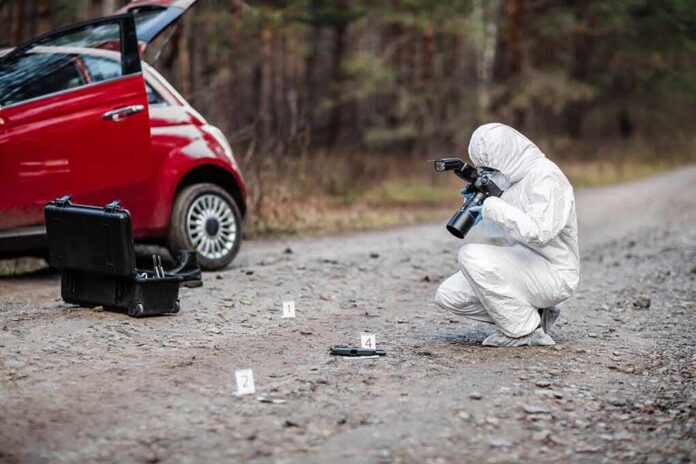
When a disappearance yields only fragments—an abandoned car, a phone gone dark, a few seconds of grainy video—those ambiguities become a vacuum that rumor rushes to fill; the discipline is to separate what is actually established from what online audiences infer, and in the Schuck case the public record supports concern for a missing father, not accusations against his wife.
At a Glance
- Police timelines document an unresolved disappearance: a final delivery, a lost phone signal, an abandoned vehicle, and an unidentified figure on doorbell video—none of which identifies a culprit.
- Jennifer Schuck located her husband’s last known area via Life360 and met troopers by the Vanport Bridge; participation in the search is documented, not incriminating.
- Family disclosures about hidden job loss and significant debt explain why theories proliferated, but they do not tie Jennifer to any wrongdoing.
- No publicly established evidence links Jennifer to planning or causing the disappearance; accusations remain speculative.
What the record actually shows
The hard facts are sparse and specific. Surveillance placed 32-year-old DoorDash driver Zachariah Schuck picking up a food order at New Sheffield Cafe on October 22 and completing a delivery in the Beaver area shortly before 7 p.m. That is the last clear, confirmed sighting. Later, his vehicle was found abandoned with the keys inside; a delivery bag and a phone charger were reportedly still in the car. Doorbell footage from Croxall/Crooks Hollow Avenue shows a person stepping out of the vehicle and walking away, but neither family nor police have identified who that person is from the available images. North Sewickley Township Police have not announced an arrest or named a suspect; they have not ruled out foul play.
On the home front, the documented timeline shows Jennifer using the Life360 family-tracking app to locate Zachariah’s last known area and meeting Pennsylvania State Police near the Vanport Bridge, where officers searched but did not recover his phone. That places her in the search, not at the delivery site or the car-abandonment location. These are the data points that can be defended from the record; everything beyond them is conjecture.
How ambiguous facts become fuel for rumor
Three elements commonly convert missing-person ambiguity into suspicion of a spouse: a jarring timeline, any hint of relationship or financial stress, and a public information gap. All three exist here. The last text to Jennifer reportedly read “Everything will be okay,” an inherently unsettling message when the sender then vanishes. The family has since said Zachariah lost his previous job months earlier, concealed it, and left substantial undisclosed debt. Those disclosures are relevant to understanding stressors, but they are not evidence of collusion or harm; they explain why people start theorizing, not what actually happened.
The online rumor loop tightens when police share calibrated slivers of the case—asking for additional footage, confirming the abandoned vehicle—but withhold the investigative file. That is standard practice; the absence of disclosure is not a tell. In this environment, a few seconds of unclear video can be played and replayed, spliced into YouTube compilations of other delivery-driver crimes, and presented as pattern rather than as one case with specific unknowns; it makes the mystery feel solved by association, even when it is not.
Jennifer Schuck and the claims against her
The family has answered the insinuations directly, calling them false and unsupported. The public record aligns with that statement in a narrow but important way: there is no named law-enforcement allegation, forensic finding, or sworn record that places Jennifer at the delivery address, at the vehicle, or otherwise ties her to causing or concealing the disappearance. Police accounts instead document her use of Life360 and her presence alongside troopers at the bridge-area search. In cases like this, the key evidentiary threshold is simple: does any identified person, document, or lab result link the accused to the disappearance? On the public record to date, the answer is no.
That does not resolve what happened to Zachariah; it clarifies only what the evidence does and does not currently support. Reasonable people can be frustrated by uncertainty without leaping to assign blame.
Mechanics of a competent investigation: what would actually settle this
The unresolved questions are technical, not rhetorical. Investigators typically sequence five workstreams in a disappearance like this:
– Full digital reconstruction. That means pulling Life360 logs, carrier call-detail records, handset location history, app telemetry from DoorDash, and router associations to stitch a minute-by-minute map of movements and communications. Only this synthesis can reconcile the last delivery, the bridge-area pings, and the vehicle’s path.
– Video authentication and expansion. The doorbell clip that shows a person leaving the car must be obtained at original resolution, with metadata and neighboring-camera angles, then analyzed for gait, stature, clothing, and direction of travel. Enhancement is not identification, but paired with other sensors it can exclude or include candidates.
– Vehicle forensics. A proper workup inventories latent prints, touch DNA, biological traces, and trace fibers in high-transfer zones—steering wheel, door handles, ignition, seatbelt webbing—plus the fuel system and odometer deltas. The goal is to establish whether a third party drove or exited the vehicle and in what condition the car was left.
– Platform records. DoorDash maintains order, route, and messaging data that often contain GPS pings at pickup, at handoff, and when a driver marks an order complete. Reconciling that stream with phone and car data can close timeline gaps and surface otherwise invisible detours.
– Financial and communications audit. Employment status, bank records, debt collection contacts, and recent personal communications can illuminate stressors and plans without presuming motive. In this case, family statements about concealed job loss and debt can be substantiated or corrected against primary records.
Why spousal suspicion is so sticky—and why restraint matters
Public attention reliably gravitates toward the spouse in a missing-person case. Sometimes that focus is warranted; sometimes it reflects the human urge to impose a simple narrative on complex uncertainty. Decades of scholarship on media and missing-persons coverage show that social platforms accelerate this cycle: communities do circulate photos and tips, but they also seed conspiracy narratives that can “simmer” without editorial guardrails, overwhelming both families and investigators with low-value noise. In practice, that noise can divert attention from the two immediate priorities that matter: preserving fragile evidence and generating precise, testable leads.
In the Schuck matter, the most responsible posture for the public is also the most effective: insist on verifiable facts, share only information that is sourced to law enforcement or primary records, and resist amplifying claims that do not clear that bar. That does not mean disengagement; it means disciplined engagement.
Missing Pennsylvania DoorDash Driver Sent Wife Final Text Message Before Disappearance — as Authorities Continue to Investigate #Pennsylvania #Carjacking #Foreclosurehttps://t.co/wFHuUFc2ZU
— Stay Strong, Never Give Up (@WLFWolves) November 14, 2026
The path forward: what to watch for, and what to discount
A few developments would carry genuine evidentiary weight. First, any law-enforcement disclosure of synchronized digital timelines—phone, Life360, and DoorDash—narrowing the window between the final delivery and the car’s last stop. Second, authenticated, higher-quality video or additional angles identifying who left the vehicle. Third, forensic results from the car that indicate third-party presence or exclude likely drivers. Fourth, production of platform and financial records that either corroborate or contradict family statements about employment, debt, and recent behavior. Short of that, recycled clips, armchair body-language analyses, and insinuations anchored to “someone must be responsible” do not add clarity.
Sources:
nypost.com, us.headtopics.com, thesun.co.uk, people.com, yahoo.com, ibtimes.co.uk, cbsnews.com