

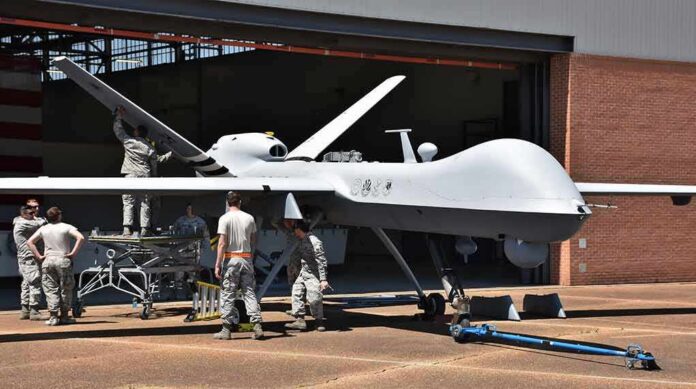
When a single satellite image can reset assumptions about naval aviation, the prudent analyst asks not whether a look‑alike exists, but what design choices reveal about the mission space China intends to fill.
At a Glance
- Satellite imagery shows an unidentified drone at China’s Pucheng test base with planform features reminiscent of the U.S. Navy’s MQ-25A Stingray.
- The likeness is categorical, not literal: shared traits point to a similar role class, while airframe details diverge from Boeing’s tanker in meaningful ways.
- For the U.S., MQ-25 is a carrier-based aerial refueling system first, with secondary ISR; that doctrine explains the shape and the payoff in carrier air wing range.
- Open-source patterns are reliable on configuration yet inconclusive on program identity until repeated sightings, test activity, or integration evidence accrues.
What the Pucheng image actually supports
The Aviationist’s reporting centers on a commercial satellite pass that captured an uncrewed aircraft at Pucheng, Shaanxi, with a straight-to-mildly swept wing, mid-fuselage engine intake, and V-tail—hallmarks that echo the U.S. Navy’s MQ-25A Stingray silhouette. Those features matter because they correlate with a design brief: endurance at carrier approach speeds, benign handling in the groove, and volumetric margin for fuel in wing and fuselage. The article is careful on the point that matters most: resemblance alone does not fix the aircraft’s precise mission or confirm an aerial refueling role. The strongest defensible conclusion from one overhead image is categorical—China is testing in the same broad design space as MQ‑25, not fielding a clone.
That discipline aligns with how open-source discovery usually unfolds. Early sighting yields shape and scale; only later do serial images, taxi or flight activity, and platform integration tighten the inference loop. Until then, configuration is evidence of intention, not proof of doctrine. The Pucheng case fits that pattern.
Why this configuration points to a carrier support problem
To understand why a V-tailed, straight-wing, centerline‑intake UAV attracts the MQ‑25 comparison, recall what drove the U.S. design. The Navy defined MQ‑25 as an organic carrier-based mission and recovery tanker, capable of boosting the strike range of F/A‑18s and F‑35Cs, with a secondary maritime ISR function. That requirement stack pulls the airframe toward generous fuel fraction, controllability around the boat, low observable features sufficient for survivability in contested littorals, and the structural provisions to lug and stabilize a refueling store (the Cobham/GE UARRSI pod in the U.S. case) on a wing station or centerline.
MQ‑25’s development history illustrates the trade space: after years of concept churn, the Navy cleared the program for low‑rate production following first flight of a production‑representative aircraft and carrier integration milestones, including control from a shipboard ground station and successful probe‑and‑drogue refueling of fleet aircraft during test phases. Those milestones are not trivia—they explain the Stingray’s proportions and surfaces. A drone designed to tank fighters off the catapults prioritizes deck handling, approach stability, and reliable wake behavior around the carrier, which in turn shape the wing planform and tail geometry.
What the likeness does—and does not—imply about China’s aims
If Beijing is iterating a drone in this mold, the strategic logic is straightforward. China’s embarked air wings, like all carrier air wings, are range-limited without organic tanking. A purpose-built tanker UAV extends fighter reach, preserves finite fighter airframe hours otherwise spent as buddy tankers, and increases deck cycle flexibility. In U.S. analysis, that uplift in range and persistence is the chief value proposition of MQ‑25. A Chinese program occupying the same niche would be rational, given the PLAN’s parallel investments in catapult carriers and fixed-wing early warning aircraft, both of which benefit from organic tanking.
However, convergence in form does not force identity in function. The Pucheng airframe could be a refueling prototype, a multi‑mission ISR/communications relay with tanker growth provisions, or even a test article to mature carrier-approach control laws. The Aviationist notes design differences alongside the shared traits, a caution that fits the historical record: prototypes and mock‑ups often borrow successful geometries while aiming at different payloads or mission emphases. One image cannot adjudicate that; repeated imagery and observed carriage of a refueling store would. Until then, the sober reading is that China is interrogating the same carrier support problem the U.S. solved with MQ‑25, not necessarily committing to an identical solution.
Mechanics of the tanker mission and the signatures to watch
Aerial refueling by probe‑and‑drogue imposes specific engineering signatures. Externally, look for plumbing fairings and strengthened hardpoints for a refueling pod, hose reel door contours, and wingtip or wingroot provisions for pod stabilization. Operationally, watch for taxi tests with representative loads, tethered engine runs paired with pod power checks, and deck-handling analogs such as tug movements into launch positions. In MQ‑25’s case, these breadcrumbs were visible: taxi trials at MidAmerica, controlled flights from a carrier, and documented refueling of fleet aircraft during test events marked the transition from resemblance to role validation. If Pucheng imagery begins to show a consistent pod carriage or ground crew activity around pod support equipment, the inference tightens quickly.
On the avionics side, a tanker UAV demands robust ship‑to‑aircraft control links and autonomous recovery precision. U.S. program documents emphasize mission reliability around the carrier and integration with the air wing’s cycle; those are non‑negotiable regardless of nation. Evidence of dedicated ground control shelters, SATCOM domes, or specialized test antennas near the test strip can therefore be as probative as airframe tweaks in understanding program maturity.
How the U.S. experience frames expectations for timeline and payoff
The United States has spent years turning a promising configuration into a deck‑safe, sortie‑reliable system. After the production‑representative MQ‑25’s first flight, the Navy approved Milestone C, awarded low‑rate initial production, and set a sequence for carrier trials and fleet integration—a cadence measured in years, not months. That timeline is instructive for any observer mapping Pucheng sightings to operational consequence. Even with aggressive resourcing, the distance from prototype on a ramp to predictable tanking in a deck cycle is long, with failure‑intolerant test gates along the way. If China is at the beginning of that arc, the operational payoff—extended fighter radius, preserved fighter fatigue life, and higher carrier sortie flexibility—would lie ahead rather than already in hand.
The payoff itself is not speculative; it is codified in U.S. planning. By offloading tanking from strike fighters, MQ‑25 is expected to increase the effective range and persistence of the carrier air wing. The Navy’s own materials and independent oversight reports are unambiguous on the program’s purpose and expected contribution to carrier lethality and flexibility; those documents provide a useful benchmark for what a Chinese analogue would seek to achieve.
China appears to be testing a new unmanned aircraft resembling the U.S. Navy’s MQ-25 Stingray carrier-based aerial refueling drone.
The aircraft was identified in an April 23 satellite image of Neifu Airfield in Pucheng County, Shaanxi Province. Its wingspan is estimated at… pic.twitter.com/8soAw8DFqo
— Drone Wars (@Drone_Wars_) November 21, 2026
Reading Pucheng like an analyst: prudent conclusions now, testable claims later
From one image, draw narrow but meaningful conclusions. The airframe at Pucheng belongs to the same design family as MQ‑25; that places it in the carrier support ecosystem rather than the high‑altitude, high‑speed strike or the flying‑wing stealth penetrator families. That, in turn, implies Chinese engineers are working a problem set—deck handling, approach stability, fuel fraction, and mission systems integration—that maps closely to what the U.S. Navy has already prioritized for its own carriers. The next evidentiary steps are well understood: recurring imagery, visible carriage of a refueling store, taxi and flight testing, and eventually cues of integration with PLAN carrier operations. When those arrive, the analysis can graduate from resemblance to role assignment, and then to strategic consequence.
Sources:
theaviationist.com, congress.gov, doncio.navy.mil, dote.osd.mil, media.defense.gov