
When political opponents concede ground on specific issues, they are not changing sides; they are clarifying the terms of a serious debate. Bill Maher’s on-air agreement that President Trump “was right” on NATO burden-sharing, the southern border, and ideological excesses on campus is one of those clarifying moments—limited in scope, concrete in its examples, and revealing about how cross-party acknowledgments travel in a polarized media ecosystem.
At a Glance
- In a sit-down with Piers Morgan, Bill Maher affirmed Trump’s criticisms on NATO under-spending and the southern border.
- Maher independently added higher education’s ideological drift as another area where Trump “was right.”
- The exchange functioned as a cross-party concession: selective agreement, not a blanket endorsement.
- Maher also called Trump’s return to power “the greatest comeback in American presidential history.”
What Maher Actually Agreed With, And Why It Matters
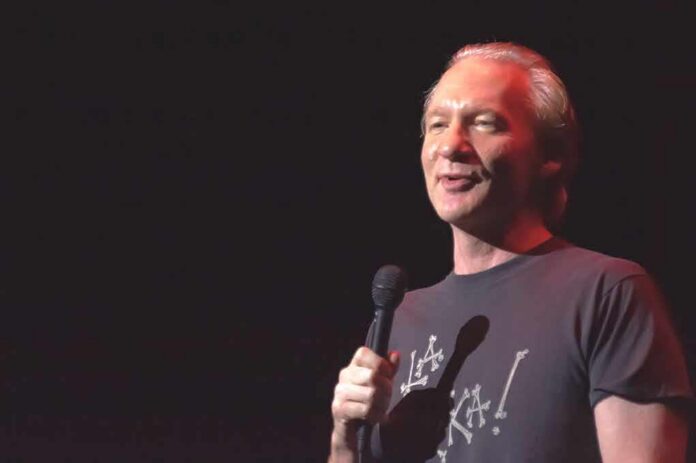
In their extended interview, Morgan ticked through examples—NATO allies “not pulling their weight” and “shutting the southern border”—and Maher answered plainly: “Yes.” He then volunteered a third: colleges had become “out of control,” overly focused on indoctrination rather than teaching. The sequence matters. This was not a slip or a single hedged nod; it was a short list of defined points, capped by Maher’s own addition, and followed elsewhere by his description of Trump’s political rebound as the “greatest comeback in American presidential history.”
That combination—specific issue concessions plus an acknowledgment of political prowess—travels far beyond the studio. In a polarized environment, such moments are amplified because they are rare and because they cross identity lines. The risk is over-reading them. What happened here is straightforward: a critic of Trump said the quiet part out loud about a few issues where he thinks Trump had a point, without recanting his other criticisms or declaring a realignment.
NATO Burden-Sharing: The Claim Behind the Quip
Trump’s persistent critique of NATO centered on allied defense under-spending relative to agreed benchmarks. The formal yardstick for years was the 2014 Wales pledge—2% of GDP on defense; in 2025, Allies went further, adopting a 5% “defence investment” commitment that bundles readiness, modernization, and industrial capacity into a more demanding standard. The thrust of Trump’s argument—that Europe, in particular, needed to accelerate outlays—landed inside an alliance now documenting rapid, double-digit annual increases and a majority of members finally clearing the older 2% bar. That shift, chronicled in NATO’s own spending reports and public pledges, gives Maher’s “yes” a factual backbone even as it compresses nuance about timing, causation, and the diplomatic cost of Trump’s blunt pressure.
It is analytically sloppy to attribute every euro of new spending to a single politician; Russia’s war on Ukraine is a massive confounder. But the narrower proposition—were many allies under-spending for years relative to stated goals, and was pressure to spend more substantively warranted—has become difficult to deny as Europe races to rebuild magazines, harden infrastructure, and scale defense industry. Maher’s agreement lived at that level of generality: the critique, long derided as bombastic, aligned with where the alliance itself has moved.
The Southern Border: Agreement Without a Policy Blueprint
Maher’s assent to Morgan’s line that Trump “was right about shutting the southern border” gestured toward outcomes rather than detailed policy. “Shutting” is political shorthand, not a statute; it blurs physical barriers, asylum rules, expedited removals, parole criteria, and cooperative arrangements with Mexico. Still, the practical concern is plain: a system that fails to credibly control inflows—lawful and unlawful—erodes public consent for immigration broadly, strains local budgets, and invites ever more improvisation by executive branch actors.
Maher’s yes was not an endorsement of any single policy instrument; it was an acknowledgment that the impulse to regain operational control was directionally sound. Serious people can argue the optimal tool mix—tightening credible fear standards, expanding adjudicatory capacity, metering ports of entry, or adjusting parole practices—but the criterion a broad public intuitively applies remains: can the government manage the border in a predictable, humane, and lawful way? On that yardstick, praising the objective while reserving judgment on the instruments is a rational, bounded concession, which is what Maher offered.
Colleges, Ideology, and the Line Between Teaching and Indoctrination
Maher’s third point was volunteered, not prompted: colleges, he said, had grown “out of control” and “way too indoctrinating.” That claim is evaluative, not numerically testable in a single statistic, but it taps into well-documented cultural shifts—ideological homogeneity within many humanities and social-science faculties, mandatory DEI training that blurs civic norms with contested dogma, and episodic suppression of dissenting speakers or research. One does not need to criminalize disagreement to see how campus incentives—hiring pipelines, peer review circles, administrative mission statements—can nudge institutions from teaching how to think toward prescribing what to think.
Maher did not list universities or cite surveys on viewpoint diversity. He did not need to for the concession to make sense. His claim is that the center of gravity on campus life tilted too far into ideology; Trump, often crudely, called the same problem out. Agreement on the existence of tilt does not settle reform—curricular pluralism, institutional neutrality charters, or changes to admissions or governance—but it concedes that the concern itself is legitimate, not manufactured.
During His Interview With Piers Morgan, Bill Maher Admits Trump Was Right About a Lot of Things https://t.co/Q22seCW8wH via @townhallcom #GreenwichCT
— GWVAT (@gwvact) November 25, 2026
Selective Agreement Is Not a Conversion
Because cable, social, and algorithmic feeds monetize friction, cross-party concessions are quickly reframed as “admissions” of wholesale correctness. That is not what happened. Maher’s remarks were an archetypal cross-party concession event: a prominent commentator acknowledged a few discrete points associated with a political opponent, and the media ecosystem translated that limited agreement into a broader identity signal. Political communication research shows why this resonates—cross-cutting cues can make a pundit sound more moderate to the other side while risking credibility among their own audience—so both amplification and backlash are baked in.
Maher’s broader posture toward Trump has long been mixed: personal anecdotes, sharp criticisms of staffing and execution, balanced by a willingness to credit discrete claims or political effectiveness. Calling Trump’s return the greatest comeback reinforces that he is describing a political fact pattern—a defeated president returning to office—rather than reversing long-held judgments about character or governance. That distinction preserves clarity: agreement on a few issues is not a general endorsement.
How To Read This Moment Going Forward
First, separate the rhetoric from the referents. On NATO, the referent is tangible spending against publicly stated goals; the alliance’s own reports and pledges supply the yard lines. On the border, the referent is operational control and the legal architecture that sustains it. On higher education, the referent is institutional culture and incentives that can either invite pluralism or police it. If you keep your eye on those referents, the political heat recedes and the claims become legible.
Second, recognize the analytic value of bounded agreement. Politics rewards tribal absolutes; governing rewards marginal improvements on concrete problems. Maher’s concessions occupy that governing register. They neither sanctify every Trump-era policy nor deny the trade-offs within each domain. They simply say: on this, that, and the other, the critique holds.
Sources:
townhall.com, podcasts.whipscribe.com, audioscrape.com, news.ssbcrack.com, news.today