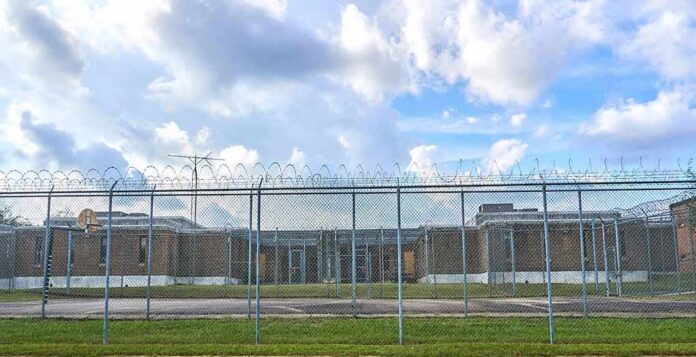
At modern U.S. air bases, the line between routine access control and crisis can narrow to a few seconds; when a civilian breaches a gate and turns violent, the installation’s layered defenses are no longer theoretical—they are the difference between a contained incident and a cascading security failure.
At a Glance
- MacDill Air Force Base security detained a civilian who breached the perimeter near 1 p.m.; during the encounter, the individual “violently engaged” security personnel.
- Both the civilian and one security officer sustained non-life-threatening injuries and were transported for medical care.
- The Dale Mabry Gate was closed to inbound and outbound traffic as the installation executed standard force-protection procedures.
- The account originates from base officials and contemporaneous local and national reporting; timing and core details are consistent across outlets.
What Happened: A Contained Breach at a Critical Gate
MacDill Air Force Base security forces detained a civilian after a perimeter breach at approximately 1 p.m., with base public affairs describing the subject as having “violently engaged” security personnel during the stop. The confrontation left both the individual and one officer with non-life-threatening injuries; both were transported for treatment. In the immediate aftermath, the base closed the Dale Mabry Gate—one of the primary access control points—to all traffic while responders stabilized the scene and command implemented standard protective measures. These core facts appear consistently across multiple outlets citing the 6th Air Refueling Wing Public Affairs Office and contemporaneous reporting, which aligned on timing, injuries, and the gate closure.
The detail that matters operationally is not only the gate closure but the choreography behind it. Closing a primary gate following a breach is a textbook step in integrated base defense: it halts further ingress, collapses security focus to known sectors, and prevents opportunists from exploiting diverted attention. For a base like MacDill—home to significant operational tenants—this is not theater; it is a calibrated response designed to compartmentalize risk quickly and keep the installation on its front foot while facts are gathered.
How Gate Security Works: Layers, Decision Points, and Use of Force
Air Force installations defend themselves through layered access control and response, from standoff barriers and serpentine lanes to credentialing checks, denial barriers, and armed security forces. The goal is to detect, assess, delay, and, if necessary, defeat a threat before it reaches mission-essential areas. The doctrine has evolved over decades—accelerated by lessons from prior gate runs and perimeter penetrations—to emphasize early detection and rapid consequence management when an incident crosses the threshold from suspicious to hostile.
At the tactical level, an attempted breach triggers a chain: guard posts alert the Base Defense Operations Center, cameras and sensors are cued to track the contact, and pre-briefed response elements move to interdict. Force options escalate according to training and policy—verbal commands, non-lethal control, and, if warranted to protect life or prevent catastrophic mission loss, lethal force. Injuries to both a suspect and an officer in such engagements are not unusual: controlling a combative subject while preventing vehicle movement or weapon access is physically risky work, and the imperative is to end the encounter swiftly before it migrates deeper into the base.
Why MacDill’s Response Fits the Pattern—and Why That’s Reassuring
The public narrative around installation incidents almost always starts the same way: a short base statement foregrounding the breach, the detention, and the immediate protective actions taken. Media coverage then relays those essentials while the gate stays closed and responders complete scene control. That is not a PR dodge; it is a reflection of how integrated base defense doctrine views time and information during an unfolding event. You stabilize access, you treat injuries, you clear the lane of unknowns, and you buy decision space for commanders before re-opening to normal traffic.
Measured against that yardstick, MacDill’s handling looks disciplined. The timing was clear, the status of the injured parties was communicated, and the gate was shut as a control measure. Stars and Stripes, local Tampa outlets, and regional affiliates reported the same essentials—an indication that the core message came from those directly charged with installation protection and that it was coherent across channels.
MacDill’s Recent Security Context
Security incidents at large installations rarely happen in isolation. MacDill has seen a spectrum of threat activity over recent years—from gate-line confrontations to a 2024 improvised explosive device case that prompted renewed scrutiny of threat reporting, surveillance coverage, and incident response tempos. When a base has confronted both nuisance breaches and more consequential threats, the organizational muscle memory tends to harden around immediate, unambiguous containment at the perimeter—a bias toward swift denial and deliberate, incremental re-opening rather than permissive risk tolerance.
This is why closing Dale Mabry Gate matters beyond traffic inconvenience. A high-throughput gate is where design and discipline are most likely to be tested: more vehicles, more credentials to verify, more potential for a determined actor to exploit distraction or tempo. Shuttering that node after a violent engagement is not a sign of panic; it is the doctrine-appropriate move that preserves optionality while medical and investigative actions proceed.
Lessons from Prior Breaches Across the Force
The Air Force’s approach to base security has been reshaped by past breaches that exposed gaps—both physical and procedural. The 2017 Mildenhall gate run in the United Kingdom, for instance, catalyzed upgrades in barriers, tactics, and training designed to turn the gate from a point of convenience into a point of dominance for defenders. Those changes echoed across major U.S. installations, elevating the priority on standoff distance, vehicle denial systems, and scenario-based drills that compress the time from detection to decisive action.
Layer that history onto MacDill’s current posture and the through-line is clear: the system is engineered to make the perimeter a problem the intruder cannot solve—whether the driver is intoxicated, disgruntled, confused, or malicious. When the system works, as it did here, the outcome is detention at the edge, injuries contained to the initial contact, and operations preserved inside the fence line.
(National) A civilian reportedly breached the perimeter of MacDill Air Force Base in Tampa and violently engaged security personnel, closing the Dale Mabry Gate. https://t.co/OvQm7SdOc5
— RED BARN NEWS 🇺🇸 (@JasperRoads) September 27, 2026
What This Means for the Public—and for People Who Drive Up to a Gate
For the public, two takeaways are practical. First, base gates are not ordinary checkpoints; they are federally protected access control points where failure to comply can quickly escalate to physical control measures. Second, when an incident occurs, closures and traffic holds are not punitive—they are the security system’s pressure relief valve. The quickest path back to normal is cooperation at the perimeter, patience with closures, and adherence to posted instructions from uniformed security personnel.
Sources:
noticias.foxnews.com, patch.com, stripes.com, wtsp.com