

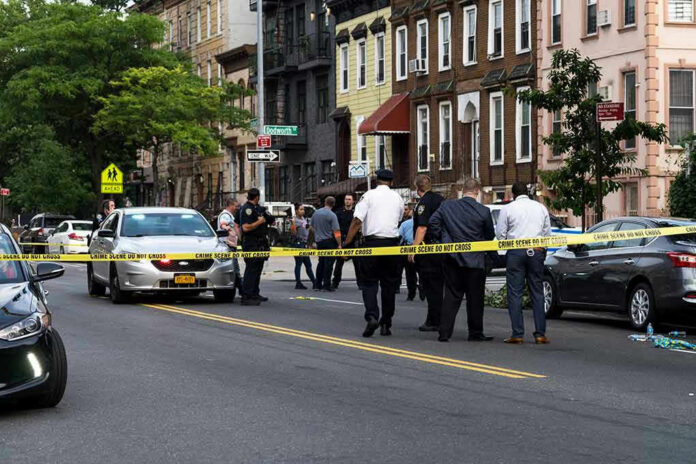
Arrests close an investigative loop; they do not end the case. In Queens, police moved from a brutal discovery to a named defendant in three days—an illustration of how homicide cases are built on probable cause first, then tested by forensic work and courtroom scrutiny.
At a Glance
- NYPD arrested and charged 54-year-old Zhordrack Blodywon with murder, robbery, and weapon possession tied to a fatal stabbing inside a Flushing massage business.
- The arrest followed a November 6 discovery of a woman with multiple stab wounds at 36-17 164th Street; she was pronounced dead at the scene.
- Officers reported seizing a knife at arrest and cited surveillance placing a man matching the suspect at the location shortly before the killing.
- Probable cause—not proof beyond a reasonable doubt—governs arrests; the evidentiary questions that decide guilt come later.
What Police Say Happened: Timeline and Core Facts
According to multiple contemporaneous reports summarizing NYPD statements, officers responded around 4:30 p.m. on November 6 to a storefront at 36-17 164th Street in Flushing. Inside, they found an adult woman unresponsive with multiple stab wounds; she was pronounced dead at the scene. Three days later, an NYPD warrants squad arrested 54-year-old Zhordrack Blodywon and charged him with murder, robbery, and criminal possession of a weapon. Reporting consistent across outlets places the arrest on November 9 and attributes the charges to NYPD statements conveyed to the press.
Police-linked accounts further indicate that officers seized a knife from Blodywon at the time of his arrest, a piece of potential physical evidence that—if forensically connected—could be probative at trial. One report, citing law-enforcement sources, also describes surveillance video showing a person in black clothing entering the business shortly before the killing; another adds an exit detail of the individual kicking the door on the way out. In a separate account, the apprehension location was identified as East Elmhurst, roughly four miles from the scene.
How an Arrest Standard Works: Probable Cause versus Proof
The law draws a bright line between the threshold for arrest and the burden at trial. Probable cause is a practical, common-sense standard: information sufficient to support a reasonable belief that a crime occurred and that the person arrested committed it. New York courts have consistently held that proof beyond a reasonable doubt is not required to arrest; the standard rests on probabilities, not certainties. That is why a combination of reported facts—surveillance placement, time proximity, a suspect match, seizure of a knife, and an investigative timeline—can justify charges even before laboratories finish their work or a grand jury returns an indictment.
This framework matters for readers who rightly ask what has and has not been established. Early in a case, police describe the who, what, when, and where; the why and how—motive, weapon linkage, biological trace evidence, and wound-to-weapon concordance—typically emerge through discovery, lab reports, and the medical examiner’s findings over weeks or months. If the case proceeds to indictment, a presumption of probable cause attaches; the defense can contest that presumption by showing misconduct or material omissions, but the standard for conviction remains proof beyond a reasonable doubt.
The Evidence Described So Far—and What It Can and Cannot Do
From the public record of this arrest, three categories of evidence stand out. First, place-and-time evidence: surveillance reportedly shows a person matching Blodywon entering the premises around 4:16 p.m., minutes before the 4:30 p.m. police response. Such footage, when authenticated, can be powerful corroboration of presence; on its own, it does not establish intent or the act itself. Second, possession evidence: the seizure of a knife at arrest. Without forensic testing—DNA, blood serology, latent prints, and blade-to-wound comparison—its probative value is potential, not dispositive. Third, investigative continuity: the suspect was located several miles from the scene within days, which is consistent with a focused manhunt but not, by itself, a linkage to the homicide.
These are exactly the kinds of facts that meet an arrest threshold: they tell investigators they likely have the right person and the right case. They are not the same as trial-quality proof. The next evidentiary mile typically includes lab results on the seized knife, any recovered clothing, the full video sequence from interior and exterior cameras with timestamps, autopsy findings on wound characteristics, and—given the robbery charge—documentation of missing property and its connection to the accused. Those steps are standard in New York prosecutions and move a file from probable to persuasive.
The Scene and the Establishment: Consistent Core, Mixed Peripheral Details
Reports agree on the address, the afternoon timing, and the discovery of a woman with multiple stab wounds. They diverge at the margins on descriptors—massage parlor, spa, skincare business—and on whether a friend or officers first found the victim. Such variations are common in the first week of coverage and do not alter the central picture: a homicide inside a commercial space with indications of massage services on the frontage. Separately, NBC New York pointed to an open Department of Buildings complaint alleging adult-business activity in violation of zoning laws—a regulatory thread relevant to neighborhood context and licensing, not to the elements of murder or robbery.
It is also common for the victim’s identity to remain undisclosed early in a case, especially pending next-of-kin notifications or medical examiner confirmation. That anonymity, while frustrating to the public, protects family privacy and preserves investigative integrity. As with many workplace or customer-interaction homicides, the relationship between victim and accused—if any—will be traced through business records, digital communication, and witness statements obtained during discovery.
Why Early Narratives Can Drift—and How to Read Them
Homicide arrests attract coverage that often weaves in biographical details about the accused and the venue. Those details—homelessness, prior arrests, or a business’s reputation—can shape perception but are not proof of the charged conduct. Courts, juries, and experienced readers keep the lanes clear: what matters for adjudication are identification, linkage of the act to the fatal injuries, intent where required, and any corroborating physical or digital evidence. That discipline is not just legal hygiene; it is a guardrail against the well-documented risks of wrongful inference in violent-crime cases.
What Comes Next: From Case File to Courtroom
In a case like this, the prosecutorial roadmap is familiar. Investigators firm up the timeline using 911 logs, surveillance timestamps, and phone location records; lab analysts test the seized knife and any clothing for DNA and blood; the medical examiner correlates wound tracks with a candidate blade. Detectives close the loop on the robbery count by documenting missing items and any recovery. Prosecutors memorialize the probable-cause narrative in a complaint and, if pursued, present the case to a grand jury. Defense counsel vets the same material for gaps, challenges any suggestive identification procedures, and litigates suppression if warranted. Through that crucible, the case either tightens into a trial-ready file or resolves earlier via plea.
For now, the public record supports a clear, factual summary: a woman was found fatally stabbed inside a Flushing massage business; within three days, NYPD arrested and charged a 54-year-old man, reporting surveillance placement and the recovery of a knife. That is what probable cause looks like. What justice requires—proof—will be built, tested, and decided in the months ahead.
Sources:
nypost.com, nydailynews.com, nbcnewyork.com, amny.com, people.com, audacy.com, gothamist.com, pix11.com