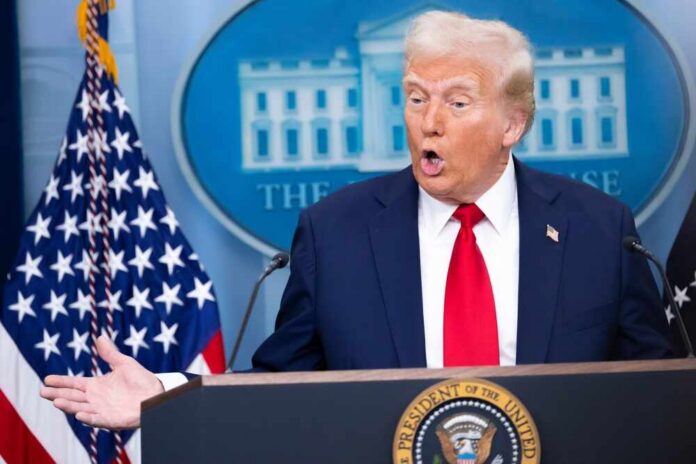
President Trump survived a third assassination attempt in less than two years when gunfire erupted at the White House Correspondents’ Dinner, exposing catastrophic security failures that should alarm every American regardless of political affiliation.
Story Snapshot
- Gunman breached security checkpoints at elite Washington Hilton event on April 25, 2026, firing multiple shots before Secret Service intervention
- Trump evacuated unharmed alongside First Lady Melania, VP Vance, and Secretary Rubio during what should have been the most secure venue imaginable
- Third attempt in 21 months follows Butler rally shooting that killed attendee Corey Comperatore and Florida golf club incident
- President remarked he’s “honored” by attacks, claiming “they go after the most impactful people” in controversial video statement
- House Task Force investigation reveals pattern of Secret Service communication failures and security lapses at prior incidents
Elite Event Turned Crime Scene
Cole Tomas Allen, a 31-year-old from Torrance, California, charged through security checkpoints at the Washington Hilton Hotel around 8 PM EST on April 25, 2026. The suspect fired between five and eight gunshots during a break in the White House Correspondents’ Association dinner while President Trump conversed with First Lady Melania Trump and an aide. Secret Service agents confronted Allen immediately, neutralizing the threat as protective details rushed the President, Vice President JD Vance, and Secretary of State Marco Rubio to safety. The breach occurred at an event attended by administration officials, journalists, and celebrities under supposedly maximum security protocols.
Pattern of Threats Raises Fundamental Questions
This marks the third serious attempt on Trump’s life since July 2024, when 20-year-old Thomas Matthew Crooks fired eight AR-15-style rounds from a rooftop 130 yards from a Butler, Pennsylvania rally stage. That attack grazed Trump’s right ear, killed 50-year-old attendee Corey Comperatore, and injured two others before Secret Service snipers eliminated Crooks. Two months later, 58-year-old Ryan Wesley Routh established a sniper position at Trump International Golf Club in Florida before an agent spotted him, prompting his flight and subsequent capture. The escalating frequency and brazenness of these attacks demand answers about how determined individuals repeatedly penetrate layers of protection surrounding the President of the United States.
Security Failures Expose Institutional Rot
House Task Force investigations into prior attempts revealed alarming communication breakdowns and oversight failures within the Secret Service. The Butler incident exposed how Crooks accessed an unsecured rooftop with clear sightlines to the President despite enhanced security protocols implemented after previous threats. Americans across the political spectrum should question whether the agencies entrusted with protecting elected officials have become complacent, bureaucratically ossified, or simply incapable of adapting to determined adversaries. Trump released CCTV footage showing Allen’s breach, providing visual evidence of security perimeter failures at what should have been an impenetrable venue hosting the nation’s political and media elite.
Political Violence Deepens National Divisions
Trump’s response framing the attempts as validation of his impact reflects how political violence has become weaponized in national discourse. Post-election polling indicated 16 percent of 2024 voters cited the assassination attempts as influencing their choice, demonstrating how these incidents galvanize supporters while fueling conspiracy theories across the spectrum. Conservative outlets emphasize potential ideological motivations behind the attacks, while investigations have yet to establish clear political manifestos from any suspect. The motives of Crooks, Routh, and Allen remain under investigation, leaving Americans to speculate whether these represent isolated acts or symptoms of broader societal breakdown driven by rhetoric from all political quarters.
Accountability Demands Transcend Partisanship
The fundamental issue transcends which party controls power: federal agencies charged with protecting the President have failed three times in 21 months. Whether voters support or oppose Trump’s policies, they should demand competent execution of basic governmental functions. The Secret Service exists precisely to prevent what happened in Butler, Florida, and Washington from occurring even once, yet the pattern suggests systemic problems requiring immediate reform. Congress must move beyond partisan finger-pointing to address whether leadership failures, inadequate resources, or institutional culture created vulnerabilities that allowed Cole Tomas Allen to fire weapons inside a venue hosting the President, First Lady, Vice President, and Secretary of State surrounded by hundreds of witnesses.
Investigations continue into how Allen obtained access and whether coordination existed between the three attempts. Families of victims like Corey Comperatore deserve answers, as do Americans concerned about political violence regardless of the target. The costs of enhanced security, investigative resources, and eroded public trust in institutions mount with each breach, raising questions about whether the agencies and officials responsible will face meaningful accountability or simply issue reassurances until the next failure occurs.
Sources:
Hungarian Conservative – Trump Third Assassination Attempt at White House Correspondents’ Dinner
Chosun Biz – Trump Assassination Attempt Coverage
The Times – Trump Shooting Latest News Assassination Attempt Dinner
AMAC – Third Trump Assassination Attempt: Left Must Acknowledge Its Violence Problem
Wikipedia – Attempted Assassination of Donald Trump in Pennsylvania
House Task Force Investigation
Wikipedia – Security Incidents Involving Donald Trump