When a pontiff celebrates Mass at the very center of a militantly secular republic, the event is never just devotional; it is a masterclass in public ritual, crowd logistics, and the delicate choreography between church, state, and city that turns belief into shared civic spectacle.
At a Glance
- Pope Leo XIV celebrated an open-air Mass at Paris’s Place de la Concorde, extending along the Champs-Élysées, a centerpiece of his apostolic journey to France.
- Authorities and organizers planned for hundreds of thousands of attendees, with registrations above 600,000 and day-of estimates ranging higher.
- France deployed a large, multi-agency security operation; gates, perimeters, and staged arrivals shaped a calm, processional rhythm.
- The site choice fused history and symbolism: a former stage of revolutionary justice recast, for a day, as a liturgical commons in the capital of laïcité.
What Happened: A Liturgical Mass Scaled to a Capital City
The Vatican’s public itinerary fixed the anchor: a 15:00 Holy Mass at Place de la Concorde in Paris, part of Pope Leo XIV’s multi-day visit that also included Lourdes and other engagements. That single line in the Holy See’s program set the cascade of planning that followed—zoned access, progressive closures, and a processional route configured to absorb a population the size of a major French city into a walkable, securitized worship space in the nation’s ceremonial heart. French-facing organizers published a granular schedule: access opened at 09:00, gates closed at 13:00, the popemobile descent and processional set to bring the celebrant into view before Mass began—a timetable engineered to meter arrivals, keep pressure off choke points, and give volunteers time to stage communion logistics across the avenue.
Crowd scale was not a surprise; it was the premise. Registrations for the Mass crossed the 600,000 mark in the days prior, a figure that justified the city-scale footprint spanning the Concorde basin and the length of the Champs-Élysées. Media and institutional estimates varied—as they do at any marquee public rite—but clustered in the same order of magnitude: many hundreds of thousands, with some outlets and Vatican-linked tallies pointing to 700,000 and beyond. As a planning metric, the registered count mattered more than the eventual headline number: it gave police, transit, and medics a rational baseline for personnel and egress modeling.
How It Was Made to Work: Security, Logistics, and Ritual Engineering
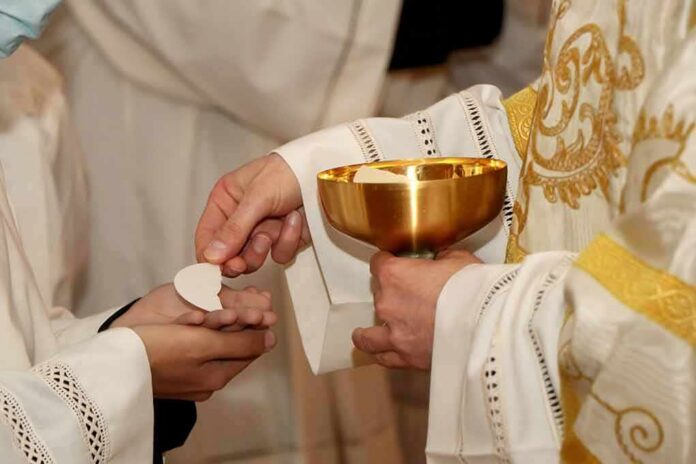
Major papal gatherings are simultaneously liturgical assemblies and mass-mobilization exercises. Paris treated this one accordingly. The perimeter expanded beyond the plaza to envelop the axial spine of the Champs-Élysées; controlled entries and timed closures helped maintain a one-way flow, reducing cross-currents that produce surges. Communion distribution—often the most demanding operational element after ingress—was delegated to large teams of trained volunteers subdivided by sectors, each paired to clergy with clearly marked positions and fallback routes. This is not improvisation; it is the accumulated craft of World Youth Day-scale events transposed onto a dense, high-security European capital.
French authorities, accustomed to presidential transitions, parades, and protest management, scaled up familiar toolkits: layered screening, mobile first-aid stations, staged reserves, and intelligence-driven posture. Reporting during the lead-up referenced security deployments in the mid-five-figure range across the trip, with thousands concentrated in Paris on the Mass day—a footprint consistent with high-profile gatherings in the current European threat environment. The result visible to participants is deceptively simple: a tranquil crowd, audible prayer, and a clean line of sight—achieved by absorbing complexity in the back-end plan.
Why Here: The Symbolic Weight of Place de la Concorde
No Paris site compresses more republican symbolism into a single frame than Place de la Concorde. Once a stage for revolutionary executions, today it anchors the city’s grandest axis—an idealized vista from the Tuileries to the Arc de Triomphe. Installing a papal altar there does not erase that history; it reframes it for an afternoon, transforming a square of state ceremony into a liturgical commons. For a country that codified church-state separation in 1905, that is a visible stress test of laïcité’s practice: not prohibition of religion in public, but neutrality of the state among beliefs alongside robust public order. The Associated Press captured that balance well, describing the visit as a case study in how France holds together strict secularism with the practical excitement—and security requirements—of very large religious gatherings.
There is precedent for scale, if not for that exact setting. The last comparable central-Paris papal Mass before Leo XIV was Benedict XVI’s 2008 liturgy on the Esplanade des Invalides, which gathered hundreds of thousands. The choice of Concorde ups the symbolic ante—closer to the political core, more legible to the non-churchgoing public, harder to dismiss as an inward-facing Catholic event. It is the church choosing to be visibly present at the republic’s front door, and the republic choosing to make room.
The Message: Spiritual Thirst in a Secular Age
Homiletically, Leo XIV has leaned on an image that travels well: spiritual thirst in a desert of indifference. The Paris Mass threaded that theme through readings and exhortation, inviting the faithful to become “wells” for others—a metaphor that resonates in a city where the church’s institutional footprint has shrunk but sacramental life still gathers vast, if episodic, publics. Coverage summarized a through-line familiar from his prior travels: critiques of reductive materialism, a summons to practical charity, and a call to younger Catholics and new converts to carry a hopeful, public-facing faith. In a French context, that registers less as culture war than as pastoral realism, aware of the gap between nominal heritage and daily practice, yet unembarrassed by the claim that the Gospel belongs in the agora.
The Mass also functioned as a hinge in the broader trip. Before and after Paris came meetings with civil authorities, encounters with migrants, and pilgrim liturgies in Lourdes—program elements that locate the event within a diplomatic-pastoral hybrid itinerary. The Vatican’s formal bulletin is sparse by design, but cross-referencing media briefings and the national organizing site fills in the mechanism: this was the capital’s signature moment in a four-day arc designed to touch France’s political, cultural, and spiritual nerve centers.
Hundreds of thousands of worshippers flood the heart of Paris as Pope Leo XIV celebrates a massive open-air Mass and calls on Catholics to openly share their faith in an "increasingly secularized society."
The Vatican estimates 800,000 people packed the Champs-Élysées and Place…
— THE17thLETTER (@The17thllettter) September 27, 2026
Attendance, Estimates, and the Politics of Big Numbers
How many came? For practitioners, the better question is why the number matters. Attendance estimates serve different masters. The church wants to testify to reach; the state wants to justify resource allocation and reassure the public; newsrooms want scale that reads at a glance. Registrations above 600,000 set the scale early; day-of visuals and Vatican-linked tallies pushed higher. Le Monde and wire services framed the planning bands straightforwardly—hundreds of thousands, with 600,000 a credible base case.
Experienced readers treat ranges as ranges. Counting humans in open grids is inexact; barriers, sightlines, and churn turn any point estimate into a composite. The point here is not whether 620,000 or 780,000 filled the axis; it is that Paris accommodated a congregation on the order of three-quarters of a million in the republican heart of the city, without incident severe enough to eclipse the rite itself. For a secular state, that is not a contradiction. It is laïcité functioning as designed: a neutral public power guaranteeing the freedom to assemble—even, and perhaps especially, when the assembly is avowedly religious.
What Endures After the Crowds Go Home
The lasting significance is twofold. First, France demonstrated institutional confidence: police, prefecture, and Church volunteers cooperated to mount a mega-event whose atmosphere, by all accounts, remained reflective rather than restive. That matters for future gatherings—religious, civic, or commemorative—because it normalizes a standard for safety without suffocating spontaneity. Second, the church modeled a public presence suited to secular space: not a siege narrative, but a sacramental act done well, audible beyond its baptized core. Whether one counts Mass-goers or measures decibels, the deeper metric is intelligibility—could the city understand what was happening and why it mattered to those present? On that score, the answer in Paris was yes.
Sources:
youtube.com, foxnews.com, lemonde.fr, france24.com, pape-france.fr, osvnews.com, sortiraparis.com, apnews.com, catholicworldreport.com