
A single offhand joke at a White House state dinner recently illustrated how quickly modern politics can be reshaped into viral “gotcha” content, even when the countries involved are long-standing allies.
Story Snapshot
- King Charles III used his White House toast to trade friendly historical jabs with President Donald Trump, including a line that Americans “might be speaking French” without Britain.
- The toast responded to attention around Trump’s earlier World Economic Forum-style remark that Europe would “be speaking German” without U.S. WWII intervention.
- Viral clips and headlines framed the exchange as a “roast,” but the underlying event was a formal diplomatic ritual designed to signal alliance and stability.
- Trump later highlighted the optics of unity, saying King Charles “got the Democrats to stand,” underscoring how symbolism now competes with policy for airtime.
What Happened at the White House State Dinner
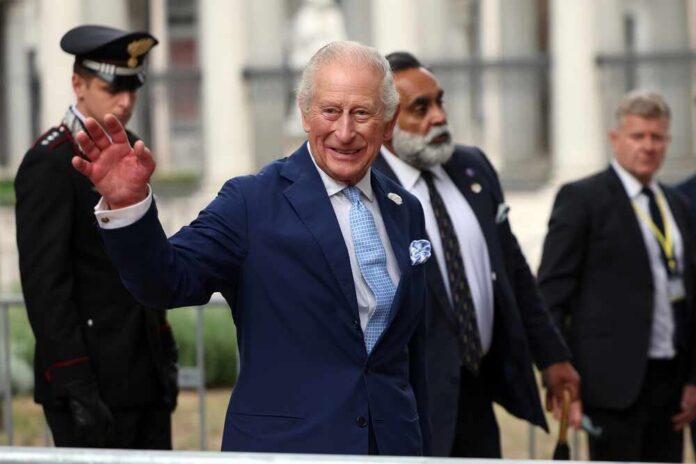
President Donald Trump hosted a white-tie state dinner for King Charles III and Queen Camilla during the King’s first U.S. state visit as monarch, timed to the broader buildup toward America’s 250th anniversary. Trump delivered the first toast, praising British heritage and the long arc of American independence and freedom. King Charles replied with a warm, protocol-friendly toast that also included pointed humor aimed at Trump’s history-laced rhetoric.
King Charles’ most repeated punchline played off old-world rivalry and colonial history: he quipped that, “if it wasn’t for us, you’d be speaking French.” The joke landed precisely because it sounded like a correction of American self-congratulation while remaining safely inside a shared, friendly narrative between allies. Coverage also highlighted a separate line thanking the hosts and praising an “improvement on Boston,” a jab that many viewers interpreted as a wink at Revolutionary-era tensions.
The Viral “Roast” Framing Versus the Actual Exchange
Online, the exchange was quickly repackaged as a comedic takedown. Headlines and short clips presented the toast as a sequence of sharp “moments,” despite the reality being a single, continuous exchange. This distinction matters. The “roast” framing can make routine diplomacy appear adversarial or humiliating, even when both participants are clearly engaging in mutual, good-natured humor. Video clips—looped, trimmed, and amplified—highlighted the punchlines while minimizing the broader tone of respect and cooperation. What remains consistent across recordings is the substance: the jokes were mild, the audience reaction measured, and there is no evidence of tension or policy fallout tied to the remarks.
Why This Matters Politically in 2026
In Trump’s second term, with unified Republican control of Congress, political communication has taken on heightened importance. Democrats have leaned more heavily on messaging and procedural tactics, while the administration has pursued an assertive agenda across trade, security, and foreign policy. In that environment, symbolic moments, like a state dinner, carry disproportionate weight. A brief exchange can be spun as either strength or embarrassment depending on the audience.
The same clip can reinforce entirely different narratives about leadership, respect, and national identity. Trump’s comment that King Charles “got the Democrats to stand” underscores how the White House interpreted the evening: not just as diplomacy, but as a visual demonstration of unity and stature. For supporters, that image signals legitimacy and global respect. For critics, it may look like political theater overshadowing substantive policy debates.
A Deeper Take: Trust, Institutions, and the “Deep State” Mood
The broader story goes beyond whether anyone “won” the exchange. It reflects how ceremonial diplomacy now doubles as digital content, optimized for rapid consumption and reaction. In an era where trust in institutions is already strained, viral political clips can reinforce skepticism. Short, punchy moments often crowd out deeper discussions about governance; budgets, energy policy, border security, and economic conditions. The incentive structure favors applause lines over complexity. At the same time, the exchange highlights something more reassuring: the resilience of the U.S.–U.K. alliance. The ability for leaders to joke about history without consequence signals a relationship stable enough to absorb it.
5 Moments When King Charles Turned His White House Toast Into a Playful Trump Roast https://t.co/KJ34PtSTlY
— Mediaite (@Mediaite) April 29, 2026
The state dinner exchange between King Charles III and Donald Trump was less a “roast” and more a reflection of modern political media dynamics. What was intended as a routine, even cordial, diplomatic ritual became a viral moment shaped by editing, framing, and audience interpretation. The takeaway is straightforward: in today’s media environment, the story isn’t just what happens—it’s how fast, and how selectively, it gets turned into content.
Sources:
Trump: King Charles Got The Democrats To Stand, I Couldn’t Believe It
You’d be speaking French without us: King Charles roasts Trump with history jab