A confession alone rarely closes a homicide case; it is the fit between what a suspect says and what investigators can independently verify — a body in the place he described, a wound pattern that matches his account — that transforms an admission into evidence a prosecutor can charge. That is precisely the mechanism now playing out in San Jose, where a man’s walk-up confession to a patrol officer has already yielded two bodies, two murder counts, and a district attorney’s office openly weighing whether it has stumbled onto something larger.
Key Points
- Marcelino Castro flagged down a San Jose police officer around 5:14 p.m. and said he had killed someone, setting off a rapid two-scene recovery of bodies
- Prosecutors filed two murder counts after bodies were found near Lelong and Alma avenues and near Autumn Parkway and Coleman Avenue, both close to the Guadalupe River
- A probable cause affidavit describes Castro luring a victim “to smoke,” then strangling him and striking him with a rock before wrapping the body in a red tent
- Santa Clara County Deputy District Attorney Michael Gadeberg called it the possible “start of a serial killer case” and said the office is bracing for additional victims
- Both victims remain unidentified in public reporting, and the case’s broader scope depends on forensic and investigative work still underway
How the Case Unfolded: From a Flagged-Down Officer to Two Recovery Scenes
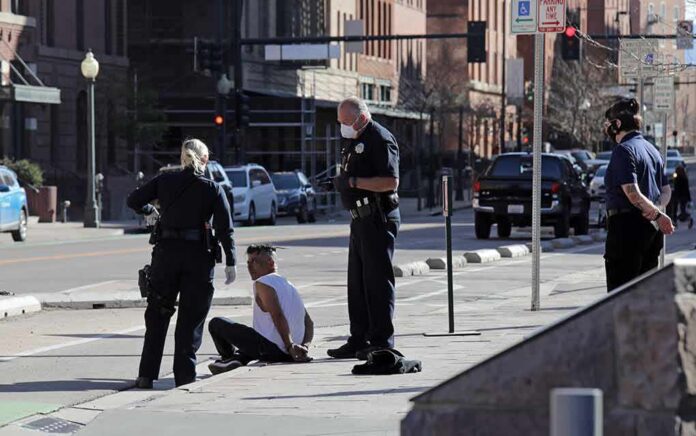
The case began not with a tip or a missing-persons report but with Castro himself. San Jose police say he approached an officer on patrol at roughly 5:14 p.m. and volunteered that he had killed someone. That single act set the entire investigation in motion. Officers followed his account to a location near Lelong and West Alma avenues, close to the Guadalupe River and Highway 87, where they found the body of a deceased man. Castro was taken into custody, and further questioning led detectives to a second, distinct scene near Autumn Parkway and Coleman Avenue, where they recovered a second body.
What makes the sequence notable to investigators is not merely that Castro talked, but that his statements kept leading to physical confirmation. According to the Mercury News, a police probable cause affidavit filed with the murder complaint quotes Castro describing how he lured one victim “to smoke,” then strangled him and struck him with a rock before wrapping the body in a red tent. Detectives told reporters that the location and condition of the second body corroborated details he had already given them. That corroboration — a nonpublic detail confirmed by physical evidence — is the feature that separates a credible confession from a merely alarming one.
Why Corroboration, Not the Confession Itself, Carries the Legal Weight
Homicide investigators and forensic psychologists have spent decades studying why confessions, despite their emotional power in the public imagination, are treated cautiously inside the justice system. The Stanford Law Review’s landmark analysis of confession reliability, drawing on the work of interrogation researchers Richard Ofshe and Richard Leo, put it plainly: reliability is usually determined “by evaluating the fit between a post-admission narrative and the crime facts”. A confession is legally meaningful when it produces details investigators could not have already known — an unrecovered body, an unreported method, a hidden location — and those details check out.
That standard is exactly what appears to be operating in San Jose. Castro’s statements did not merely describe a killing already known to police; they generated the discovery of two bodies at two separate locations investigators had not previously identified. Clinical literature on false admissions, published in the Journal of the American Academy of Psychiatry and the Law, defines a false confession as an admission paired with a “postadmission narrative” that fails to match crime facts. Here, prosecutors describe the opposite pattern — a narrative that led directly to physical confirmation — which is the evidentiary foundation the DA’s office is now building charges around.
The “Possible Serial Killer Case” Language, and Why the DA’s Office Is Being Careful
Santa Clara County prosecutors have filed two murder counts against Castro, but their public language has gone further. Deputy District Attorney Michael Gadeberg told reporters this looked like “the start of a possible serial killer case,” adding that he was glad Castro turned himself in. The DA’s office has separately said it believes there may be more victims beyond the two already recovered. That is a significant statement from a prosecutor’s office, which typically avoids speculative characterizations of an active case — and it signals that investigators see something in Castro’s timeline, movements, or statements that extends beyond the two confirmed killings.
At the same time, the two victims have not been publicly identified, which limits how far the case can be tied to any broader pattern of missing persons or unsolved deaths along the Guadalupe River corridor. An arrest and two filed counts represent allegations that Castro is presumed innocent of until proven otherwise in court. The serial-killer framing describes prosecutorial concern about scope, not a documented history of additional victims — the two-body case is confirmed; anything beyond it remains an open investigative question that identification, forensic testing, and timeline reconstruction will have to answer.
San Jose’s Long, Uneasy History With Violence Along Its Waterways and Public Spaces
San Jose’s relationship with high-profile violent crime is not new, and it offers useful context for how communities and investigators process cases like this one. The 1933 kidnapping and murder of department-store heir Brooke Hart ended not in a courtroom but in a lynching at St. James Park, a reminder of how quickly public fear can outrun due process. Decades later, the 1974 killing of Arless Perry at Stanford’s Memorial Church went unsolved for 44 years until DNA testing on mislabeled evidence identified a security guard as her killer. The 1977 strangulation of Janette Ralston sat cold for 48 years until a single fingerprint, run through modern FBI databases, produced a match. Each case underscores the same lesson now facing the Castro prosecution: physical corroboration, not early narrative, ultimately decides what a case becomes.
What Happens Next
The immediate legal path is straightforward: Castro faces two murder counts, and the strength of the case will turn on forensic pathology findings for both victims, formal identification, and whatever additional physical evidence — DNA, trace material, timeline reconstruction from phone and location data — investigators develop. The DA’s warning about additional victims means detectives are likely cross-referencing Castro’s known movements and associates against open missing-persons cases in the region. None of that changes what is already established: a man walked up to a police officer, confessed, and led investigators to two bodies that corroborated what he told them. Whether the case grows beyond those two counts is now a matter for the evidence still being gathered.
Sources:
nypost.com, sfgate.com, cbsnews.com, us.headtopics.com, yahoo.com, youtube.com, patch.com, ktvu.com, casetext.com