
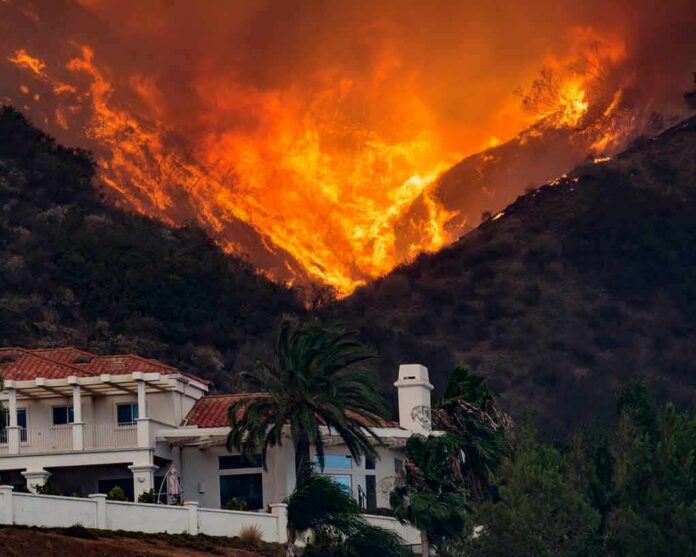
The security camera clip of a wildfire racing toward a home near Madrid is not an isolated spectacle, but a close-up window into one of the most severe wildfire emergencies the Madrid region has ever experienced.
Key Points
- Wildfires in the Madrid region and neighboring Toledo forced mass evacuations, destroyed homes, and prompted a national emergency declaration, with regional officials calling it the worst wildfire crisis in Madrid’s history.
- Broadcast and agency footage show fast-moving fires advancing into residential areas, with police and Civil Guard officers going door to door evacuating communities south and west of Madrid.
- The viral “security camera” clip fits a broader pattern: authentic fires documented through short, dramatic social videos whose original files, exact locations, and timestamps are seldom visible to the public.
- Drone, helicopter, and ground footage from emergency services reveal how heat, wind, and dry vegetation turned wildland fires into direct threats to homes, highways, and urban fringes across the Community of Madrid.
When wildfire reaches the garden wall: what the Madrid footage shows
Viewed in isolation on a social feed, the security camera footage of flames racing toward a home near Madrid looks like a freak incident: a strip of countryside, a house, and then, in a matter of minutes, a wall of fire. In reality, that sequence sits squarely inside a much larger emergency. Multiple outlets documented fast-moving wildfires in the Community of Madrid and nearby Toledo, pushing directly into residential zones and forcing evacuations by the tens of thousands.
Reporting and official imagery from Spain’s interior and emergency services show the same pattern as the home camera: low vegetation and scrub igniting first, driven by wind across dry ground, then transitioning into taller fuels—trees, hedges, structures—as the fire front reaches built-up areas. In the most dramatic cases, aerial footage released by the Spanish Civil Guard’s air service shows individual homes and small clusters of buildings engulfed in flames while thick smoke hangs over the outskirts of Madrid.
The broader wildfire emergency around Madrid
The security camera clip went viral because it compresses the entire wildfire crisis into a single, terrifying perspective: the homeowner’s. But the scale of what Spain was battling goes far beyond one property. News agencies, broadcasters, and emergency services describe several significant fires in and around the Madrid region, some in the province itself, others just over the boundary in Toledo and Ávila, all interacting with the capital’s wider metropolitan footprint.
In the southwest, Euronews documented Spanish police and Guardia Civil officers evacuating residents in Villa del Prado and nearby communities as a “fast-moving wildfire” threatened homes near Toledo. Footage shows officers knocking on doors, escorting older residents out, and checking properties to ensure no one was left behind, while flames and dense smoke creep around residential streets. To the north, separate fires near Tres Cantos and Lozoyuela burned scrub and grassland just tens of kilometers from the city, with aerial video showing flames advancing toward a new apartment complex and forcing evacuations and road closures.
By the time international outlets began to describe the episode as the worst wildfire crisis Madrid had ever seen, tens of thousands of people had been ordered either to evacuate or to shelter indoors with doors and windows shut to avoid smoke. Regional and national authorities deployed hundreds of firefighters, Spain’s Military Emergency Unit, and dozens of aircraft, while also coordinating assistance from other European countries.
From landscape fire to urban threat: how the flames moved so fast
To understand that racing wall of fire on a home camera, you need to understand how Mediterranean wildfires behave when weather, fuel, and topography line up against you. Much of the land ringing Madrid is a mix of pine forest, scrub, agricultural fields, and scattered housing developments—fuel-rich mosaics that can burn explosively under the right conditions. When those fuels are baked dry during heatwaves, fire moves quickly through fine vegetation (grass, low shrubs), preheating and igniting larger plants and structures downwind.
In the Madrid fires, emergency footage and agency descriptions point repeatedly to three linked drivers: prolonged heat, low humidity, and strong, shifting winds. Under those conditions, a small ignition in grass or scrub can evolve into a fast-moving front, with flame lengths increasing as the fire finds denser fuels. On slopes or rising ground, hot gases and embers preheat vegetation above the fire line, accelerating the spread. This is why, in the security camera clip and similar recordings from Navas del Rey and other localities, a seemingly distant glow can become a fully involved fire around the house in under ten minutes.
Aerial footage from Madrid’s emergency services shows this mechanism at work in real time. Drone and helicopter shots capture thin tongues of flame racing across open country, then thickening into a continuous front as the fire reaches tree lines, hedgerows, and garden vegetation near housing estates. Once embers start landing on roofs, decks, and outbuildings, the distinction between “wildfire” and “structure fire” collapses; the incident becomes an urban-interface fire, and individual homes can ignite even before the main flame front arrives.
Evacuations at the wildland–urban interface
For residents, the most consequential part of this story is not the flame physics but the evacuation experience. Time-lapse clips and security camera footage reveal how narrow the margin can be between routine and catastrophe. In several Madrid-area fires, residents were told to leave with little warning as conditions changed rapidly. The evacuation of Soto de Viñuelas and Fuente El Fresno, for instance, followed a lightning-triggered ignition near Tres Cantos that escalated within hours into a fast-moving threat to nearby urbanizations.
Video released by the Guardia Civil and carried by international outlets shows officers going door to door in threatened areas, urging people to evacuate and assisting those with limited mobility. In other localities, where roads were at risk or air quality had deteriorated sharply, authorities opted for “confine to home” orders instead, instructing residents to stay indoors and seal their homes against smoke. That mix of strategies—evacuation where fire spread and access allowed it, shelter-in-place where it did not—reflects how variable conditions can be even within a single fire perimeter.
The security camera angle makes one further point that official footage rarely captures: how residents who stay too long end up racing the fire themselves. When a blaze is advancing quickly and visibility is degraded by smoke, a delay of a few minutes—finishing garden work, packing extra belongings, hesitating over whether to leave—can mean evacuating through ash and embers rather than away from them. The Madrid episodes underscore why modern guidance emphasizes leaving early, not waiting until you can see flames from the driveway.
Security camera footage capture a wildfire racing toward a home near Madrid raging wildfires 🔥 have forced more than 300,000 people to flee pic.twitter.com/z0CycbiWhV
— Franko (@Franko52808) July 26, 2026
The viral video problem: real fires, partial provenance
Unlike some disputed disaster clips, the Madrid wildfire footage is not being used to manufacture a crisis that did not exist. The fires were real; the evacuations were large-scale; homes and infrastructure were genuinely threatened and, in some cases, destroyed. What remains less clear to outside observers is the exact provenance of any single viral clip: which property it depicts, which municipality it sits in, and the precise date and time.
In this case, Spanish outlets and social posts describe a security camera in a home in Navas del Rey, southwest of Madrid, capturing a fire front that reached the house in roughly eight minutes—imagery that closely matches the English-language social captions about a blaze “racing toward a home near Madrid.” Yet the version most people see online is a compressed, reuploaded video, stripped of metadata, location tags, and any clear connection to the original homeowner or device. The same clip, or near-identical versions, cycle through multiple accounts with identical language and no additional sourcing, typical of viral wildfire content chains.
This is not a trivial detail for journalists or investigators. Without the original file, EXIF data, or official incident logs tied to a specific address and time, external analysts cannot conclusively geolocate or time-stamp the home camera video, even though it plainly shows a real fire. That verification gap is a recurring feature of modern wildfire coverage, where dramatic visual snippets often outrun the slower, more methodical work of collecting primary evidence.
Why this footage matters beyond Madrid
For a global audience, Madrid’s security camera clip is part of a wider catalogue of “instant evidence” from wildfires in southern Europe and elsewhere: drone shots of flames lining highways, phone videos from evacuating cars, satellite views of smoke plumes stretching across borders. Each serves a different purpose. Aerials help emergency managers plan strategy and communicate scale. Ground footage tests the readiness of local evacuation and communication systems. Home cameras, perhaps most viscerally, show what it looks like when all those systems are just minutes away from being too late.
As Mediterranean climates warm and heatwaves lengthen, the interface between wildland fuels and human settlement around cities like Madrid will only become more consequential. Houses built on the edge of pine forest or scrubland, attractive for their views and relative tranquility, sit directly in the path of potential fire fronts. The Madrid fires, and the security camera footage of flames rushing toward a home, underline the practical implications of that reality: defensible space around structures, fire-resistant building materials, and robust evacuation planning are not abstractions but the difference between minor damage and total loss.
The Madrid episode also raises a quieter, but important, question about how societies remember and learn from crises in the age of viral video. Clips that flash through social feeds for a day or two, stripped of context and attribution, rarely feed back into long-term planning debates. Yet they are often the clearest, most immediate records of what went wrong and what worked under pressure. Treating them as evidence—corroborated, sourced, and integrated with official data—rather than as disposable shock content is one way to ensure that the next wildfire reaching the garden wall near a major city ends with fewer evacuations, fewer destroyed homes, and fewer near misses captured on security cameras.
Sources:
facebook.com, ru.euronews.com, youtube.com, euronews.com, bbc.com, eldebate.com, shutterstock.com, spectee.com, gettyimages.co.uk, thespanisheye.com, aljazeera.com