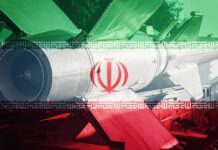

Modern naval blockades live or die on enforcement, and in the U.S. campaign against Iran that enforcement now hinges on something deceptively simple: commercial ships and whether they obey—or try to slip past—a line the United States has drawn across the sea.
At a Glance
- U.S. Central Command has turned the Iran blockade into a sustained maritime campaign, redirecting dozens of commercial vessels and disabling multiple ships that persisted toward Iranian ports.
- The seizure of the Iranian-flagged M/V Touska, with Marines rappelling from helicopters after a destroyer disabled her propulsion, is the emblematic operation that shows how this enforcement works in practice.
- Washington frames these actions as necessary defense against Iranian attacks on shipping and as leverage in parallel peace talks; Tehran calls them piracy and ceasefire violations.
- The core factual claims—destination, cargo, and legal authority—are still based largely on U.S. official assertions, leaving unresolved questions that matter for both maritime law and long‑term stability.
From Policy to Practice: How the Iran Blockade Is Being Enforced
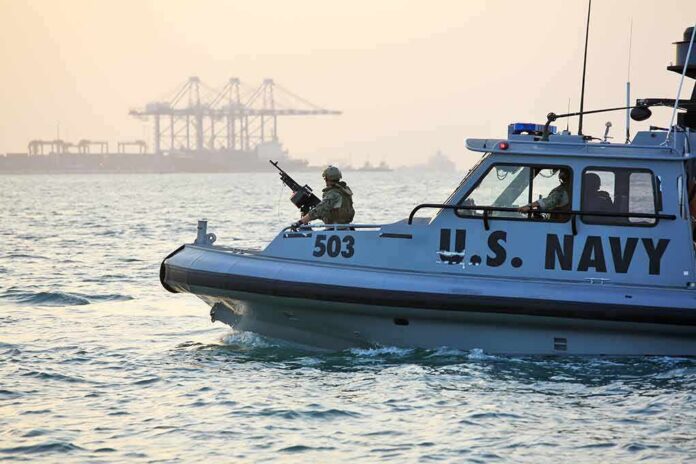
The current U.S. blockade of Iranian ports is not a single dramatic event; it is an ongoing operational regime that uses warships, aircraft, and Marines to police commercial traffic across the Gulf of Oman, the Strait of Hormuz, and adjacent waters. Central Command (CENTCOM) statements and corroborating news reports describe a pattern: identify vessels believed to be heading to Iranian harbors, warn them repeatedly, redirect those that comply, and disable or seize those that do not. That pattern is now the spine of U.S. maritime strategy in the conflict with Iran.
CENTCOM’s own public accounting gives a sense of scale. In one update, the command said it had redirected 12 commercial vessels and disabled one since resuming the blockade, with strikes continuing nightly against Iranian targets tied to maritime threats. Another tally—from CENTCOM and regional reporting—put the total higher: more than 100 ships redirected and multiple vessels disabled by precision strikes into their engine rooms when they pressed toward Iranian ports despite more than twenty warnings. In these communiqués, the blockade is presented as routine enforcement work, akin to coast guard interdiction but carried out with destroyers, carrier aircraft, and expeditionary Marines.
The Touska Operation: A Template for Boarding and Seizure
The best-documented case—the one that has come to define the blockade in the public mind—is the seizure of the Iranian-flagged cargo ship M/V Touska. According to CENTCOM and multiple outlets, the guided-missile destroyer USS Spruance disabled Touska’s propulsion after the vessel spent roughly six hours ignoring repeated stop orders in the Gulf of Oman. Once the ship was dead in the water, Marines from the 31st Marine Expeditionary Unit launched from the amphibious assault ship USS Tripoli by helicopter, flew over the Arabian Sea, and rappelled onto Touska’s deck to take control.
The U.S. released video of this operation: a destroyer firing on the ship, smoke from the engine area, and Marines descending from hovering helicopters in full combat gear. President Trump amplified the footage with his own narrative, stating that Touska tried to “get past” the blockade, was given “fair warning to stop” in the Gulf of Oman, refused, and was “stopped right in its tracks by blowing out the engine.” Media explainers filled in the context, noting that this was the first interception since the blockade was re‑imposed and that U.S. officials were examining the cargo to determine whether it constituted “spoils of war.”
Beyond Touska: A System of Redirects, Disablings, and Boardings
The Touska boarding was not an isolated stunt. CENTCOM press releases and Associated Press reporting describe additional commercial ships disabled after they repeatedly attempted to run the blockade. The Gambia‑flagged Lian Star, for example, reportedly ignored over twenty warnings as it tried to enter an Iranian port; U.S. forces responded by firing a missile into its engine room, leaving it adrift in the Gulf of Oman without boarding. Another tanker, M/T Lavine, was said to have tried at least four times to run the blockade; after multiple warnings, U.S. forces fired into its engine room and disabled the ship.
Separate CENTCOM releases detail strikes on unladen tankers and stateless vessels linked to Iran—Sea Star III, Sevda, Lexie, and others—whose propulsion systems were disabled by precision airstrikes as they transited toward Iranian ports. In each case, the U.S. narrative is similar: a vessel heading toward Iran, multiple warnings ignored, a final disabling shot into the engine or smokestacks, and then custody or redirection. Over time, CENTCOM has quantified this pattern, claiming that U.S. assets have redirected more than a hundred commercial vessels, disabled a handful, and boarded a few to verify compliance.
Strategic Logic: Shipping, Strikes, and Leverage in a Wider War
These interdictions sit inside a broader U.S.–Iran confrontation that now spans multiple waterways and domains. U.S. statements and independent coverage describe nightly American strikes on Iranian missile and drone storage sites, coastal radar, naval craft, and command nodes—designed, in CENTCOM’s phrase, to “degrade Iran’s ability to threaten civilian mariners and commercial vessels transiting regional waters.” In parallel, Iran and its proxies have attacked merchant ships, energy infrastructure, and desalination plants across the Gulf region, including incidents where a Cyprus‑flagged or Singapore‑flagged cargo ship was hit by Iranian drones as it transited the Strait of Hormuz.
President Trump has explicitly tied maritime attacks to infrastructure retaliation, warning that “anytime the Islamic Republic of Iran shoots at a ship in the Strait of Hormuz…the United States will bomb and destroy one bridge or power plant.” That threat was echoed by U.S. strikes on Iranian infrastructure following attacks on the M/V Ever Lovely and other vessels leaving or entering Hormuz. In that sense, the blockade is not only about constraining Iran’s import and export flows; it is part of an economic and psychological pressure campaign that uses control of shipping lanes—and the ability to impede or punish traffic—to shape Tehran’s calculus in ongoing peace talks.
Iran’s Response: Piracy, Ceasefire Violations, and Counter‑Narratives
Tehran’s public response has been sharp and categorical. Iranian officials describe the boarding and disabling of their vessels as “piracy” and as violations of a ceasefire memorandum negotiated in Islamabad. In reaction to the Touska seizure and subsequent interdictions, Iran vowed a “swift response,” accused the U.S. of committing unlawful acts against commercial shipping, and insisted that these actions breached not only bilateral understandings but also basic norms of freedom of navigation.
In Iranian framing, the legal center of gravity is simple: U.S. forces are imposing an unauthorized unilateral blockade and using force against non‑combatant vessels in international waters. From this vantage point, whether a ship was heading to Bandar Abbas or Kharg Island is secondary; the act of firing on and boarding an Iranian‑flagged commercial vessel is, by definition, illegitimate. Iran’s rhetoric is not only directed at the United States; it is meant to shape neutral opinion in global shipping, insurance, and energy markets, where risk perceptions can quickly translate into higher costs and reduced willingness to transit contested waters.
The Legal and Evidentiary Gaps: Destination, Cargo, Authority
The evidentiary record available publicly is strong on the fact that U.S. forces are firing on, disabling, redirecting, and sometimes boarding ships; it is much weaker on the underlying voyage details that determine legality. CENTCOM and President Trump say repeatedly that ships like Touska, Lian Star, Lavine, and Lexie were “attempting to enter an Iranian port,” “heading toward Kharg Island,” or “trying to get past the blockade,” but the public documentation supporting those claims—cargo manifests, bills of lading, AIS tracks, charter parties—is absent from the sources summarized here.
Similarly, while U.S. releases speak of “repeated warnings over six hours” or “more than twenty warnings overnight,” they do not provide the actual radio logs, bridge‑to‑bridge recordings, or language used. For maritime law, those details matter: the legality of firing into a vessel’s engine room depends in part on whether clear, comprehensible orders to stop were issued and acknowledged. The CENTCOM press release that recounts the six‑hour standoff with Touska is authoritative as an institutional statement, but it remains a narrative rather than a primary communications record.
The cargo question is equally unresolved. In earlier interdictions of China‑to‑Iran shipping, U.S. officials briefed that military‑related goods were seized en route to Iran, which fits a sanctions‑enforcement model. In the current blockade, however, publicly available sources offer no detailed cargo inventories for the most recent disabled or boarded ships; media accounts mention that Marines are “examining the cargo” or that a ship could become “spoils of war,” but they do not reproduce customs records or inspection reports. Without that information, it is impossible for outside observers to judge whether a particular shipment was prohibited, dual‑use, or entirely benign.
On legal authority, the gap is even more stark. The blockade is described consistently as a U.S. measure aimed at crippling Iran’s economy and preventing attacks on shipping. Yet none of the sources in this research package reproduces the executive order, congressional authorization, United Nations mandate, or formal legal opinion that would ground that blockade in a specific legal regime. That does not mean such instruments do not exist; it does mean that, in the public narrative, “blockade” functions more as a policy label than as a legally elaborated status that has been subjected to scrutiny. For critics, this absence is the heart of the piracy claim.
Information War at Sea: Footage, Headlines, and Public Perception
One reason these gaps persist is that the dispute is being waged first in the information domain. CENTCOM releases edited video of dramatic boardings; television channels replay the footage with assertive captions about “blockade enforcement”; social media accounts condense complex operations into seconds‑long clips of helicopters, explosions, and Marines on deck. Iranian state outlets respond with their own images and statements of victimization. The underlying voyage records—AIS data, manifests, legal memoranda—are slow, technical, and less visually compelling.
For shipping companies, insurers, and states that must decide whether to route vessels through or around contested waters, this imbalance matters. Policy is being made, and risk is being priced, on the basis of official narratives rather than shared documentary evidence. Over time, that dynamic tends to harden positions: U.S. audiences come to accept “blockade violator” as a settled description; Iranian audiences accept “piracy” with equal certainty. The space for neutral forensic analysis of individual incidents narrows.
What It Means Going Forward
For an intelligent observer of maritime security, the core insight in this episode is not that navies can disable merchant ships—they have been able to do that for a century. It is that in an era of contested legality and instant information, the legitimacy of such actions depends far more on what can be shown than on what can be said. The U.S. has made a clear choice: enforce a blockade against Iran vigorously, accept the reputational risk of unilateral interdictions, and rely on publicized footage and official assertions to carry its case.
Whether that strategy remains sustainable will turn on whether more of the documentary record is eventually disclosed—voyage tracks, cargo inventories, and legal opinions—or whether the conflict continues to be litigated primarily in headlines and social video. For now, the picture is incomplete but clear enough on one point: in the waters around Iran, commercial shipping is no longer a neutral backdrop. It is a central arena of the confrontation, and every disabled engine room is a reminder that the line between trade and war at sea has become thin indeed.
Sources:
facebook.com, aljazeera.com, euronews.com, nytimes.com, youtube.com, cnn.com, bbc.com, fortune.com, foxnews.com, centcom.mil, apnews.com, wsj.com, cbsnews.com