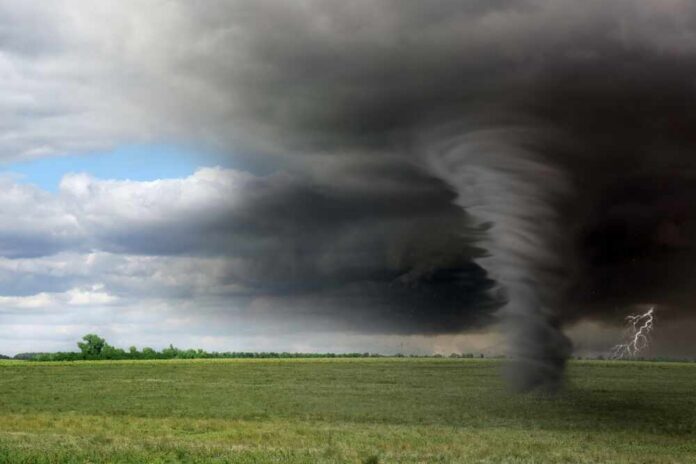
As families in southwest Michigan picked through splintered walls and flipped trucks, one simple truth hit home: when disaster strikes, it is neighbors, not distant bureaucrats, who stand between survival and chaos.
Story Highlights
- Cell phone footage from Three Rivers, Michigan, shows a violent March tornado shredding buildings and tossing debris through populated areas.
- Nearly 10,000 residents lost power as homes, garages, and a storage facility suffered severe structural damage.
- Local media, storm chasers, and the National Weather Service provided rapid warnings and wall-to-wall coverage that likely saved lives.
- The storm underscored how much ordinary Americans still depend on resilient infrastructure, personal preparedness, and strong local response.
Violent Tornado Tears Through Three Rivers Community
On the afternoon of March 6, 2026, a powerful tornado dropped near Three Rivers in southwest Michigan, cutting across a rural-suburban community of roughly ten thousand people and leaving a trail of splintered lumber, twisted metal, and shattered routines. Eyewitness cell phone footage captured the funnel’s rotation in real time, showing debris spiraling through the air as residents struggled to hold doors shut against roaring winds and blinding sheets of rain hammering nearby homes and businesses.
Video from the scene showed the tornado ripping through several buildings, tearing the roof off a storage facility and turning common commercial fixtures into airborne shrapnel. Residents described debris coming from nearby big-box stores such as Menards and Meyers, including long sections of metal roofing hurled across lots and roads. In seconds, once-familiar sights along local streets were reduced to piles of lumber, twisted siding, and scattered insulation clinging to trees and power lines.
Homes Shredded, Power Knocked Out For Thousands
Damage assessments in the immediate aftermath revealed how narrowly the community escaped an even worse outcome. One home, opened to cameras after the storm moved on, had furniture tossed around “like paper,” with an entire wall ripped out and daylight pouring through jagged gaps where siding, studs, and windows had been. A two-car garage was destroyed, a nearby truck was battered by falling branches, and sections of neighborhood streets were blocked by splintered lumber, roofing, and uprooted trees.
Utility crews reported nearly ten thousand people without power across St. Joseph and neighboring Branch counties, a stark reminder of how quickly modern life can grind to a halt when grids fail. Downed lines presented an immediate hazard, forcing residents to navigate darkened neighborhoods cautiously while first responders worked to secure live wires and clear paths. The situation underlined how critical robust, well-maintained infrastructure is for safety, especially in smaller towns that lack deep resources but still face big-league weather threats.
Warnings, Weather Coverage, And Community Response
National Weather Service meteorologists issued a tornado warning around 4:18 to 4:20 p.m. for northeastern St. Joseph and northwestern Branch counties as a severe thunderstorm capable of producing a tornado moved near Colon, roughly fourteen miles east of Three Rivers. Local broadcasters relayed the alerts quickly, with on-air meteorologists tracking rotation signatures, urging viewers to take shelter, and warning that multiple storms across southwest Michigan had the potential to produce additional tornadoes. Those precious minutes of advance notice likely kept more families in basements instead of on roads.
Local stations sent crews into the field once the worst passed, documenting both the damage and the response. Reporters standing among shattered walls described scenes of furniture strewn about and vehicles hammered by debris, while storm chasers’ live streams had already shown the tornado’s evolution as it crossed the countryside. Utility teams and emergency managers moved in to restore power, secure hazardous areas, and check on residents who had just watched their homes or workplaces torn apart. Even without initial reports of injuries, the destruction left no doubt about the storm’s power.
Unusual March Outbreak Highlights Ongoing Vulnerabilities
Meteorologists noted that the March 6 tornado was part of a broader line of severe thunderstorms fueled by unusually warm and windy conditions, a setup more typical of peak spring than late winter for Michigan. Multiple tornadoes were confirmed that day, including another near Union City, with storms firing near Grand Rapids and marching east toward Jackson County and metro Detroit. For residents, the outbreak reinforced that so-called “off-season” months no longer guarantee calm skies, especially in regions sitting on the fringes of traditional Tornado Alley.
Insane Footage Shows Tornado Ripping Through Southwest Michigan (VIDEO) https://t.co/yAOjlXUrbA
— The Gateway Pundit (@gatewaypundit) March 7, 2026
For conservative readers who prize self-reliance and local control, this storm offers a hard but useful reminder. National agencies can issue warnings, but it is local broadcasters, volunteer spotters, utility crews, and prepared families who ultimately stand in the gap when winds rise and sirens sound. In Three Rivers, quick alerts, community grit, and sheer providence appear to have prevented widespread casualties, even as walls fell, garages crumpled, and lives were upended in a matter of minutes.
Sources:
FOX 2 Detroit coverage of southwest Michigan tornado outbreak
Michigan tornado damage videos: Menards in Three …
Destructive supercell storm rolled across Michigan …