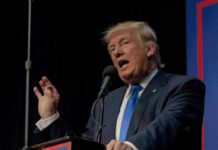

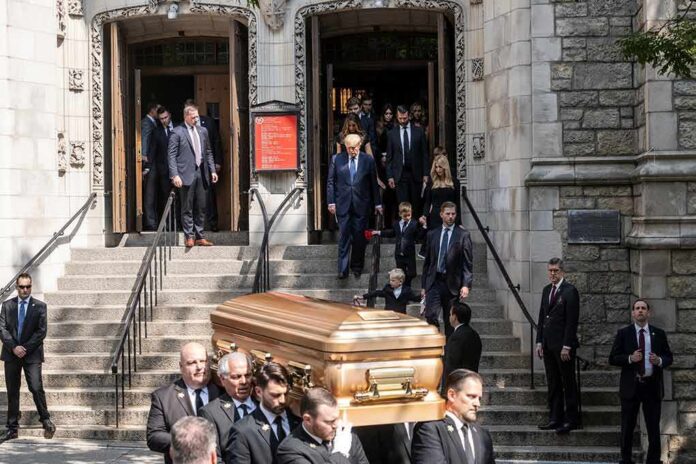
In the age of clip-driven politics, a president quietly sharing Tic Tacs at a state funeral became a global talking point—not because it changed policy, but because it perfectly illustrates how minor gestures now compete with formal rhetoric as evidence of character.
Key Points
- President Trump led tributes to Senator Lindsey Graham at a high-profile funeral at Washington National Cathedral, delivering a lengthy, sometimes jocular eulogy before a front row of senior U.S. officials and foreign leaders.
- Multiple video clips and international reports show Trump pulling out Tic Tacs, eating one, and offering them to Vice President JD Vance and Treasury Secretary Scott Bessent during the service, prompting visible smiles and quiet laughter.
- The moment was not mentioned in formal U.S. press write-ups of the funeral but was amplified by social media and foreign outlets, which treated it as either harmless levity or inappropriate informality in a solemn setting.
- The episode sits atop a broader controversy about Trump’s eulogy style—mixing warm tribute with barbed lines about Graham “never seeing a war he didn’t like” and recalling their combative 2016 rivalry—and about how audiences read his demeanor at high-ceremony events.
A State Funeral Where Every Gesture Was on Camera
Lindsey Graham’s funeral at Washington National Cathedral was not a quiet, local memorial; it was a carefully choreographed national event that placed President Trump, JD Vance, and Scott Bessent in the front pews, flanked by foreign leaders such as Benjamin Netanyahu and Volodymyr Zelenskyy. The cathedral’s nave, with its cameras and press positions, has become a familiar stage for American political funerals, and this service followed that template. Trump’s schedule, the seating of his vice president and treasury secretary beside him, and live coverage by PBS, NBC, ABC, Fox affiliates, and the White House itself ensured that essentially every move made in that front row would be recorded from multiple angles.
In that setting, Trump’s role was central. He was the principal eulogist from the political class, billed in advance as the one who would “lead tributes” and remember Graham as a “true American original” and “giant of the United States Senate.” His remarks ran to full-form campaign-length—legislative achievements, military service, family narrative, and a thick layer of personal anecdote—delivered with his characteristic mix of script and improvisation. The ceremony was designed to be solemn, but like most high-level funerals, it was also a stage-managed public ritual in which every participant understood that cameras were always running.
Trump’s Eulogy: Warm Tribute, Sharper Edges
The eulogy itself is the backbone of any serious assessment of the day. In the official White House and ABC News feeds, Trump moves through Graham’s biography as if ticking off a résumé: 33 years in the Air Force and Air National Guard; early election as the first Republican in his House district in more than a century; ascent to the Senate; and prominent roles in securing what Trump calls record military funding, the largest border security package, and the 2017 tax cuts. He highlights Graham’s defense of Justice Brett Kavanaugh as “perhaps his finest hour,” framing the senator as a warrior for conservative judicial causes.
But the speech is not purely laudatory. Trump reminds the audience that Graham “never saw a war that he didn’t like,” an acknowledgment—wrapped as a joke—of the senator’s hawkish reputation that drew attention precisely because such lines cut against the usual funereal deference. He revisits their 2016 primary clash, recounting how he read Graham’s personal cell number aloud to millions and turned a spiteful gesture into the origin story of their friendship. Outside commentators, from The Guardian to Pod Save America, seized on these tensions, reading the speech as revealing Trump’s ambivalence and ego, while more sympathetic outlets like Newsmax and Time emphasize his praise and emotional tone.
None of that is unusual in modern political funerals. Eulogies often double as historical narrative and soft self-portrait. What is distinctive here is that the speech quickly became secondary, in online discourse, to a small physical gesture that occurred while choirs sang and cameras roamed across the front pew.
The Tic Tac Exchange: What the Record Actually Shows
There is now a surprisingly consistent evidentiary trail around the Tic Tac moment itself. Foreign outlets, notably Spain’s RT in Spanish and Turkey’s SonDakika, ran short pieces built on the same visual sequence: President Trump takes a small container from his pocket, wrestles briefly with it, eats a mint, then turns to offer it to JD Vance and Scott Bessent. Their descriptions match the clips circulating on X and YouTube, where niche and partisan channels freeze and replay the interaction—Trump leaning toward Vance with a tiny plastic box in hand, Vance declining or demurring, and Bessent eventually accepting, producing a subdued round of smiles.
The British tabloid Mirror goes further by commissioning a lip reader, Nicola Hickling, who reconstructs a brief whispered exchange: Trump allegedly says, “I found these in my pocket. Want one?” Vance replies, “No, it’s all right,” prompting Trump to turn toward Bessent with the line “You’ll feel fresher,” and a joking clarification from Vance that “They’re Tic Tacs. They come in a little box.” Lip-reading from broadcast footage is an interpretive technique, not a court-level transcript, but Hickling’s account roughly aligns with the physical choreography seen in multiple clips and with commentary from online reactors who describe Vance as effectively saying “Not now” while Trump persists.
News18 and other video packages clip the same sequence into compilations that also show Trump briefly dozing and struggling to pop a Tic Tac into his own mouth, framing the snack as part of a pattern of restlessness during a long liturgy. Rolling Stone and Times of India reference the mint handoff as a minor but telling detail: Trump “showed generosity” by offering a Tic Tac even as he appeared sleepy, and the moment sparked debate over “who laughs during a memorial.” A Turkish report describes the three men quietly exchanging candy and “kıkırdayarak gülümsemeleri”—tittering smiles—while hymns played, noting that the clip quickly became one of the most discussed images from the service on social media.
By contrast, formal U.S. news stories—ABC’s main write-up, CNN’s liveblog, Reuters-based explainers—either ignore the Tic Tac entirely or mention only Trump’s struggles to stay awake and the tone of his eulogy. That silence is an editorial choice rather than a refutation; their focus is macro (Graham’s legacy, Trump’s speech, global attendees), not micro (every minor gesture caught on camera).
Humor, Impropriety, or Harmless Human Moment?
Once the clips hit X, interpretation splintered. Comment threads and commentary videos split into at least three broad camps. One group frames the Tic Tac exchange as harmless, even endearing—a president trying to share a mint with exhausted colleagues two hours into a long religious service. Rolling Stone’s aside about Trump “showing generosity to his fellow man” sits in this lane. So do lighthearted social posts that caption the clip with candy emojis and treat it as a meme about boredom at formal ceremonies.
A second camp leans into impropriety. News18’s headline asks, “Who laughs during a memorial?” and its coverage emphasizes that the mint-sharing and missed “toss” into Trump’s own mouth triggered debate over respect for the occasion. Turkish and Spanish pieces underscore that this took place during “en los momentos más serios” of the liturgy, suggesting that the levity jarred against the cathedral’s heavy atmosphere. More pointed YouTube commentary from channels like Pondering Politics builds the Tic Tac into a larger critique of Trump’s demeanor—falling asleep, fidgeting with candy, and then offering it to Vance like a bored child, all at a funeral for a man he once publicly humiliated.
A third view treats the episode as emblematic of the clip economy rather than of Trump himself. In this reading, something like a Tic Tac exchange is almost structurally guaranteed to surface from any modern state funeral. Cameras search constantly for human texture, editors compile “viral moments,” and audiences reward short, replayable gestures more than lengthy speeches. What becomes emblematic is not the mint but the speed with which it outcompetes Graham’s career and Trump’s eulogy in online attention.
How Minor Moments Become Major Narratives
The Tic Tac episode is best understood as part of a pattern, not as an isolated quirk. High-visibility political ceremonies—from funerals to State of the Union addresses—now unfold in two parallel spaces: the formal, institutional record, and the fragmented, social-media record. The first privileges transcripts, guest lists, and official rhetoric. The second privileges body language, micro-interactions, and humor. In many cases, those micro-moments are the only part of the event that a broad public ever sees.
At Graham’s funeral, the official record presents Trump as a somber but occasionally jocular president paying tribute to a “true American original,” weaving legislative detail with personal story and a biblical flourish about Graham now wearing “the crown of life.” The online record splices in sleepy eyelids, coffin taps, and Tic Tac offers. Together, they produce a composite image that different audiences interpret through their priors: admirers see warmth and humanity; critics see disrespect and self-absorption. Neither set of clips is fabricated, but each is partial.
What makes the Tic Tac moment interesting is not that a president ate a mint at a funeral—that is trivial on its face—but that foreign outlets and partisan commentators recognized, almost instinctively, that this was the kind of detail that travels. It is visually legible, mildly comic, and flexible enough to carry many narratives: Trump as relatable, Trump as bored, Trump as inappropriate, Trump as incapable of sitting still. A small plastic box becomes a Rorschach test.
Evidence, Limits, and What We Can Say Confidently
On the narrow factual question—did President Trump pass Tic Tacs to JD Vance and Scott Bessent at Lindsey Graham’s funeral?—the evidence is strong enough to treat the exchange as real. Multiple independent video sources show Trump handling a small box, eating candies, and offering them to the men beside him; contemporaneous foreign and tabloid coverage identifies the candies as Tic Tacs and describes the interaction in consistent terms; a hired lip reader supplies dialogue that matches the visible reactions. No serious outlet has produced a contrary visual record, and the behavior is minor enough that U.S. mainstream pieces’ decision not to mention it is best read as editorial triage, not skepticism.
What remains interpretive is whether the gesture was “funny,” “awkward,” or “disrespectful.” Humor depends on audience and context; the cameras catch smiles, not intent. The choir’s hymns and the cathedral’s gravity made any levity conspicuous, but the line between humanizing and inappropriate is in the eye of the beholder. Critiques that fold the Tic Tac into a larger indictment of Trump’s eulogy and his past comments about Graham are essentially normative arguments, not evidentiary ones.
The deeper lesson is that in contemporary political life, minor, human-scale behavior during major events is no longer private. It is raw material. A president reaching for a mint beside his vice president and treasury secretary at a national funeral may seem inconsequential, but once that motion is captured from three angles and clipped to twenty seconds, it becomes part of the historical record of how power is performed—and of how millions of viewers judge it.
🍬😂 *WATCH: JD Vance Chuckles as President Trump Offers Treasury Secretary Scott Bessent a Tic Tac at Lindsey Graham’s Funeral*
During a lighthearted moment following the funeral service for Senator Lindsey Graham, President Trump pulled out a pack of Tic Tacs and offered one… pic.twitter.com/TNTqjnHvTE
— (((IsraelMatzav))) (@IsraelMatzav) July 29, 2026
What This Tells Us About Modern Political Ritual
For readers trying to make sense of the Tic Tac debate a year or a decade from now, the episode offers a compact case study in how political ritual has changed. The Washington National Cathedral remains a place where the U.S. establishment gathers to mark the passing of its own: senators, presidents, justices. The architecture demands seriousness. Yet the presence of wall-to-wall cameras, paired with an attention economy that rewards brevity and personality, means that no ritual is immune from being reframed around its smallest, most human moments.
President Trump’s behavior at Lindsey Graham’s funeral—his blend of detailed tribute, sharp-edged humor about war, reference to their 2016 feud, and the now-famous Tic Tacs—fits squarely within that evolution. He did what eulogists have long done: told stories, mixed reverence with familiarity, and tried to personalize a colleague’s life. What is new is the way a single, quiet offer of a mint to JD Vance and Scott Bessent has been elevated, by cameras and commentary, into a symbol for how he conducts himself when the eyes of the world are on him. Whether one reads that symbol as warmth or impropriety, the underlying truth is clear: in an era of ubiquitous video, there is no such thing as an inconsequential gesture in the front row.
Sources:
thegatewaypundit.com, youtube.com, politico.com, theguardian.com, newsmax.com, abcnews.com, facebook.com, biz.chosun.com, whitehouse.gov, cnn.com, nbcnews.com, time.com