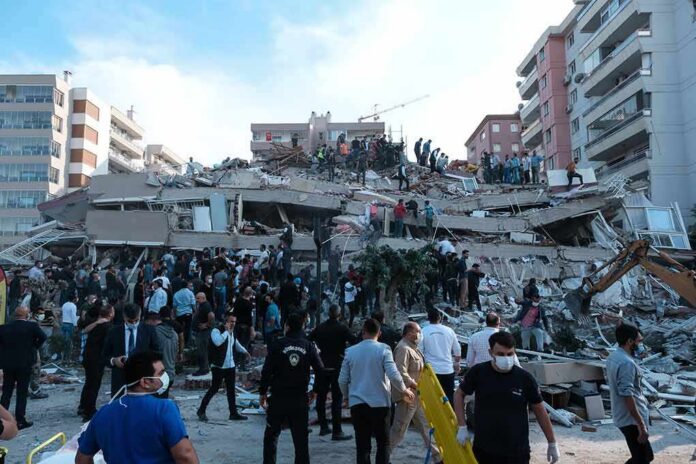
The most dangerous moment for a bombed building in Gaza often isn’t the airstrike itself — it’s the months afterward, when a family moves back in because there is nowhere else to go, and the structure’s damaged bones finally give way on an ordinary morning.
Key Points
- A six-story residential building in Gaza City, previously damaged by Israeli bombing, collapsed early Wednesday, killing at least 21 people — including 11 children and five women — and injuring at least 14 more.
- The building, known as Al-Saada, sat near UNRWA’s headquarters and had been sheltering roughly 100 displaced people; civil defense crews spent 16 hours pulling 21 bodies and 45 survivors from the rubble.
- Humanitarian officials tie the collapse to a broader shelter crisis: emergency shelter materials have barely entered Gaza, and most temporary structures were engineered to last only about six months.
- The Norwegian Refugee Council says over 80 percent of Palestinians in Gaza live in critical or catastrophic shelter conditions, with reconstruction effectively stalled by blockade conditions on cement, rebar, and timber.
- This is not an isolated event — similar war-damaged buildings collapsed during winter storms in December 2025, a pattern likely to recur as long as families have no safer alternative.
What Happened at the Al-Saada Building
In the early hours of Wednesday, September 16, the Al-Saada building in Gaza City came down. The structure had already absorbed damage from earlier Israeli bombing raids in the war, yet like tens of thousands of other partially destroyed homes across the strip, it remained occupied because no alternative housing existed. Gaza Health Ministry spokesperson Zaher al-Wahidi reported that the collapse killed at least 21 people, among them 11 children and five women, with 14 more injured. Civil defense spokesperson Mahmoud Basal said crews worked a 16-hour rescue operation, ultimately recovering 21 bodies and pulling 45 survivors from the debris.
The building’s location made the disaster harder to miss: it stood close to the headquarters of UNRWA, the UN agency for Palestinian refugees, in a part of the city where displacement camps and damaged apartment blocks sit within view of one another. Before it fell, Al-Saada had been sheltering roughly 100 people — families who had lost their original homes earlier in the war and had nowhere else to relocate. Early casualty figures varied across outlets in the collapse’s immediate aftermath, as is typical in fast-moving disaster reporting, before converging on the toll above.
Why a Building Fails Without Another Strike
A structure doesn’t need to be leveled outright to become lethal. Modern reinforced-concrete buildings rely on a continuous load path — columns, beams, and slabs working together to carry weight down to the foundation. A nearby blast can fracture concrete, sever rebar connections, or knock a structure out of plumb without dropping it immediately. The building keeps standing, sometimes for months, its damaged frame slowly losing capacity under its own weight, seasonal temperature swings, and added stress from residents moving back in and improvising repairs. Eventually, a compromised joint or beam reaches its failure point, and the collapse that follows can look sudden even though the structural damage had been accumulating since the original strike.
A Pattern That Predates This Collapse
Al-Saada is not an outlier; it is the latest entry in a pattern that has repeated itself across Gaza for more than a year. In December 2025, Al Jazeera reported that a severely war-damaged residence in Gaza City collapsed during a winter storm, killing a neighboring resident and injuring others. Days earlier, the outlet documented 13 home collapses and roughly 27,000 tents flooded or swept away in a single storm system, with civil defense and health officials attributing deaths to both structural failure and cold exposure. The mechanism is consistent across these incidents: conflict-weakened buildings, families with no safer option, and weather stress arriving on top of already-compromised structures.
Shaina Low, a communications adviser for the Norwegian Refugee Council, described the underlying conditions to DW in stark terms, noting that “very little shelter material has entered Gaza” and that two-thirds of displaced people have been living in tents or makeshift shelters for over a year — well beyond the roughly six-month lifespan those materials are designed for under Gaza’s climate. NRC’s shelter-cluster reporting found that more than 80 percent of Palestinians in Gaza live in critical or catastrophic shelter conditions, with 94 percent needing some form of shelter or household assistance.
The Blockage Behind the Collapse
What separates this crisis from an ordinary natural-disaster recovery is the near-total absence of rebuilding. Low told DW that “no reconstruction efforts have begun,” pointing to continued restrictions on cement, rebar, and timber entering Gaza, alongside denials of basic humanitarian items. That distinction matters: in most post-conflict settings, damaged housing gets triaged, shored up, or demolished within a predictable timeline. In Gaza, the raw materials to do any of that consistently fail to arrive in sufficient volume, which means every damaged building that survived the war continues degrading, unaddressed, until weather or time finishes what the original strike started.
"The building that collapsed today onto its residents in Gaza City is neither the first nor will it be the last. The danger comes from hundreds of buildings that were bombed by Israeli forces but are still standing, and could collapse at any moment, as happened [Tuesday].
That… https://t.co/0C2yEgj10B— Marian Houk (@Marianhouk) September 17, 2026
What Comes Next
Low’s warning to DW carried an explicit forward-looking edge: winter is approaching, bringing floods and heavy rain that will stress the same compromised structures again. Given the December 2025 storm collapses that preceded this event, that warning reads less like speculation and more like a forecast grounded in recent precedent. Civil defense officials have separately flagged a substantial number of war-damaged residential buildings across Gaza City as remaining occupied despite visible structural risk, underscoring that Al-Saada’s collapse is a symptom of scale rather than a freak accident. Until shelter materials and reconstruction supplies move into Gaza in volume, the underlying hazard — occupied buildings that were never repaired because they were never allowed to be — stays in place, and with it, the near-certainty of another collapse before the next storm passes.
Sources:
independent.co.uk, amp.dw.com, bbc.com, gulftoday.ae, democrata.es, aljazeera.com