
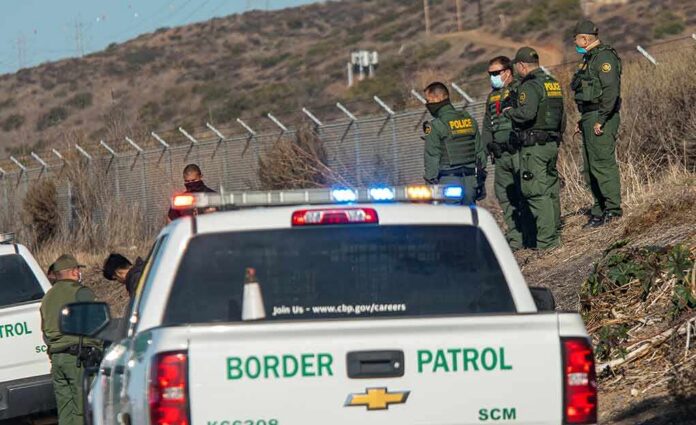
The headline-grabbing irony obscures the simple, consequential fact: a field journalism team in Texas’s Big Bend needed a professional wilderness rescue, and U.S. Border Patrol did what it routinely does in that region—mounted a multi-vehicle response in punishing terrain and brought people out safely.
At a Glance
- An MS NOW crew’s Jeep Wagoneer bottomed out near sunset in the Big Bend region; Border Patrol responded and rescued the team.
- The on-air account described eight agents arriving in four trucks, with three vehicles reportedly getting stuck during the effort.
- Multiple outlets carried the same core facts; none disputed the basic rescue narrative.
- The response profile matches Border Patrol’s documented rescue playbook in rugged West Texas.
What happened in the desert
Correspondent Antonia Hylton’s account is straightforward: while reporting in Texas’s remote Big Bend region, her crew’s Jeep Wagoneer “bottomed out” as the sun went down. She said eight Border Patrol agents arrived in four trucks to pull the team out, and that three of the four trucks became stuck before the rescue concluded. That package of facts—immobilized vehicle at dusk, multi-truck Border Patrol response, crew extracted—was published in near-identical form by Mediaite, the New York Post, Yahoo News, and AOL, with no competing version of events offered by any outlet that covered it.
Big Bend locals will recognize the dynamics. Daylight collapses quickly in canyons and arroyos. “Bottoming out” in desert country typically means the frame or drivetrain meets rock or sand at a ledge, wash, or soft shoulder; ground clearance and approach angles that look generous on pavement evaporate under load in rutted caliche and deep sand. Once a heavy SUV loses momentum in a wash, extraction can require multiple vehicles, traction aids, and line-of-sight knowledge of passable tracks. In other words, a routine off-road mistake can turn into a complex night recovery fast.
Why Border Patrol is often the rescuer of record in Big Bend
U.S. Border Patrol’s Big Bend footprint is built for precisely this combination of remoteness, rough terrain, and time-sensitive risk. Agents in Alpine, Marfa, Presidio, and the Big Bend National Park area operate with air and ground coordination, night-vision and thermal imaging, and a standing habit of interagency work with Park Service rangers, county EMS, and Air and Marine Operations (AMO). Agency releases from the sector document exactly these patterns: multi-agency searches across trackless desert, air assets vectoring ground teams, and patient transfers to EMS once people are located and stabilized.
Consider a representative case: agents from the Big Bend Park Substation coordinated with multiple partners to locate and rescue four individuals lost in the desert—AMO pilots found them, ground teams secured them, and an ambulance took over at the handoff. The press note is unglamorous in its phrasing because the work is procedural: cross-load responsibilities, move deliberately, and close the loop safely. In another period, Big Bend teams executed multiple rescues over four days, emphasizing the same cadence: call intake, asset tasking, rugged approaches, and basic medical screening or evacuation at the end. This is not exotic heroics; it is the routine operating system of a sparsely populated, high-risk landscape.
Mechanics of a desert recovery: why even rescue trucks can get stuck
Rescue operations in the Chihuahuan Desert are a physics problem disguised as logistics. Vehicles bog down for three reasons: loss of flotation in soft sand, high-centering on a berm or rock ledge, and weight-transfer failures on steep breakovers. A convoy responding at night magnifies the risk because each truck must traverse the same soft sections and breakovers the lead vehicle disturbed. It is commonplace—though always frustrating—for a second or third vehicle to mire while attempting to reach or extract the first. In sandy washes, the “accordion” of churned substrate creates a trap that only methodical shuttling, winching, and sometimes backtracking can unwind.
Border Patrol’s fleet in this terrain typically includes high-clearance pickups and SUVs with off-road tires, but even those platforms respect the desert’s arithmetic. Agents often stage vehicles at different choke points, approach on foot when necessary, and use air assets to minimize ground risk. The MS NOW narrative that three of four responding trucks became stuck during the effort is unusual only to readers unfamiliar with how easily desert substrates degrade under repeated loads; the core claim remains that agents reached the crew and got them out.
The media moment versus the operational reality
Why did this particular rescue ricochet across aggregators? It compresses several high-engagement elements into a single beat: a national outlet on the border beat, the politically freighted image of Border Patrol as rescuer, and the cinematic detail of a multi-truck struggle after sunset. That formula guarantees distribution. But the operational reality aligns with years of documented practice in the sector: Border Patrol is frequently the nearest, best-equipped responder for remote incidents, whether the subjects are migrants, hikers, ranch workers, or—in this case—journalists. Official releases from the region read the same way regardless of who needed help: locate, stabilize, transfer or clear the scene.
Big Bend’s hazard profile explains the institutional muscle memory. Heat illness spikes quickly; comms are patchy; distances are deceptive. CBP and local partners have warned repeatedly about the danger, citing fatalities and urging against underestimating the terrain—guidance that applies to everyone, not only to those crossing the river illegally. In winter, storms invert the risk profile but preserve the core challenge: long response times and the need for specialized mobility. In one statewide cold snap, agents reported rescuing more than 200 people across Texas—again, a reflection of capacity where other responders may lack reach.
Practical takeaways for field crews and travelers
The lesson set is old, but it bears repeating. First, route planning trumps vehicle marketing; a luxury SUV with road-biased tires is not a desert recovery rig. Second, daylight is a resource—budget more of it than you think, and turn around early when ground conditions deteriorate. Third, carry the basics that change outcomes before help arrives: water at desert scale (a gallon per person per day as a floor, more for exertion), a traction kit, a redundant communication plan, and heat management. Finally, know who to call and how to describe your location; in Big Bend country, the nearest competent responder is often a Border Patrol unit with the maps, radios, and trucks to reach you.
In the end, the story’s center is not the punchline; it is the system working as designed. A crew got into trouble in unforgiving country. Border Patrol dispatched trained people with capable trucks and brought them home. That outcome is ordinary for the agents who do this work and extraordinary for those who need it—which is why it is worth understanding on its own terms, politics aside.
JUST IN: An MS NOW news crew led by Antonia Hylton got stranded in the desert near Texas' Big Bend region after their Jeep Wagoneer bottomed out. Eight Border Patrol agents in four trucks responded to rescue them, and three of the four vehicles got trapped. pic.twitter.com/X9BIvRpcWU
— JUST IN (@justinnews67) September 13, 2026
Sources:
twitchy.com, thegatewaypundit.com, nypost.com, yahoo.com, 1stheadlines.com, paprclips.com, cbp.gov, x.com