
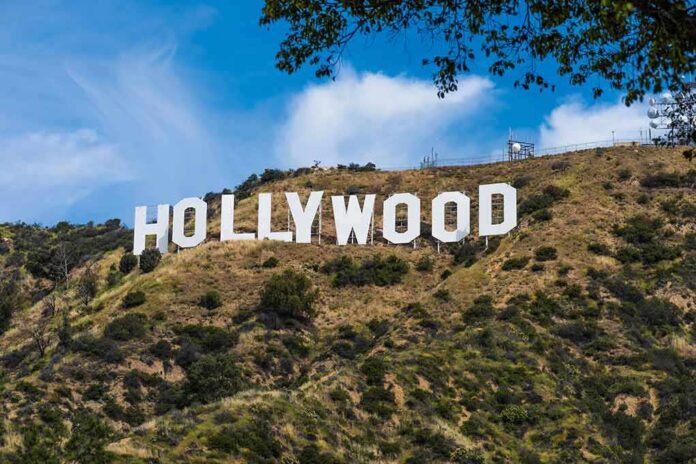
Iconic landmarks invite meaning, but the law treats them as property; when artists turn monuments into stages, the result is almost always the same hybrid verdict—memorable art, charged as trespass.
The Short Version
- Sabine Tautou’s “Public Figure, 2026” at the Hollywood Sign was framed by the artist as a conceptual performance, not vandalism.
- Police detained Tautou and cited her for trespassing; that enforcement track mirrors decades of Hollywood Sign interventions.
- In U.S. law, expressive intent rarely neutralizes unauthorized access; the art can be meaningful and still be a misdemeanor.
- Past cases—from “HOLLYWeeD” to banner drops—show a stable pattern: brief, high-visibility acts, swift removal, and low-level charges.
What Actually Happened, and Why It Wasn’t Treated as Harmless Spectacle
Artist Sabine Tautou staged a 25‑minute performance at the Hollywood Sign, titled “Public Figure, 2026,” in which a nearly nude participant was bound against the landmark to evoke a symbolic clash between aspiration and erasure. Coverage quoting the project’s press materials described a “compelling physical and ideological juxtaposition”: the Sign as fame’s beacon, the mummified body as constrained identity. Police detained Tautou and cited her for trespassing; no serious injury or long disruption was reported, but the intervention ended under routine enforcement rather than curatorial applause.
That outcome is not an outlier. The Hollywood Sign has long functioned as both a cultural screen for projection and a legally guarded asset. The duality explains the recurring cycle: an eye‑catching intervention attracts media attention on expressive grounds, while authorities respond on property and safety grounds. Meaning and misdemeanor coexist.
How the Law Sees It: Expression Meets Access Control
U.S. courts separate what you say from where and how you say it. Artists may assert a message of public interest, but unauthorized entry onto restricted land remains trespass—especially at sites fenced, posted, or otherwise regulated for safety and preservation. Los Angeles has enforced that distinction repeatedly at the Sign; when Zachary Cole Fernandez altered it to read “HOLLYWeeD” in 2017, police pursued misdemeanor trespass because the structure wasn’t damaged, underscoring that access violations stand even when no property harm occurs.
This isn’t an eccentric local quirk. As a general rule, use of government or quasi‑public property beyond the scope of permitted access constitutes trespass; the First Amendment protects content from censorship but does not guarantee a right to occupy or alter a site of one’s choosing absent authorization. As a result, site‑specific interventions—however thoughtful—are judged under ordinary access and safety rules, not under a bespoke “art exception.”
The Hollywood Sign’s Special Status: Symbolic Magnet, Security Reality
The Sign is more than wood and metal letters on a hillside; it is trademarked, institutionally stewarded, and physically protected. The Hollywood Chamber of Commerce and Hollywood Sign Trust have long balanced visibility with control, a posture hardened by episodes that drew crowds or risked copycats. After the 2017 modification, authorities discussed surveillance upgrades and reiterated that even non‑destructive alterations would be investigated as misdemeanor trespass, reflecting the calculus that attention begets attempts.
The Sign’s guardianship also blurs categories people often conflate: filming permits versus site permissions, image licensing versus physical access. A permit to film in the hills does not authorize climbing the letters; a license to depict the landmark in commercial work is distinct from a right to rig hardware to it. Artists and marketers frequently learn those distinctions only after the fact, when enforcement, not curatorial debate, appears.
Precedent and Pattern: Why Tautou’s Case Tracks Prior Interventions
Look across the Sign’s intervention history and three constants emerge. First, acts are short and theatrical: a banner drop, a letter tweak, a body or object affixed for minutes—not hours or days. Second, enforcement proceeds on low‑level charges keyed to access rather than message or damage; where structures remain intact, trespass is the default. Third, institutional actors emphasize deterrence narratives—“you will be caught and prosecuted”—to discourage emulation.
Tautou’s performance fits that template. The brief duration, theatrical staging, and immediate policing all align with prior incidents; the citation for trespass is consistent with the way Los Angeles has managed similar acts. Whether on New Year’s Day with “HOLLYWeeD” or a banner in 2021, authorities have treated the Sign as a secured site that cannot be repurposed for unsanctioned expression, even when the gesture is plainly artistic rather than malicious.
Artistic Intent Versus Legal Outcome: Why Meaning Doesn’t Moot the Misdemeanor
In public art scholarship, uncommissioned, site‑specific works are often read as critiques of power, commerce, or spectacle precisely because they seize attention in places where attention is already currency. Yet the same traits that make an act conceptually resonant—high visibility, iconic context, physical intervention—activate the legal tripwires of trespass and, when materials are attached or surfaces marked, potential vandalism. Scholars chronicling “trespass practices” point out the friction bluntly: the work may be site‑dependent and socially valuable, but criminal liability is adjudicated by access rules, not by the artist’s theory of the site.
That is why the debate over Tautou’s intent, while culturally interesting, is legally orthogonal. The city’s responsibility is to preserve safety and deter ad hoc modifications to a hillside monument that draws global tourism. The artist’s responsibility, if she chooses the transgressive route, is to accept the predictable enforcement that follows. The public can judge the work on its merits even as the state issues a citation; these judgments operate on parallel tracks.
Where Reasonable Disagreement Lives
There is room for serious disagreement on policy, not on the facts. One camp argues that brief, non‑destructive, clearly expressive interventions at robust public symbols should be met with warnings or civil fines rather than criminal process, to avoid chilling experimental art. Another camp prioritizes deterrence, noting that the Hollywood Hills are hazardous, the letters are not designed for load‑bearing performance, and normalization of “temporary tweaks” invites risk and costly response. Los Angeles has, to date, sided with deterrence by maintaining trespass enforcement even when damage is absent.
That choice reflects institutional risk management more than cultural arbitership. Cities are not museum curators; they are stewards of safety and infrastructure. As long as those responsibilities dominate, artists who select controlled symbols as their medium should expect the familiar consequence: the work will run in culture pages; the citation will run in court dockets.
Practical Implications for Artists and Producers
For practitioners, the lesson is specific, not abstract. Separate questions before you plan: Do you have legal access to the ground beneath the work? Do you have authorization to touch or alter the structure? Do you have a license to use the symbol in commercial material? Each answer involves different decision‑makers, and a yes in one lane does not imply a yes in the others. At the Hollywood Sign, history says that if any of those answers is no and you proceed anyway, the artistic read may be generous—but the legal outcome will be routine and unromantic: trespass citation issued, act concluded, message debated elsewhere.
Sources:
nypost.com, x.com, tmz.com, news.artnet.com, dw.com