

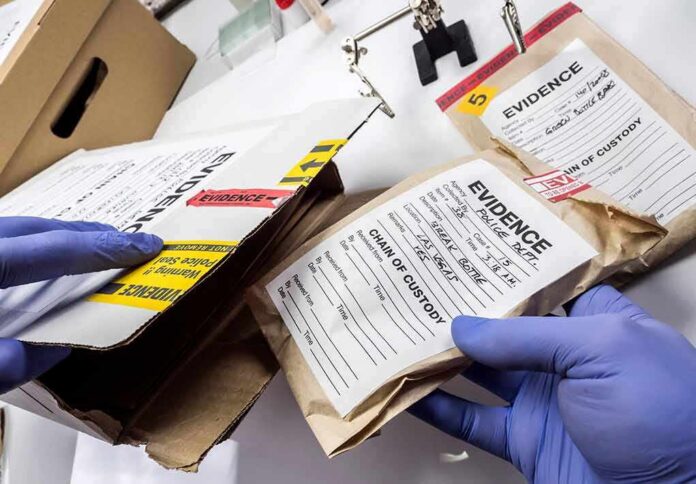
When post-conviction DNA testing excludes a defendant from the most probative biological traces in a homicide, the criminal case tilts—not necessarily to legal exoneration, but decisively away from the reliability of the original conviction. That is the crux in Douglas Stewart Carter’s 1985 Provo murder case: modern forensics undercut the state’s theory, the death penalty is off the table, and a man who spent decades on Utah’s death row is out on bail while prosecutors reassess what, if anything, still holds.
At a Glance
- New DNA testing excludes Carter from key crime-scene items; prosecutors withdrew their intent to seek death.
- A judge granted Carter bail pending retrial, reflecting the weakened evidentiary posture of the case.
- Prosecutors say the DNA results do not by themselves exonerate Carter, citing a prior confession and an unrecovered gun.
- The case sits in a familiar pattern: DNA narrows culpability even as courts weigh confessions, misconduct findings, and non-biological proof.
What changed: the evidentiary core moved
In September 2026, Utah County prosecutors received a state crime lab analysis excluding Carter as the source of biological material on two central items in the killing of Eva Olesen: blood on a doorknob and DNA on the handle of the knife used in the attack. The prosecutor withdrew the office’s notice to seek the death penalty and told the court the state would reassess whether and how to proceed. This was not a rhetorical shift; it marked the state’s own recognition that the biological record at the scene does not point to the man it has pursued for four decades.
Courts treat source-level DNA evidence on a weapon handle or a blood-bearing touchpoint as highly probative because it links a flesh-and-blood person to the mechanics of the crime. When the known defendant is excluded from those profiles, two consequences follow. First, the state’s original narrative becomes less coherent—especially in a single-perpetrator account. Second, the defense gains a clear, testable alternative: if not this person, then someone else whose DNA is physically embedded in the implements of the offense. That is why prosecutors pared back their exposure and judges revisited custody decisions.
How we got here: a long arc of reversal and re-testing
The conviction and first death sentence date to 1985; a second death sentence followed after an earlier procedural vacatur. In 2022, a judge set aside the conviction and granted a new trial after misconduct findings; the Utah Supreme Court affirmed in 2025. Only then did the case move fully into the modern scientific lane, with the state submitting items for contemporary DNA work. The lab’s results excluded Carter across multiple pieces of tested evidence, according to defense summaries and prosecutors’ own filings; crucially, the prosecution’s filing singled out the doorknob blood and the knife-handle DNA as exclusions.
These steps track a broader pattern in late-stage corrections. DNA capacity available today—short tandem repeat (STR) testing, with adjuncts like Y-STR when needed—can interrogate aged and mixed samples that 1980s-era forensic practice simply could not. Across the United States, hundreds of convictions have been overturned following post-conviction DNA analysis; a meaningful fraction involve homicides, and some emerged from capital cases. The mechanism is consistent: a discrete probative item (the weapon, a semen or blood source, a worn garment) yields a profile that excludes the convicted person, eroding the plausibility of the state’s theory and often requiring a wholesale evidentiary rethink.
Where the dispute now lives: confession versus biology
Prosecutors have been explicit: the DNA exclusions do not automatically exonerate Carter. They point to his past confession and the unresolved firearm as reasons the case is not closed. That is a legally cognizable position; courts do not treat DNA as a trump card in every posture. But confession evidence exists on a spectrum, and the legal system has learned hard lessons about its fallibility—especially when paired with allegations of coercion or when later proceedings identify investigative misconduct. In this case, the prior vacatur for misconduct and the state’s own recalibration amplify concerns about the confession’s reliability as a stand-alone pillar, particularly now that the hands-on DNA evidence no longer fits the original narrative.
How to weigh this? Start with probative value. Source-level DNA on the knife handle—a direct interface with the murder weapon—speaks to who wielded it; a confession, by contrast, is only as sound as the conditions that produced it and the corroboration that surrounds it. Modern innocence research shows a nontrivial share of DNA exonerations included false confessions, a reminder that admissions cannot be evaluated in a vacuum. When the biological record and the admission diverge, the system’s responsibility is to interrogate the admission, not discount the biology.
Mechanics of the science: what an exclusion means—and does not
Forensic STR testing compares genetic markers from a questioned sample to a known reference. An “exclusion” means that, at the loci analyzed, the known individual could not have contributed the DNA in that sample. On a single-source handle swab, that’s straightforward; on complex mixtures or degraded samples, analysts use statistical thresholds and mixture deconvolution to prevent over-interpretation. Prosecutors in this matter did not hedge with mixture ambiguity in their filing about the knife handle and the doorknob blood; they reported exclusions. That narrows the field: whomever left that DNA is not Carter—full stop for those tested items.
Exclusions on multiple probative items do not prove what did happen, but they powerfully influence what could have. They constrain any viable prosecution theory and redirect investigative energy toward the persistent unknown profile. They also change bail calculus: if the most physically direct evidence no longer points to the defendant, continued pretrial incarceration after decades served becomes much harder to justify.
Consequences: death penalty withdrawn, custody recalibrated, case strategy reset
Once the DNA exclusions landed, the Utah County Attorney’s Office withdrew its notice to seek the death penalty and asked the court to revisit Carter’s custody status. A judge subsequently granted bail. Those coupled decisions signal both a legal and prudential pivot: capital exposure is indefensible when the state’s own filing acknowledges that core biological traces exclude the accused; pretrial detention is likewise strained where the state is actively reassessing whether to proceed at all.
From here, prosecutors have three rational options. They can dismiss and reinvestigate using the unknown DNA profile as a lead; they can seek additional forensic work (e.g., testing unexamined items, re-sampling, or familial search where lawful) to see whether any probative item still implicates Carter; or they can attempt a pared-down retrial anchored in non-biological evidence. The first option aligns strongest with the current evidentiary posture; the third invites jurors to accept a confession untethered from the physical record—a risky proposition in a post-DNA era.
A Utah judge has ordered 71-year-old Douglas Carter’s release on bail after more than four decades on death row for a 1985 murder, following new DNA tests that exclude him as a match for key crime-scene evidence.
Prosecutors say the results do not prove Carter’s innocence, and… pic.twitter.com/klvCTORGiz
— Safari Reports (@Safari_Reports1) September 29, 2026
The broader pattern: why late-stage DNA often narrows more than it ends
Across exoneration scholarship, DNA has been a clarifier and, in many cases, a liberator—but not in every instance a silver bullet. National tallies show hundreds of DNA-based exonerations since 1989, with homicides heavily represented. Yet in many other cases, DNA serves to exclude a named defendant from critical items without identifying the true perpetrator, leaving prosecutors to decide whether the remaining circumstantial or testimonial evidence can carry a retrial. The Carter matter squarely fits that “narrowed but not closed” lane: biology undercuts the original case theory while the state weighs a contested confession under the shadow of prior misconduct findings.
What to watch next
Two developments will define the endpoint. First, whether prosecutors pursue additional forensic avenues using the unknown DNA profile—potentially yielding a hit that resolves culpability. Second, whether the state concludes that, without a biological through-line and with a compromised confession, a retrial would be an exercise in re-animating doubt rather than proving guilt beyond a reasonable doubt. If the science continues to point away from Carter and no new inculpatory evidence emerges, the principled course is dismissal. The justice system’s credibility rests not on defending old verdicts, but on following the strongest current evidence where it leads—and, here, it no longer leads to the man who spent decades on death row.
Sources:
apnews.com, innocenceproject.org, academic.oup.com