
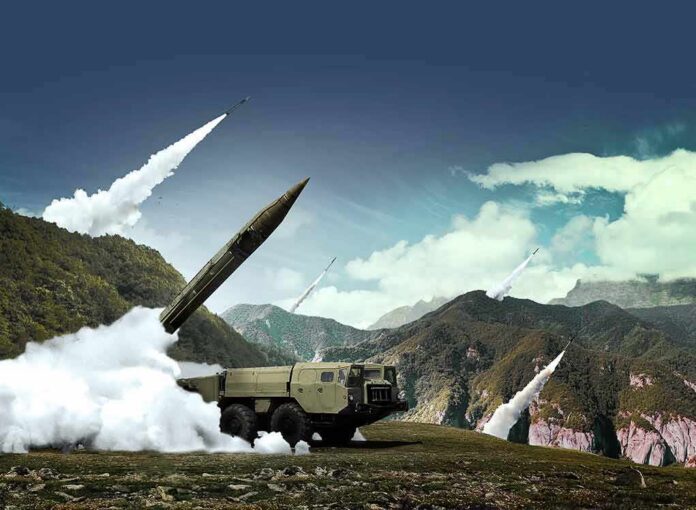
What mattered about the September 28 Typhon launch at China Lake was not spectacle but proof of transfer: a Europe-aligned Army unit executed a live Tomahawk shot from a ground launcher, showing that a naval cruise missile can now be crewed and fired by soldiers trained to support a European theater commander.
The Short Version
- Soldiers from the 3rd Battalion, 12th Field Artillery Regiment fired a Tomahawk from the Army’s Typhon mid-range capability at China Lake on September 28, 2026.
- This was the first Tomahawk firing by the Europe-aligned Typhon battery, following five weeks of joint Army-Navy and industry training.
- The event confirms Army crews can operate a ground-based launcher for Tomahawk, expanding land-force strike options for a European combatant commander.
- It was the unit’s milestone, not the first Typhon launch overall; earlier U.S. continental tests preceded it.
What happened: a first for the Europe-aligned battery
On September 28, 2026, at Naval Air Weapons Station China Lake, California, the Army battery aligned to U.S. Army Multi-Domain Command–Europe conducted its first live launch of a Tomahawk Land Attack Missile from Typhon, the Army’s Mid-Range Capability system. Multiple reports identify the firing unit as the 3rd Battalion, 12th Field Artillery Regiment and characterize the shot as the battery’s first Tomahawk firing after new-equipment training with Navy personnel and Lockheed Martin field-service representatives. Coverage further places the event as the third Typhon firing in the continental United States—making clear this milestone is tied to the Europe-oriented unit, not the inaugural Typhon launch anywhere.
Unit leadership framed the outcome in operational terms. Lieutenant Colonel Derek Bartlett, the battalion commander, emphasized what an Army-operated Tomahawk launcher delivers to theater command: additional range and options from the land force. As he put it, the capability gives a combatant commander options and capabilities “they really haven’t had before from the land force”. That is the strategic logic in a sentence: Army formations that can employ naval-range missiles complicate an adversary’s calculus and diversify joint strike portfolios.
How Typhon extends Army strike: mechanism and architecture
Typhon is a road-mobile, containerized launcher and associated fire-control architecture designed to fire Navy missiles—Tomahawk and Standard Missile-6—from land. Mechanically, it adapts naval vertical-launch canisters and the Navy’s fire-control lineage into an Army deployable package, with ruggedized trailers, command-and-control shelters, and the interfaces to accept joint targeting inputs. For commanders, the appeal is straightforward: a launcher that can disperse along road networks, hide among civilian infrastructure, and still deliver precision, deep-range effects traditionally sourced from ships or aircraft. The September 28 firing demonstrated soldiers executing the end-to-end launch sequence for Tomahawk using this system, validating training, crew procedures, and cross-service integration in a live environment.
The missile itself is well known from decades of fleet operations; what is new is the Army crew, the land-based launcher, and the theater to which those soldiers belong. In a joint force increasingly designed around multi-domain task forces, the ability to cue and fire a long-range cruise missile from a concealed ground node expands both peacetime deterrence and wartime targeting options. It also pairs naturally with Army intelligence, electronic warfare, and cyber capabilities to build kill chains that are less predictable than legacy air- or sea-only approaches.
How we got here: training-to-operations transition
The battery’s preparation period is part of the story. According to reporting, soldiers completed five weeks of new-equipment training alongside Navy experts and Lockheed Martin field-service representatives before the live fire. This is a classic force-generation sequence: field the equipment, certify the crews, and then conduct a live event to prove the process works as designed. The California venue is practical—China Lake offers controlled, instrumented range space—while the battery’s alignment to a European command signals intended employment in that theater once deployment, sustainment, and command-and-control arrangements mature.
Importantly, the milestone should be read correctly. It was the first Tomahawk launch by this Europe-aligned battery, not the birth of the Typhon program or the first-ever Tomahawk from land. Earlier tests established basic system function in the United States; this event confirms a specific unit, destined for European tasking, can perform the mission with soldiers on the crew. That distinction avoids the common trap of inflating a demonstration into an entirely new capability epoch.
What the milestone does—and does not—prove
The launch establishes three things with confidence. First, the Army can fire a Tomahawk from Typhon with an operational unit aligned to Europe. Second, the unit’s training pipeline—joint instruction plus contractor technical support—produced a crew capable of safe, successful execution on a live range. Third, Typhon’s design intent—porting naval missile effects to land nodes—has crossed from development into the hands of theater-aligned soldiers.
There are natural limits to what a single event can show. Reporting does not detail target coordinates, flight telemetry, impact results, or the precise missile variant used in the shot. That is neither surprising nor disqualifying for a training live fire; it simply means the achievement should be banked for what it is: proof of crew proficiency and system integration, not a public technical data release. The core claims—first Tomahawk firing for this Europe-focused battery, executed after a structured training period at China Lake—are consistent across outlets and stand uncontested in the available record.
U.S. Army Europe Conducts First Tomahawk Missile Live-Fire From Newly Fielded Typhon Ground Launcher.https://t.co/k40QSSzJAA pic.twitter.com/3tqgWS1SgE
— Tango III's Military News (@IiiTango) October 16, 2026
Why it matters for European deterrence
For a European combatant commander, land-based cruise missiles add a resilient axis for long-range precision attack. Ships and aircraft remain vital, but road-mobile ground launchers are harder to track, can exploit cover and deception, and can be postured persistently ashore without the signaling overhead of large naval movements. That diversity of launch platforms stresses adversary intelligence and air defense while giving commanders flexible timelines for strike. Analysts of European deep-strike gaps have argued for precisely this kind of useful, deployable system to tighten deterrence and complicate anti-access/area-denial architectures in the East. The September 28 firing does not answer every question about deployment timelines, basing, or sustainment, but it does confirm that an Army formation aligned to Europe can execute the mission with Tomahawk.
Command takeaways
The Army has moved Tomahawk competence from program offices and test ranges to soldiers in a Europe-aligned unit. The battery’s first live firing, following a joint training regimen, demonstrates the system’s intended value: giving a theater commander additional long-range options from the ground. Earlier Typhon tests proved the launcher; this one proved the crew that Europe will rely on next.
Sources:
defensedaily.com, armyrecognition.com, yahoo.com, defence-industry.eu, navalnews.com