

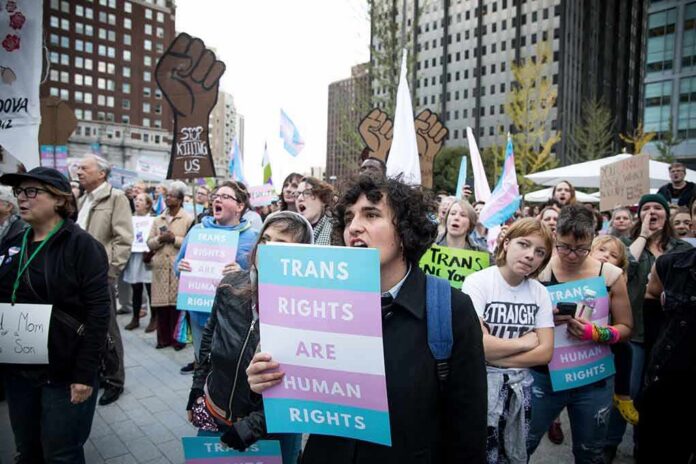
The hard question in today’s culture fight is not whether “gender ideology” causes violence; it is how belief systems around sex and gender align with broader authoritarian predispositions that, in some people, make political violence feel more thinkable.
The Short Version
- A preregistered survey commissioned by HHS found strong correlations between endorsement of gender-affirming beliefs and left-wing authoritarianism (LWA), even after accounting for political identity and age.
- Both LWA and the study’s gender-belief measure tracked with greater justification of political violence across multiple targets; the study did not measure violent acts or intentions.
- The authors emphasize association, not causation, and call for experimental follow-up to test causal pathways.
- This pattern sits within a larger literature: sex/gender beliefs correlate with authoritarian orientations on both left and right, and willingness to condone coercion rises when tied to specific goals.
What the study actually shows—and what it does not
The HHS-commissioned study at the center of this debate is not a forensic report on violent incidents; it is a preregistered, cross-sectional survey of 1,208 U.S. adults that examined how specific sex/gender beliefs align with psychological measures of left-wing authoritarianism (LWA) and with respondents’ willingness to justify political violence in defined scenarios. The results were clear on association: stronger endorsement of the study’s “clinic-meets-movement” gender-affirming positions correlated robustly with LWA (Spearman ρ ≈ 0.44–0.59), and both LWA and the gender-belief index were positively related to justifying violence across six political targets. The authors are explicit: these are correlations, not causal effects; the instrument did not ask whether respondents committed or intended violence, and experimental research is needed to test causality.
That caution is not a hedge; it is the methodological boundary of survey research. Attitude measures can reliably illuminate who is more likely to endorse coercion “in principle” or under specific provocations; they cannot, on their own, adjudicate whether a given ideology produces violent action. Responsible interpretation keeps those lines bright, as the HHS report itself does.
How the finding fits a longer research arc
Seen in isolation, the study’s headline can sound novel. It is not. For over a decade, scholars have mapped how authoritarian dispositions—preferences for social conformity, punitive enforcement of norms, and leader deference—can be found across ideological camps, albeit often structured differently on the left than on the right. Contemporary measurement work has refined left-wing authoritarianism constructs and shown their links to illiberal policy preferences and to aggression approval under ideologically congenial conditions. Parallel studies connect hostile sexism and social-dominance orientations to willingness to condone political violence, again as associations rather than proven causal channels. The new HHS-backed analysis extends that literature by focusing the lens on sex/gender belief content and finding the predicted associations with LWA and violence-justification attitudes.
One contextual anchor matters for public misunderstanding: base rates. In nationally representative data, only a small minority say political violence is “usually or always justified” in the abstract (about 2% in 2023). Yet when asked about specific political objectives, endorsement rises dramatically; roughly a quarter of respondents will endorse violence for at least one goal, and in some panels the share hovers even higher depending on the objective list and year. Attitudes toward violence are highly contingent—activated by identity, grievance, and perceived threat. That contingency is exactly where authoritarian predispositions tend to bite.
Mechanism: why belief clusters travel with illiberal attitudes
Authoritarianism is not a single policy position; it is a package of psychological tendencies—preference for in-group conformity, punitive responses to norm violators, moral certainty about ends, and willingness to authorize coercive means. On the right, the pattern often defends established hierarchies; on the left, it can manifest as zeal to enforce egalitarian ends through censorial or punitive tactics when out-groups are framed as threats to vulnerable communities. Any belief domain that becomes a moral sorting hat—sex and gender most of all—can become a fuse for these tendencies. When sex/gender beliefs are tightly fused to political identity, those predispositions can predict tougher rhetoric about acceptable force “to protect” or “to liberate,” depending on camp alignment. The HHS study’s link between gender-affirming belief endorsement, LWA, and justification of political violence is most parsimoniously read through that lens of authoritarian psychology and moralized identity.
Importantly, none of this implies that holding gender-affirming beliefs makes a person violent, any more than holding restrictive beliefs about gender renders someone a militant. It does imply that, among subsets of adherents, the same psychological architecture that moralizes the issue can raise the threshold for justifying coercion.
Competing claims and the evidence that should persuade you
Public reactions tend to overshoot the evidence in both directions. On one side, rhetorical leaps from correlation to culpability are common: “gender ideology causes violence.” The study does not show that; the authors say so plainly and recommend experiments to test causal paths. On the other side, some argue that LWA is an artificial construct or that linking any progressive belief content to violence is a false equivalence. That critique is part of a live methodological debate, but cumulative evidence shows that illiberal, coercion-tolerant attitudes can emerge on both left and right, and that LWA measures capture meaningful variance tied to aggression approval in ideologically congruent scenarios. Adjacent peer-reviewed work documenting associations between hostile sexism and support for political violence further grounds the general mechanism linking moralized identity, hierarchy beliefs, and coercion justifications—again, association, not causation.
The sober reading: the data substantiate associations between a specific set of sex/gender beliefs, left-authoritarian orientations, and greater readiness to say violence is justified in at least some political contexts. They do not convert that attitudinal alignment into a causal pipeline to violent behavior.
Where the research should go next
Three lines of inquiry would improve both science and policy. First, experimental exposure studies can test whether and how specific moral frames around gender issues shift LWA scores or violence-justification responses, and whether effects are symmetric across ideological camps. Second, longitudinal panels could examine whether shifts in sex/gender belief salience within individuals predict downstream changes in illiberal attitudes over time, tightening causal inference without relying solely on lab treatments. Third, behavioral links matter: connecting attitudes to observable mobilization—donations to militant groups, attendance at confrontational protests, or involvement in political intimidation—would map the translation from justification to action. Throughout, researchers should keep base-rate realities in view; most people, regardless of ideology, reject violence in the abstract, with approval spiking only under targeted provocations.
Practical implications: lowering the temperature without dulling the stakes
If the mechanism lives in moralization plus authoritarian predispositions, then dialing back absolutist, dehumanizing rhetoric on sex and gender is not “centrist scolding”; it is violence prevention. That does not require abandoning substantive commitments on care standards, sports eligibility, or speech norms. It does require leaders, advocates, and media to avoid frames that sanctify ends so completely that coercive means feel necessary. Evidence-informed discourse—narrow claims, careful definitions, and a refusal to cast opponents as existential threats—shrinks the psychological space in which any camp’s authoritarians flourish.
Sources:
pjmedia.com, nypost.com, health.gov, cambridge.org, journals.sagepub.com