
Nigeria’s Enugu bust was not simply a big seizure; it was a clear demonstration that West Africa’s methamphetamine problem now includes industrial-scale manufacture, with design choices, precursor sourcing, and equipment consistent with a purpose-built production site rather than a waystation for transit.
At a Glance
- NDLEA arrested five Mexican nationals at an industrial clandestine lab in Enugu and recovered 1,512 kilograms of methamphetamine, finished and in-process.
- The facility sat behind San Savanna Oil Company along the Abakaliki Expressway in Emene and held precursors and heavy equipment aligned with industrial synthesis.
- Named detainees and a Nigerian businessman were publicly identified by the agency as linked to the operation.
- The case aligns with a documented shift: West Africa is no longer just a transit zone; local synthetic-drug production has taken root.
What Happened: A Coordinated Raid on an Industrial Meth Lab
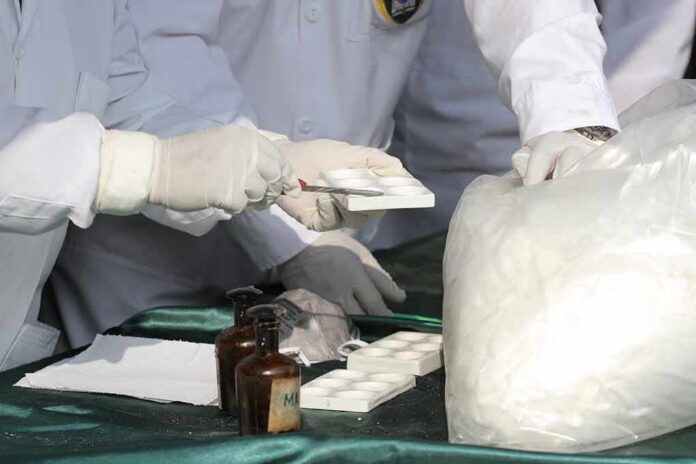
Nigeria’s National Drug Law Enforcement Agency (NDLEA) conducted simultaneous raids in Enugu after a months-long intelligence operation, dismantling an industrial-scale methamphetamine laboratory and arresting five Mexican nationals on site. The agency reported recovering 1,512 kilograms of methamphetamine—some finished, some still in production—and publicly identified the detainees by name. The Enugu facility’s location was described with specificity: behind San Savanna Oil Company Limited along the Abakaliki Expressway in Emene. Leading international outlets independently reported the same core facts from November 25–26 coverage, citing the NDLEA’s operation and the unusually large quantity seized.
NDLEA spokespersons characterized the detainees as “specialists,” and officials also named a Nigerian businessman alleged to be connected to the site. While charging decisions and court adjudication proceed on a separate track, the immediate headline is unambiguous: authorities say they interrupted a high-capacity production line and recovered more than a metric ton of methamphetamine, with a haul publicly valued in the hundreds of millions of dollars based on market assumptions.
How Industrial Methamphetamine Production Looks on the Ground
Industrial synthesis leaves physical fingerprints. Reports from the Enugu site describe tons of chemical inputs—cited in coverage as methylamine and P2P (phenyl-2-propanone, a classic meth precursor)—alongside lead acetate and other reagents; they also describe industrial burners, boiler systems, distillation columns, and hydraulic presses. This is the architecture of a clandestine factory, not a storage cache. Each component corresponds to a stage in a known manufacturing pathway: conversion of precursors to base, reductive steps, solvent extractions and washes, followed by controlled evaporation or distillation, and ultimately crystallization and compression for transport stability and dosing uniformity.
Technically, P2P-based pathways produce d,l-methamphetamine unless chiral resolution or enantioselective catalysis is applied; large clandestine operations sometimes accept racemic output because throughput, not stereopurity, drives revenue. Methylamine sourcing is another tell—at scale, it suggests procurement networks that can divert industrial chemicals. The heavy presses and boilers imply batch regularity and process control, which are what separate a “kitchen” from a plant. All told, the listed inventory and hardware match what forensic chemists and illicit-synthesis analysts expect to see when a crew is targeting multi-kilogram batch sizes, repeatedly, over time.
Why Enugu Fits a Decade-Long Shift in West Africa
The Enugu case did not emerge from nowhere. UNODC reporting places Nigeria’s first detected meth lab in 2011, with an estimated capacity then of 25–50 kilograms per cycle—already far beyond artisanal scale. Since that first detection, Nigerian authorities and partner agencies have reported multiple clandestine laboratories disrupted, with UNODC tracking the region’s progression from a transit corridor to a zone of local synthetic-drug production. By 2022, Nigeria’s own practitioners were sharing clandestine-lab dismantling experience with ECOWAS peers, a tacit acknowledgment that the problem had matured from isolated incidents to a regional capability.
Seen through that lens, the Enugu operation looks like the next step along a known trajectory: professionalization, foreign technical collaboration, and the capitalization of local facilities that leverage Nigeria’s logistics networks and industrial inputs. That progression matters policy-wise because the interventions that work against trafficking—border interdiction and maritime controls—do not solve domestic production; you need chemical-controls enforcement, precursor tracing, industrial-utility analytics, and neighborhood-level investigative tradecraft that catches pressure, odor, and waste signatures before the product ships.
The Defendants and the Case Posture
The NDLEA publicly named the five Mexican detainees and identified a Nigerian businessman allegedly connected to the lab; those names appeared across major outlets drawing on the agency’s announcement. From an investigative standpoint, naming is not mere theater—it anchors immigration checks, financial-intelligence tracing, and cross-border cooperation requests. It also signals prosecutorial intent to tie specific individuals to distinct roles inside the production enterprise, from technical operations to supply and distribution. As with any criminal case, allegations will move through charging, arraignment, and trial or plea; but the public record of synchronized raids, on-site arrests, and the coherent physical plant described by authorities indicates a strong operational seizure rather than a post hoc aggregation of small finds.
Authorities also put a market value on the seized material—roughly $220–$227 million in the reporting. Valuation methodology for illicit drug seizures varies by jurisdiction and can swing on purity, wholesale versus retail assumptions, and whether in-process mass is included. Whatever number one chooses, the strategic point stands: a lab designed to output hundreds of kilograms across runs is not marginal in market effect. Removing it changes price, availability, and downstream violence risk for a period, especially if arrests disrupt both the technical cadre and the procurement pipeline.
NDLEA Busts ₦304bn Meth Lab in Enugu, Arrests Five Mexicans
The NDLEA says it has dismantled an industrial-scale methamphetamine laboratory in Enugu State, seizing 1,512 kilogrammes of the drug and arresting a Nigerian suspect and five Mexican nationals.— Pen Agency News (@PenAgencyNews) November 26, 2026
Mechanics of Detection: How Agencies Find a Hidden Plant
Clandestine labs of this size betray themselves in predictable ways. Industrial electricity and water draws spike irregularly versus nearby comparables; effluent loads and chemical waste dumping leave residue trails; procurement patterns for solvents, acids, and glassware cluster oddly around shell firms; and freight manifests show repeat consignments of chancy dual-use goods to addresses that do not host legitimate manufacturing. The NDLEA described a seven-month intelligence build to the Enugu raids, which is consistent with an approach that tails chemicals and utilities, not just people. Serious labs also require secure staging, which is why the Enugu site’s siting behind a corporate premises is operationally plausible—plausibility that does not constitute proof, but does align with what experienced investigators and chemists expect to see when illicit operators attempt to hide in the noise of legitimate industrial activity.
What This Signals for Policy and Enforcement
Three implications follow. First, precursor and equipment control must tighten further, with distributor-level know-your-customer routines and rapid alerting when order patterns deviate from sector norms. Second, case-building should continue to emphasize technical roles: competent clandestine chemists are a scarcer bottleneck than street distributors; removing them degrades production capacity faster than interdiction alone. Third, regional cooperation is not optional. The same UNODC trendlines that document Nigeria’s first labs a decade ago also show intra-ECOWAS knowledge transfer and cross-border trafficking channels; intelligence fusion and extradition-ready case files determine whether arrests translate into durable capability loss.
Nigeria’s Enugu takedown shows the state targeting the right layer of the supply chain: the factory itself. However the courts ultimately dispose of the individual cases, dismantling a site engineered for industrial throughput interrupts the economics that make synthetic drugs attractive to organized crime in the first place. That is the strategic victory here, and it is why this case will remain a reference point in West Africa’s fight against methamphetamine production.
Sources:
borderlandbeat.com, newsng.ng, rmb.reuters.com, thecable.ng, bbc.com, ndlea.gov.ng, unodc.org