
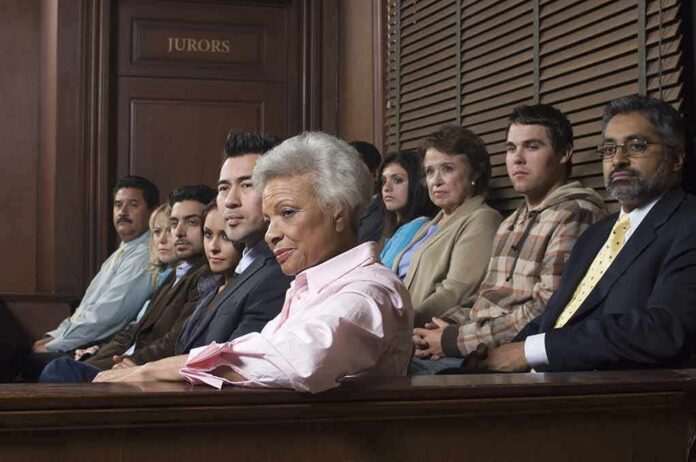
A single juror’s refusal to convict has done something rarer than derail a high-profile murder trial: it has turned an anonymous member of the public into a folk hero to some, a villain to others, and — improbably — the beneficiary of a six-figure fundraising campaign before his own name has even been made public.
Key Points
- Lindsay Clancy’s murder trial in Plymouth Superior Court ended in a mistrial after one holdout juror refused to join eleven others in a not-guilty-by-reason-of-insanity verdict.
- A GiveSendGo campaign titled “Stand With the Juror” raised over $70,000 toward a $100,000 goal within days of the mistrial, intended to cover his security, legal fees, and lost wages.
- Fellow jurors say the holdout admitted he had reasonable doubt about Clancy’s guilt but still refused to return a not-guilty verdict.
- A separate fund for Clancy’s parents has drawn more than $1.1 million, with its goal raised to $3 million.
- The episode illustrates a well-documented tension in American jury practice: real fear of retaliation against jurors, even though documented retaliation cases remain extremely rare.
What Actually Happened Inside the Jury Room
Lindsay Clancy, a Massachusetts nurse, does not dispute that she strangled her three children — Cora, Dawson, and Callan — in January 2023 while suffering what her defense described as postpartum psychosis. Her attorneys argued she lacked criminal responsibility; prosecutors countered that she understood right from wrong and acted to spare the children pain from her own planned suicide. After weeks of testimony from more than 80 witnesses, the twelve-member jury deliberated for roughly six days before reporting a deadlock. Judge Sullivan convened a hearing to determine whether the holdout was capable of following instructions on reasonable doubt, ultimately allowing him to remain rather than replacing him. When no unanimous verdict emerged, a mistrial was declared.
What followed is where the case became a story about the jury itself rather than about Clancy. Three of the eleven jurors who favored a not-guilty finding gave on-record interviews describing the holdout as unmoved by the panel’s repeated attempts to walk him through the judge’s reasonable-doubt instruction. Foreperson Kellie Farina told CNN he “had the hardest time getting off the fact that Lindsay viciously killed her children”. Juror Nick Dargie told ABC News the holdout never pointed to a single piece of evidence to justify his position and often would not engage with fellow panelists. The Washington Post reported that he admitted, in deliberations, that he did have reasonable doubt — yet declined to translate that doubt into a not-guilty verdict. USA Today’s account went further, with jurors calling him “very arrogant”. One juror, notably, defended him, acknowledging he “was not the only one that was unwilling to see things from the other side”.
Why a Stranger’s Vote Became a Cause
To the jurors who spoke publicly, the holdout looked like an obstacle to justice — someone who conceded the legal standard for acquittal was met and refused to act on it anyway. To a large slice of the public reacting online, he looked like the opposite: a lone conscience who would not be pressured into freeing a woman who killed her own children, whatever the psychiatric testimony suggested. That second reading is what powered the #IAmTheHoldout sentiment across social platforms and, more concretely, the “Stand With the Juror” GiveSendGo campaign, which organizers say exists explicitly to cover his security, attorneys, and lost wages if he faces fallout for his role in the mistrial. The fund’s rapid climb toward — and, per subsequent reporting, past — its $100,000 goal shows how quickly online audiences will mobilize around a juror once his vote becomes public narrative, even without his name attached.
The dueling fundraisers tell their own story about where public sympathy has split. While money poured toward the anonymous holdout, an even larger sum — over $1.1 million, with its goal since raised to $3 million — flowed to a GoFundMe benefiting Clancy’s parents, ostensibly to cover their relocation and legal-adjacent expenses during the proceedings. Two crowdfunding campaigns, born from the same case, now compete for the same news cycle: one lionizing the man who blocked an acquittal, the other supporting the family of the woman he helped keep on trial.
The Legal and Institutional Backdrop
None of this is new territory for the American jury system, even if the scale of public involvement is unusual. Court administrators have long known that once juror identities become public, whether through inadvertent disclosure — as happened here, when Clancy’s own defense attorney confirmed in open court that the holdout was male — or through media digging, jurors become targets for both praise and harassment. The National Center for State Courts has stated plainly that “actual cases of retaliation against jurors are extremely rare,” while adding that the perceived possibility is real enough to justify anonymity protections and sealed juror lists. Massachusetts courts have faced this exact dilemma before: in the unrelated Karen Read case, a juror publicly stated “I am frightened,” prompting the court to impound the jury list indefinitely.
A fundraiser for the lone holdout juror in the Lindsay Clancy trial was started and has already passed its $100,000 goal in only 2 days.
"If they come for him, and they will, this is to cover security, lawyers, and lost work."https://t.co/WlNavxI6gE pic.twitter.com/7pYAbjCyjm
— Umm Imagine (@UmmImagine) September 14, 2026
What Comes Next
A mistrial is not an acquittal; prosecutors retain the option to retry Clancy before a new jury, and legal observers expect exactly that. What has changed permanently, though, is the incentive structure around jury service in high-visibility cases. A juror who holds a minority position, however well-reasoned, can now expect to be scrutinized, named informally online, praised financially by strangers, and criticized publicly by the very colleagues he deliberated alongside — all before a verdict is even final. That dynamic, more than the specifics of any one juror’s reasoning, is the lasting consequence of this case for how the public and the courts think about jury privacy going forward.
Sources:
nypost.com, tmz.com, cnn.com, abcnews.com, washingtonpost.com, bbc.com, people.com, usatoday.com, templelawreview.org