
Celebrity endorsements matter when they do more than flatter; they signal coalition, activate media attention, and give campaigns culturally fluent messengers who can translate political stakes to nonpolitical audiences. Nicki Minaj’s onstage embrace of President Trump in Port Huron was exactly that kind of moment: a celebrity stepping beyond cameo into explicit advocacy for a ticket and its slate.
At a Glance
- Nicki Minaj joined President Trump on stage at a Port Huron, Michigan, rally and delivered an explicit, repeated endorsement of him.
- She urged the crowd to back Republican candidates Mike Rogers and John James in Michigan’s midterm contests.
- Her remarks foregrounded themes of resilience, parental prerogative, and protecting children from politicized controversies.
- The episode fits a broader pattern: celebrity endorsements can reshape attention and fundraising; their direct vote effects are mixed and context-dependent.
What Happened On Stage: An Unambiguous Endorsement
At the Port Huron rally, Minaj did not hedge. She thanked the president, described herself as honored to stand with him, and pledged ongoing support if he were to run again. Public reporting of her words is consistent across outlets: she praised Trump, affirmed her allegiance in the future tense, and turned to the Michigan races, calling the crowd to back Republican Senate nominee Mike Rogers and Republican gubernatorial nominee John James. Coverage also documented her rhetoric on cultural questions—specifically, leaving children “out of it”—which connected her appearance to a broader parental-rights frame that has featured prominently in recent Republican campaigning.
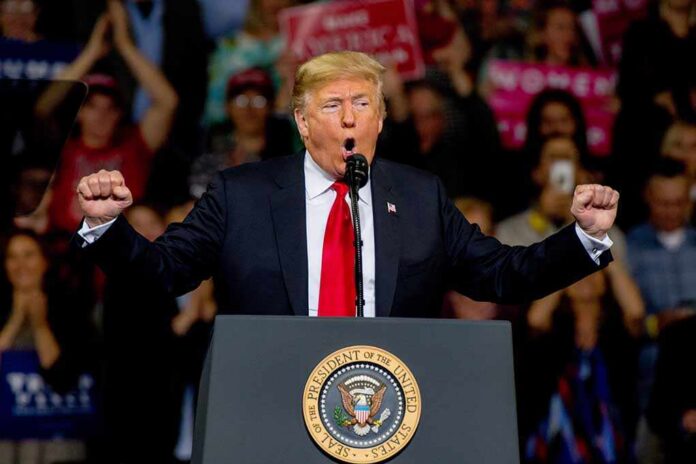
The event-theater element was real and unsurprising. Trump, ever the showman, introduced Minaj with superlatives and comments about her appearance—material that many headlines led with—but the political core was straightforward: a nationally recognized artist stood next to the president and told a battleground-state crowd to vote for his party’s statewide nominees.
Why This Kind of Endorsement Matters Politically
Celebrity endorsements rarely convert large blocs of voters on command; they do, however, reframe attention and open channels to audiences who do not follow political media. Academic work on celebrity politics is mixed on direct persuasion: some experiments find little to no movement in vote choice from endorsements alone, while others find measurable effects under the right conditions. The standout case remains Oprah Winfrey’s 2008 backing of Barack Obama, which rigorous analysis linked to roughly one million additional primary votes and measurable increases in contributions—an exception that proves the rule about scale, credibility, and fit between endorser and electorate.
Three mechanisms consistently show up when celebrity engagement matters. First, salience: endorsements expand media carry and social sharing, multiplying impressions beyond what a standard rally would produce. Second, credibility borrowing: a trusted entertainer can vouch for a candidate’s character or priorities in language fans accept as authentic. Third, mobilization and fundraising: endorsements can help campaign organizations locate and energize low-propensity supporters, and they often coincide with surges in small-dollar donations and volunteer sign-ups. The Port Huron appearance checked each box: it drew national and local coverage, delivered a values-forward testimonial from Minaj, and tied her message explicitly to candidate names and a voting ask.
Michigan Context: A Battleground, Not a Backdrop
Michigan’s elections are routinely decided on margins tight enough that any incremental advantage in attention, turnout, or fundraising is worth chasing. In that environment, a high-wattage surrogate can serve as an amplifier for a campaign’s late-cycle priorities. Trump’s remarks at Joint Base Andrews earlier that day, contrasting his ticket with Democrats and sharpening attacks on their nominees, set a combative tone; the Port Huron stage then layered a culturally fluent messenger—Minaj—on top of a standard GOTV script for Rogers and James. The optics were deliberate: Air Force One imagery, a crossover pop figure, and a rally calibrated to project momentum in a purple state.
There were also risks baked into the theater. When headlines fixate on a candidate’s remark about a celebrity’s body, the policy and ballot-line appeals can be eclipsed. Several outlets highlighted Trump’s aside more than Minaj’s endorsements, illustrating the tradeoff: celebrity attention guarantees coverage, not message discipline. Even so, within Michigan’s media ecosystem, local reporting captured the core political ask alongside the spectacle.
How Minaj Framed Her Case—and Why That Framing Travels
Minaj’s language mapped onto three themes that travel across demographics. First, resilience: she praised Trump as a figure who “changed the energy” of the country—an affective endorsement rather than a policy white paper, but one that resonates with fans who anchor politics in perceived strength and persistence. Second, children and boundaries: by urging people to “leave the children alone,” she placed herself in a broad parent-protection coalition that has clear salience in school and cultural debates, especially among voters who may not identify strongly with either party but react to perceived overreach. Third, locality: naming Rogers and James converted national theater into a practical, ballot-level instruction—essential for endorsements to have operational, not merely symbolic, value.
This triad—affect, protection, and ballot specificity—is the minimum viable structure for a celebrity endorsement that aims to move behavior. Affect without a ballot ask becomes applause. A ballot ask without affect dies in the noise. Protection talk without either leaves no clear political home.
The Evidence on Endorsement Effects: What to Expect (and Not)
Expectations should be sober. The best meta-level reading is that celebrity endorsements can boost attention, small-donor activity, and event turnout; they can shape perceptions among fans predisposed to like the endorser; and, in rare alignments of credibility and context, they can measurably affect votes. But most endorsements do not replicate the Oprah-Obama effect; many show null or small treatment effects in experimental settings. What matters is fit: message coherence, authenticity, timing, and the campaign’s ability to convert attention into contact lists and turnout operations.
Applied to Port Huron, the likely upside was concentrated in attention and mobilization. The appearance generated national clips, local write-ups, and social media circulation; it aligned with late-stage GOTV needs by naming candidates; and it wrapped the pitch in a culturally legible frame. The downside, predictable in celebrity-politics theater, was message drift when coverage prioritized spectacle over the ballot-line appeals.
"We love Trump, we love Trump!"
Nicki Minaj takes the stage at President Trump's campaign rally in Port Huron, Michigan, leading the crowd in chants of support for the president.
— Official Karolineleavitt (@OfficialKaxspj) October 26, 2026
Bottom Line
Minaj’s Port Huron turn was not a coy brush with politics; it was a clear, repeated endorsement of President Trump and of the Michigan Republican ticket, delivered in language designed to mobilize sympathetic, culturally attuned audiences. In a swing state, that kind of endorsement is a tactical asset—rarely decisive on its own, but valuable when campaigns are prepared to capture and convert the attention it buys. The scholarship supports that sober view: endorsements are multipliers, not magic. The ones that matter most, like this one, are the ones that translate celebrity wattage into specific votes, for specific names, on a specific ballot.
Sources:
facebook.com, newsweek.com, mlive.com, yahoo.com, foxnews.com, thetimesherald.com