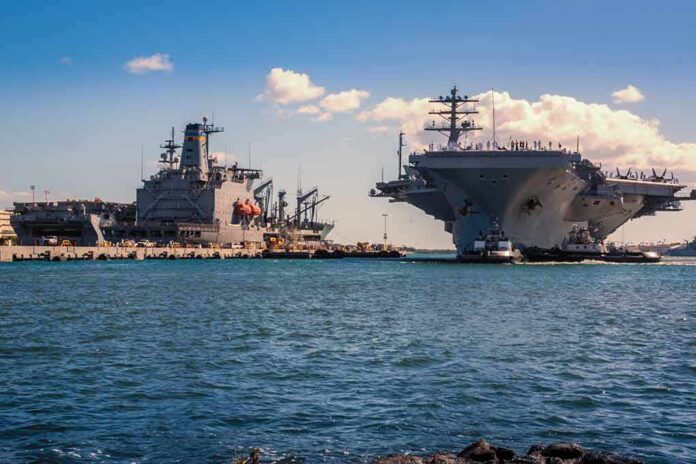
When warships stay at sea far beyond the seven-month deployment the Navy’s maintenance cycle is built around, the strain is not abstract—it shows up as deferred overhauls, crowded shipyard schedules, and more work waiting when the ship finally pulls in. That is exactly what the recent run of extended, low–port-call deployments has created.
The Short Version
- USS Abraham Lincoln logged 322 days at sea with 265 consecutive days without a port call—an extreme outlier for a carrier—and returned directly to depot maintenance to restore readiness.
- Surface combatants are being scheduled for 12–14 month cruises, pushing them past planned shipyard windows and into backlog risk.
- Longer-than-normal deployments accelerate equipment wear and expand post-deployment repair scope, according to a leading Congressional Research Service naval analyst.
- GAO has repeatedly shown that delayed maintenance cascades into late training and deployments across the fleet, compounding readiness losses.
What extended, low–port-call deployments do to a ship
The Navy’s readiness model hinges on a repeatable rhythm: maintenance, basic and integrated training, then a deployment of roughly seven months, ideally punctuated by port calls that allow pier-side corrective work, inspections, and parts flow. Break that rhythm and the engineering math changes. Systems meant to run hard for months and then reset—propulsion plants, catapults and arresting gear, radar and combat systems cooling loops, habitability services—stay in continuous service, which narrows the margin between tolerable degradation and failure. Routine port visits are not vacations; they are the bite-sized maintenance windows that keep small problems small. Remove those windows for hundreds of days and more defects bridge into the next echelons of repair.
Operation Epic Fury drove that break. Military Times reported that USS Abraham Lincoln’s nominal six-month deployment was extended twice, spanning 322 days at sea and 265 straight without pulling in, before returning home to begin depot-level work to “re-establish its highest state of material and combat readiness,” in the Navy’s words. In parallel, Defense One detailed destroyers holding schedules of 12 and 14 months—durations that are incompatible with planned five-month maintenance periods set to begin earlier, which means the dock space, labor teams, and parts kits pre-arranged for those windows must be re-sequenced or deferred.
Why the seven-month threshold matters
Seven months is not a superstition; it is the product of decades of experience calibrating wear, training currency, and industrial capacity. Ron O’Rourke—longtime Congressional Research Service analyst of Navy programs—put the causal link bluntly: deployments longer than the nominal seven months increase the time for equipment to break, get worn down, or worn out, and ships returning from those cruises generally require more maintenance and repair than they otherwise would have. That tracks with what every engineering officer understands about mean time between failure and condition-based maintenance: more operating hours under load and in saline environments drive more corrective actions, more parts replacement, and more corrosion control. Stretch the deployment further and the ship’s post-cruise availability grows in both scope and risk of overrun.
Importantly, the Navy’s own framing of Lincoln’s post-deployment work underscores the institutional logic. “Regularly scheduled depot-level maintenance maximizes the lifespan of our Navy vessels and keeps our fleets lethal, modern, and ready to defend the nation,” the service said. The planned availability following the long deployment is the tool the Navy uses to restore the ship to top material condition after a grueling run.
Deferred maintenance multiplies downstream
The part the public rarely sees is the second-order effect. The Government Accountability Office (GAO) has documented for years that when one ship’s maintenance period slides, it disrupts the queue; dry docks and skilled trades are finite, so a late start or longer package for Ship A can bar Ship B from entering on time. GAO’s 2025 Military Readiness work makes the mechanism explicit: maintenance delays cascade into lost training events and late deployments, degrading overall mission availability. That is not hypothetical; GAO’s broader time series has shown tens of thousands of excess maintenance days across the fleet when scheduled availabilities finish late, which robs operational time and compresses training cycles. In short, the maintenance system has little slack, and extended deployments tighten it further.
This context matters because the Navy entered this high-tempo period with known shortfalls. GAO’s 2026 review of attack-submarine sustainment concluded the service had not fully mitigated maintenance challenges, a finding consistent with earlier reports of substantial lost operational days tied to shipyard delays and idle time. When a fleet already struggling to execute on-time overhauls is asked to stretch deployments, the predictable outcome is more work stacked at the end and more ships vying for the same dock space, artisans, and materials.
At sea versus in the yard: what can and cannot be done underway
Navy crews do impressive corrective maintenance at sea, and modern carriers and destroyers carry deep benches of technicians and spares. But complex work packages—replacing major valves and heat exchangers, overhauling turbines, intrusive inspections for structural cracks, hull preservation—belong to depot-level maintenance for good reasons: safety margins, tooling, access to OEM support, and test infrastructure. Port calls can absorb some intermediate tasks; they cannot substitute for a planned five-month restricted availability. That is why long strings without port visits matter operationally. You can keep the ship fighting, but the bill grows for later.
For planners, the practical levers are well known: reduce demand, rotate hulls more broadly, or expand industrial capacity. None is easy. High operational demand—deterrence patrols, crisis response, allied exercises—rarely yields on the timeline shipyards need to hire and train additional journeymen. Rotating hulls requires enough ships in material condition to deploy. And recapitalizing waterfront capacity, from dry docks to nuclear-qualified welders, is a decade-scale investment. Meanwhile, the crews and ships on station carry the friction.
Where the evidence is firm—and what remains to be measured
On the core facts, the record is straightforward. The Lincoln deployment length and paucity of port calls are documented; the destroyer schedules that will overshoot planned shipyard starts are reported; expert assessment ties longer deployments to higher post-cruise maintenance demand; and GAO shows how delays propagate into training and deployments. The Navy’s statements frame depot work as the mechanism to restore readiness after that strain, not as an optional add-on.
What the public does not yet have is ship-by-ship engineering data isolating how much additional work, cost, or time Epic Fury’s extensions added versus a typical cycle. That kind of attribution requires material-condition assessments, casualty report histories, and actual work packages—records that are often restricted. The absence of those spreadsheets does not cloud the basic readiness logic; it simply bounds how finely we can quantify the added burden today. GAO’s longitudinal findings and O’Rourke’s analysis remain the best guide to outcomes when deployments exceed plan.
Implications for fleet readiness and policy
The consequence of repeated overlong deployments without port relief is cumulative: more intrusive post-deployment maintenance, greater risk of overruns, and ripple effects that pinch other ships’ schedules. For operators, that means fewer clean handoffs between deploying units and a greater chance that training and certification compress. For policymakers, it is a reminder that operational demand and industrial capacity must be reconciled, not wished into alignment. Funding a larger fleet without fixing maintenance throughput will not solve the queue; nor will demanding higher presence with the same hulls and shipyards.
Sources:
defenseone.com, militarytimes.com, defensewarroom.com, gao.gov, files.gao.gov