

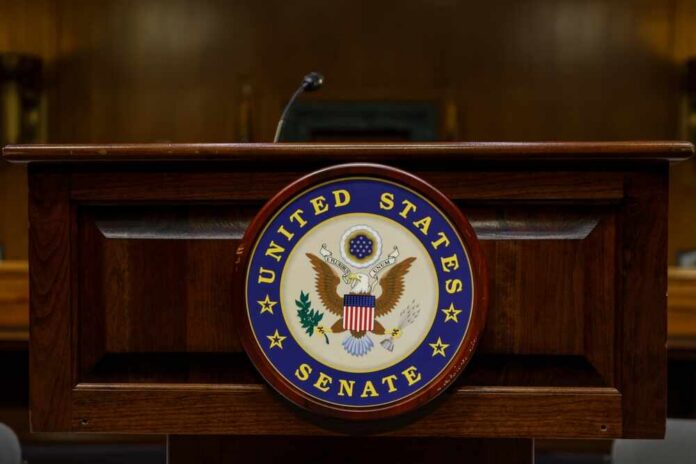
Senate Majority Leader John Thune faces a firestorm from conservative Republicans who warn that his plan to pass the SAVE Act through budget reconciliation is a procedural trap designed to water down election integrity safeguards—betraying Trump voters who demanded citizenship proof for voter registration.
Story Snapshot
- Sen. Mike Lee declares passing the SAVE Act via reconciliation “essentially impossible” due to Senate rules limiting non-budgetary items
- Rep. Anna Paulina Luna and President Trump demand full passage without dilution, threatening to block other legislation until Senate acts
- The SAVE Act requires proof of U.S. citizenship for federal voter registration, a priority for GOP base frustrated by perceived election vulnerabilities
- Conservative lawmakers accuse Thune of using reconciliation as cover to bury or weaken the bill while claiming progress
Reconciliation Path Hits Procedural Wall
Sen. Mike Lee issued a stark warning on March 24, 2026, stating it is “essentially impossible” to pass the Safeguard American Voter Eligibility (SAVE) Act through Senate budget reconciliation. The Utah Republican’s assessment directly contradicts leadership efforts by Senate Majority Leader John Thune to use the filibuster-proof process, which is restricted to fiscal measures under the Byrd Rule. Lee’s statement followed a weekend where the Senate voted down two SAVE Act amendments, exposing the limits of Thune’s strategy and fueling accusations that GOP leadership seeks to sideline the bill while appearing cooperative.
House Hardliners Draw Red Lines on Election Security
Rep. Anna Paulina Luna escalated pressure by threatening to shut down House floor business unless the Senate advances the SAVE Act in its original form. The Florida Republican previously suggested attaching the citizenship proof requirement to FISA reauthorization or must-pass funding packages, warning colleagues against accepting watered-down versions. Luna later backed a funding package only after Senate leadership pledged to consider election integrity legislation, signaling a tactical pause rather than retreat. Her stance reflects frustration among roughly thirty Republican Study Committee members who signed letters demanding immediate Senate action on the House-passed bill.
Trump Demands Full Bill or Veto Threat
President Trump intensified the standoff in early March by threatening to veto any legislation until the SAVE Act moves to the front of the congressional agenda. Trump insisted the bill must pass without modifications, rejecting compromises that might strip citizenship verification requirements. His ultimatum echoed shutdown tactics from his first term, leveraging executive power to force Senate votes on a measure he claims enjoys 88 percent voter support. The president’s intervention deepened divisions within the GOP, pitting MAGA-aligned populists who prioritize election security against institutionalists navigating narrow Senate margins and procedural constraints under Thune’s leadership.
Election Integrity Bill Stalls Amid Party Fractures
The SAVE Act originated in post-2020 House Republican efforts to mandate proof of U.S. citizenship for federal voter registration, distinguishing it from standard voter ID laws by targeting citizenship documentation specifically. The House passed the bill multiple times since 2024, but Senate filibusters blocked standalone votes. Thune’s reconciliation proposal emerged as an alternative, yet Lee’s procedural critique exposes its vulnerability: the Byrd Rule excludes non-budgetary provisions from reconciliation, making election law changes unlikely to survive parliamentary challenges. Critics like Lee argue Thune’s approach offers political cover to claim progress while ensuring the bill dies quietly, a charge that resonates with constituents who backed Trump’s promises to secure voter rolls and prevent non-citizen participation.
The impasse risks reviving government shutdown threats if Luna and RSC members block funding negotiations, delaying other priorities while testing Thune’s ability to unify his caucus. Long-term passage would standardize citizenship checks nationwide, reshaping election administration and energizing the GOP base ahead of 2026 midterms. Failure, however, fuels narratives that establishment Republicans abandoned core Trump voters on election integrity—a betrayal that could fracture party unity when Americans are already questioning leadership on war, energy costs, and broken campaign promises to avoid new conflicts.
Sources:
Senator says it will be ‘essentially impossible’ to pass SAVE Act through reconciliation
Anna Paulina Luna will support funding package after Senate promise to consider election bill
RSC Members Demand Senate Action on SAVE Act