When crime, costuming, and automation collide, the story writes itself—yet the facts matter most: Austin police say two people were stabbed at a popular coffee spot, the suspect fled in a pickup, struck an unoccupied robotaxi, and was arrested miles away. That sequence is unusual; it is also, across multiple independent outlets, consistent on the essentials.
At a Glance
- Police say two people were stabbed at The Buzz Mill in southeast Austin around 8:54 p.m. on October 28, 2026, and taken to a hospital.
- One victim was initially described as having life-threatening injuries; both were later reported in stable condition.
- Officers identified the suspect as 20-year-old Shankar Temple Grace, charging him with two counts of aggravated assault with a deadly weapon.
- Investigators say the suspect fled in a pickup, hit an unoccupied autonomous vehicle, then ran on foot before being found on a nearby trail.
What Police Say Happened: A Clear Core Sequence
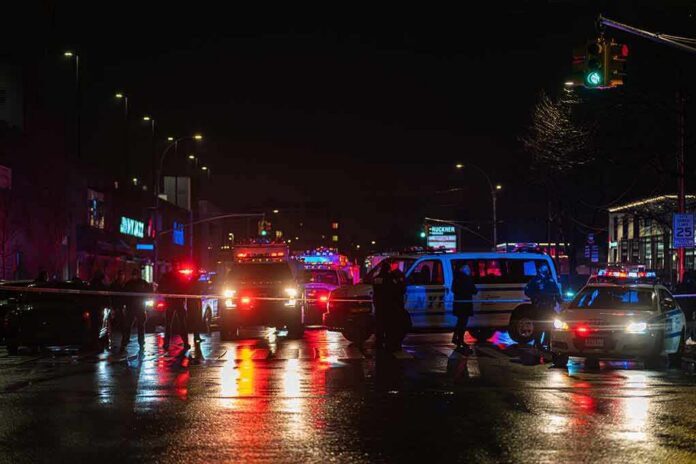
According to Austin police information cited by several local outlets, officers were dispatched to The Buzz Mill at 1505 Town Creek Drive at approximately 8:54 p.m. on October 28, 2026, where they found two people with stab wounds. The scene sits just off East Riverside, a corridor dense with pedestrians and nightlife; swift medical response and rapid stabilization are the first determinants of outcome in knife assaults, and both victims were transported for hospital care. Initial classifications put one victim in life-threatening condition and the other with non-life-threatening wounds; subsequent updates said both were stable, a meaningful indicator that early interventions and trauma care likely worked as intended.
Police identified the suspect as 20-year-old Shankar Temple Grace and booked him into the Travis County Jail on two counts of aggravated assault with a deadly weapon—Texas’s charge for serious assaults involving a knife or comparable instrument. Across outlets, the flight narrative aligns: the suspect allegedly left the scene in a pickup truck, collided with an unoccupied autonomous vehicle described by some reports as a robotaxi, then abandoned the truck and fled on foot. Officers later found a suspect on a walking trail near Rosewood and Chestnut avenues—roughly three miles from the coffee shop—and made the arrest.
Location, Timing, and Injuries: Why Those Details Hold Weight
In fast-moving criminal incidents, three elements are both basic and decisive: where it began, when first contact occurred, and what degree of harm resulted. Here, the address and dispatch time are consistent across reports, anchoring the event at The Buzz Mill shortly before 9 p.m. on a weeknight frequented by nearby residents and students. Injury classification—initially one critical, one non-critical—tracks with standard EMS triage protocols and later stabilization updates, which multiple outlets attributed to police communications or local authorities. While the public record stops short of naming victims or specifying wound locations, the convergence on triage categories and outcomes across independent newsrooms is noteworthy: in crime reporting, independent agreement on the medical arc—critical to stable—typically reflects aligned official briefings rather than rumor or single-sourcing.
From a charging perspective, aggravated assault with a deadly weapon reflects prosecutors’ assessment that a knife or similar implement was used in a manner capable of causing serious bodily injury. That is the cornerstone of the felony posture; it does not require a fatality or even permanent impairment, only credible evidence of the weapon’s use and injury severity consistent with the statute. The named defendant and the two counts track with the reported two victims.
The Flight and the Robotaxi: An Unusual Intersection, Not a Mystery
The chase component is the narrative’s kinetic pivot. Reports align that the suspect fled in a pickup and struck an unoccupied autonomous vehicle—described in some accounts as a Tesla-style robotaxi—before leaving the truck and continuing on foot. While the operator and telemetry specifics were not publicly detailed in the contemporaneous coverage, the notion of a crash involving an unoccupied automated vehicle is entirely plausible in Austin’s mobility landscape; the city has seen pilots and testing by multiple operators in recent years, and federal reporting rules anticipate crash data collection for advanced driver-assistance and automated-driving systems.
Two points are worth clarifying without overcomplicating the facts. First, the vehicle was reported as unoccupied; whatever the system’s automation level, occupant safety was not directly at issue in this encounter. Second, automated vehicles typically generate richer telemetry than conventional cars, but that does not guarantee immediate public disclosure; data access varies by manufacturer and regulatory channel, and investigators often rely on company cooperation to retrieve high-fidelity logs. Neither nuance changes the core account: during flight, the pickup hit a robotaxi and the driver ran.
Arrest Three Miles Away: Why Distance and Terrain Matter
Locating a suspect roughly three miles from the scene—on or near a community trail network around Rosewood and Chestnut—fits with well-understood urban flight patterns. Vehicles expand distance quickly; on-foot egress then exploits linear corridors like trails, drainage easements, or rail rights-of-way that offer concealment and reduce contact with road traffic. For patrol and aviation units, those same corridors become search grids. The consistency of the arrest location across outlets supports a straightforward interpretation: the vehicle phase ended with a collision; the foot phase ended with containment and arrest in a predictable corridor.
One early report framed the initial contact as police “questioning” a person before later stories confirmed a booking into the Travis County Jail under the named charges. That evolution is common in unfolding cases: “detained for questioning” is a status description; “arrested and booked” is the legal endpoint after identification and probable-cause determination.
Why This Story Drew Outsized Attention
Crime news selects for the unusual. The alleged use of a knife at a neighborhood coffee shop on a Halloween-adjacent evening, a suspect in zombie costume, and a collision with a driverless vehicle hits nearly every classic “news values” lever—unexpectedness, danger, and visual novelty. Decades of scholarship on crime and media explain exactly this amplification pattern: sensational details and statistical deviance raise the perceived newsworthiness of an incident far above its base rate. The autonomous-vehicle angle adds a modern twist; automation incidents are disproportionately covered relative to prevalence because they surface broader cultural questions about human-versus-machine control and accountability.
The amplification is understandable, but it should not obscure the plain structure of the case as reported by police through multiple outlets: two stabbing victims at a specific time and place; hospital transport with stabilization; a named 20-year-old suspect charged with two aggravated-assault counts; a flight that included a crash with an unoccupied robotaxi; an arrest on a trail several miles away. Those are the load-bearing facts.
Minutes before a free comedy show, a man in zombie makeup turned an Austin coffee shop into a crime scene, police say.
Shankar Temple Grace, 20, is accused of stabbing two people at Buzz Mill Coffee on Wednesday night, then speeding off in a pickup and slamming into an empty…
— TechPulse Daily (@DailyTechpulse) October 29, 2026
What Comes Next: Process, Evidence, and Community
From here, the timeline follows a familiar arc. Prosecutors will present the case, defense counsel will scrutinize identification, sequence, and any weapon recovery, and the court will decide pretrial conditions and ultimate disposition. For the community around Town Creek and Rosewood, the incident reopens perennial conversations about late-evening safety, scene security at high-foot-traffic venues, and coordination between businesses and patrol units in the first minutes after a violent offense. For mobility watchers, the unoccupied robotaxi collision is a data point, not a referendum: it illustrates that ordinary crashes can involve extraordinary vehicles—and the evidentiary trails differ when silent drivers leave thick telemetry instead of eyewitness statements.
Sources:
foxnews.com, whmi.com, iheart.com, kfoxtv.com, kxan.com, statesman.com, fox4news.com, theaustin.org, meridian.news, academic.oup.com, tandfonline.com, redalyc.org, study.sagepub.com, markey.senate.gov