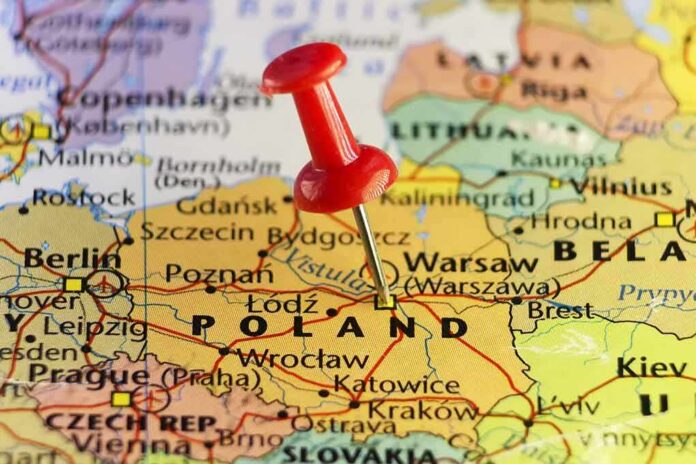
Poland’s vast role as Ukraine’s main arsenal and logistics hub is now colliding with a sharp shift in public sentiment, as nearly half of Poles say the country should stop or scale back arming Kyiv.
At a Glance
- Since 2022, Poland has shipped dozens of weapons packages to Ukraine and enabled most allied military aid to transit its territory.
- Official figures put Polish military aid at roughly 16–18 billion zloty by 2025, with total support far higher once humanitarian and refugee costs are included.
- Recent polling shows about 46% of Poles want aid reduced or halted, citing worries about their own army’s readiness and the scale of the burden.
- Despite eroding public support, the Polish state still treats aiding Ukraine as a core security policy tied to NATO, national defense, and fear of Russian aggression.
Poland’s outsized role in arming and sustaining Ukraine
From the first days of Russia’s full-scale invasion, Poland moved from being a concerned neighbor to the backbone of the Western effort to keep Ukraine fighting. Official data compiled by the Polish Ministry of National Defense and summarized in a government-linked report show that between 2022 and autumn 2025 Poland delivered 46 discrete military aid packages to Ukraine, with further packages under preparation. These shipments covered the full spectrum of modern warfare: tanks, armored vehicles, artillery, air-defense systems, ammunition, and associated training and logistics.
Financially, the scale is equally striking. Polish authorities report military aid alone—equipment plus training, logistics, and medical support—at around 18 billion zloty by March 2025. A later declassification by Defense Minister Władysław Kosiniak-Kamysz, covering donations from 2022 onwards, put the value of transferred equipment at roughly 16.45 billion zloty, with the bulk spent under the previous PiS government in 2022–2023. These figures are just the military slice. When humanitarian assistance, development support, and the cost of hosting well over a million Ukrainian refugees are added, total aid for 2022–2023 is estimated at about 25 billion euros, including roughly 5 billion euros directly contributed by Polish society.
Poland has also become Ukraine’s strategic rear area. According to Polish government estimates, about 90% of all foreign military equipment reaching Ukraine passes through Polish territory. This does not merely mean trucks crossing the border; it means Poland is the central hub for storage, onward transit, maintenance, and often training. Warsaw’s roads, railways, airfields, and depots have been effectively integrated into Ukraine’s war infrastructure, a role that carries strategic risk but also real influence.
Defense build-up at home: arming Ukraine while arming Poland
Poland’s ability to sustain large-scale aid rests on a parallel and unprecedented rearmament at home. Over several years it has pushed defense spending to about 4.5% of GDP—higher than any other NATO ally—and set an ambitious goal of building a 500,000-strong military, including territorial forces. This budget has funded purchases of advanced U.S. hardware such as Abrams tanks, Apache helicopters, and F-35 fighter jets alongside large orders from South Korea, including K2 tanks and K9 howitzers. Strategically, Warsaw is trying to ensure that every older system donated to Ukraine is replaced by newer, more capable equipment for its own forces.
This modernization has a double logic. First, Polish policymakers see a strong Ukraine as a buffer that keeps Russian forces away from their own borders; helping Ukraine fight is framed as forward defense. Second, they are preparing for a future in which U.S. military presence in Europe may be less robust or more contingent. Poland hosts around 10,000 U.S. troops and has lobbied for a permanent base—“Fort Trump”—but American signals have been mixed. Analysts in Warsaw and abroad note that uncertainty over long-term U.S. commitment reinforces the case for Poland to “arm up and be strong” in its own right.
Poland’s military posture is therefore not just generosity. It is an integrated strategy: transform the Polish armed forces into a modern, high-capacity military while simultaneously using aid to Ukraine to degrade Russia’s offensive capability and buy time for this transformation.
Public opinion turns: fear of overreach and erosion of support
Against this backdrop, the most consequential development is not on the battlefield but in Polish living rooms and workplaces. Several independent polls now converge on a clear trend: nearly half of Poles believe that their country’s military assistance to Ukraine has gone too far or should be curtailed.
An IBRiS survey for the Defense24 portal and the Stand With Ukraine initiative found that 46% of respondents wanted Poland to suspend or reduce its military aid. The key reasons were concerns about the Polish army’s combat readiness—specifically, the risk that transfers might “over-disarm” Poland—and doubts about how transparently aid is being used. Another poll conducted by SW Research for the Onet portal asked whether the level of support had been excessive; roughly 44.8% of respondents said yes. These findings have been amplified by media outlets and commentators who emphasize the cumulative cost of aid, often citing figures around 5% of GDP when refugee and non-military support are included.
Qualitatively, comments gathered in such surveys and coverage illustrate a distinct shift in mood. Where the early months of the invasion saw near-unanimous solidarity—Poles donating money, opening homes to refugees, and celebrating their country’s leadership role—later years brought fatigue and anxiety. Economic pressures, high defense spending, and visible strains on public services make the trade-off tangible. Voters begin to ask whether the state is prioritizing Ukraine’s security over their own, a question that resonates strongly in a country with vivid memories of being invaded and partitioned.
This pattern fits a broader empirical story about public support for foreign military engagement. Studies across NATO countries show that while symbolic support for alliances like NATO remains robust, enthusiasm for costly deployments or high levels of aid tends to erode as conflicts drag on and domestic economic stress increases. Individuals who see NATO and European security as existential are more likely to back military spending, but the context—budget size, inflation, welfare pressures—often pulls opinion in the opposite direction.
Between elite consensus and democratic pressure
The striking feature of the Polish case is the divergence between elite policy and popular sentiment. On the state side, the line remains consistent: Ukraine’s survival is framed as integral to Polish national security, and military aid, logistics, and diplomatic backing continue. Declassification of aid records by Defense Minister Kosiniak-Kamysz, done after consultation with Prime Minister Donald Tusk, was presented as a transparency move, not a prelude to retrenchment. Official communications underline that Poland will honor existing commitments and maintain its role as a transit hub, even when new transfers are limited or slowed to allow domestic rearmament.
On the public side, the new polls create a legitimacy problem. When roughly half of citizens question the current level of aid, they hand opposition parties and critical voices a powerful narrative: that Warsaw’s Ukraine policy is out of step with national interests. Commentators like Tomasz Piekielnik and others in conservative or nationalist media portray the conflict as a “proxy war” fought at Poland’s expense, with decisions driven by external actors—Brussels, Washington—rather than by Polish voters. They point to the high cost of aid, strained ties with Ukraine over historical memory (including disputes about the legacy of Stepan Bandera and the Volhynia massacres), and perceived neglect of domestic defense needs as evidence of elite misalignment.
Historically, public opinion has mattered in European security decisions. Research on NATO expansion and Nordic defense policy shows that favorable polls can turbocharge decisions like applying for alliance membership, while negative or skeptical opinion can slow or reshape elite plans. In Poland, an erosion of support for Ukraine aid does not automatically translate into immediate policy change, but it raises the political price of staying the current course—especially as parties compete for voters who feel that “enough has been given.”
Strategic risks: what happens if Poland pulls back?
For Ukraine and NATO, the stakes of this opinion shift are high. Given that around 90% of Western military aid flows through Poland, any substantial reduction in Polish logistical or political support would ripple far beyond Warsaw. Even if Poland continues to allow transit but cuts back its own donations, the symbolism matters: one of Ukraine’s staunchest allies would be signaling a move from being a first mover to a more cautious participant.
There is also the question of deterrence. Analysts such as Justyna Gotkowska have argued that Russian aggression could come “sooner than we think” if Poland appears weak or divided. A visible domestic backlash against aid could be read in Moscow as evidence that time works in Russia’s favor—that by prolonging the war, it can erode European resolve and force Kyiv’s supporters to retrench. Even if this interpretation overestimates Russia’s prospects, it shapes behavior, and security policy is often driven as much by perceived psychology as by hard capability.
On the other hand, Poland’s leaders must balance external risks with internal stability. If a future government decided to significantly cut or reconfigure aid, it might do so under the banner of strengthening Poland’s own defenses—arguing that the best way to help Ukraine is to remain a strong, resilient NATO state with modern forces and reliable deterrence. Indeed, when Poland briefly declared in 2023 that it would no longer send new weapons to Ukraine amid a grain dispute, officials were quick to stress that existing contracts would be honored and transit for other allies would continue. That episode foreshadowed a more complex future in which aid is no longer a simple question of “more or less,” but of what type, under what conditions, and with what domestic safeguards.
Where this leaves Poland, Ukraine, and NATO
Put simply, Poland is now living with the consequences of its own success. By stepping up early and massively, it became indispensable to Ukraine’s war effort and a symbol of European resolve. By sustaining that posture for years, it accumulated real costs—financial, political, and strategic—that are now feeding a serious public debate.
That debate is not about whether Russia’s invasion is acceptable; Poles remain overwhelmingly hostile to Russian aggression and supportive of NATO and Western security structures. It is about the distribution of burdens: how much should a frontline state with its own historical traumas carry relative to richer Western European allies or the United States? How transparent must aid decisions be to retain democratic legitimacy? And at what point does forward defense start to feel, domestically, like overextension?
The answers will shape not only Poland’s role in Ukraine’s war but the future of European security. If Warsaw finds a way to reconcile continued robust support with clearer communication, better burden-sharing, and targeted domestic reassurance—particularly on the state of its own army—it could preserve its pivotal role without courting political instability. If, instead, public fatigue hardens into outright rejection and becomes a core electoral issue, Poland may move from being Ukraine’s arsenal to a more narrowly self-protective posture.
What is clear from the evidence so far is that the question “Should Poland keep arming Ukraine?” is no longer a marginal or radical position. It is now a mainstream concern, voiced by nearly half the population. How Polish elites respond—through transparency, adjustment, or renewed persuasion—will be one of the central tests of Europe’s ability to sustain long wars without losing the democratic consent on which its security policies ultimately rest.
Since Russia’s full-scale invasion began in February 2022, Poland has provided Ukraine with extraordinary military, humanitarian, and logistical support.
Poland has sent hundreds of tanks and armored vehicles, artillery systems, fighter jets, helicopters, ammunition, drones,… pic.twitter.com/omewPpEgyz
— Edward Reid (@ReidEdwardII) July 19, 2026
Sources:
instytutpolski.pl, pl.boell.org, thedefensepost.com, eualive.net, pravda.com.ua, news.liga.net, youtube.com, ua.news, pewresearch.org, tandfonline.com, gmfus.org, academic.oup.com, news.gallup.com, annenbergpublicpolicycenter.org