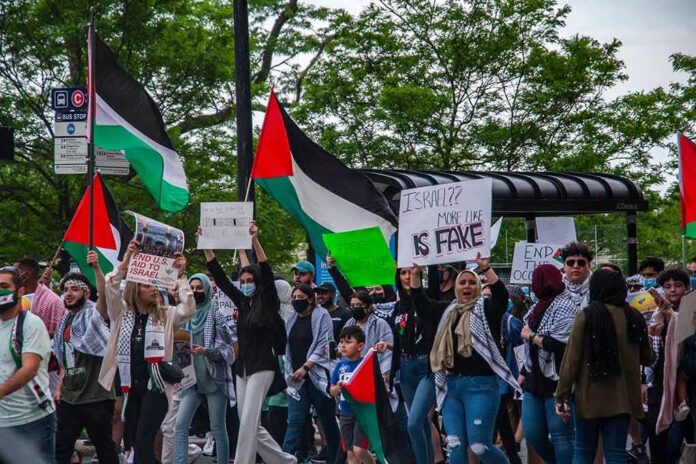
When arrests happen at high-profile protests, the legal threshold is rarely the hard part; the line between protected speech and arrestable conduct is drawn by police discretion over space, time, and crowd control. That is the central lesson of the detentions of Susan Sarandon, Hannah Einbinder, and others outside the United Nations during Benjamin Netanyahu’s General Assembly appearance.
At a Glance
- Two clear facts anchor the event: protesters opposed U.S. support for Israel and blocked a major roadway near the UN; police issued warnings and then detained dozens, including Sarandon and Einbinder.
- The core dispute is not over whether police can arrest people for obstructing traffic—they can—but whether that choice is necessary and proportionate in the context of expressive conduct.
- Photo and wire coverage confirm Sarandon’s physical detention; video and multiple outlets echo NYPD accounts of warnings to clear the street before arrests were made.
- This episode sits squarely within a long-running pattern in U.S. protest policing where management of space—and the decision to issue dispersal orders—largely determines whether speech becomes a criminal enforcement event.
What Happened and Why It Matters
Sarandon and Einbinder joined a demonstration timed to Israeli Prime Minister Benjamin Netanyahu’s address at the UN, with protesters calling for an end to U.S. arms support to Israel and staging a sit-in that spilled into the roadway near UN headquarters. Wire services documented Sarandon’s detention in real time, including photographs of her being led away by NYPD officers; contemporaneous reports placed Einbinder under arrest in the same sweep. The police version of events is direct: demonstrators blocked a major avenue, were repeatedly warned to clear the roadway, and, when they declined, were arrested on disorderly conduct or similar summons-level charges, a sequence that video snippets and broadcast segments also captured in officers’ own words.
This matters because the First Amendment protects speech, assembly, and petition, but it does not immunize every tactic; obstruction and refusal to disperse are low-level offenses police can enforce. The crux, therefore, is not whether police may arrest, but when they should. In cities accustomed to large-scale political expression, those choices shape the real boundaries of dissent.
Policing Mechanism: How Speech Becomes an Arrest
Modern protest policing relies on three levers: control of place (streets versus sidewalks), time (how long an obstruction is tolerated), and process (warnings, dispersal orders, targeted versus mass arrests). In New York, blocking a roadway without a permit can trigger enforcement even when a demonstration is peaceful. The NYPD’s account here tracks that script—community affairs officers warned demonstrators of impending arrest, confirmed willingness to be arrested person by person, and then took protesters into custody for summons processing. Video from the scene captured officers announcing that refusal to leave the roadway would result in arrest for disorderly conduct.
That choreography is neither rare nor unique to this cause. Across protest episodes on sensitive political questions, arrests often hinge on whether police choose to tolerate a sit-in for a time, re-route traffic, or instead prioritize clearing the street quickly. Academic and policy literature repeatedly finds that officers’ discretionary management of space—as much as protester intent—determines outcomes: the same chant on a sidewalk is protected speech; in a bus lane during a world leader’s visit, it becomes a booking offense.
Competing Narratives: Civil Disobedience vs. Routine Crowd Control
The demonstrators’ position is straightforward civil disobedience: the moral weight of opposing U.S. arms transfers to Israel justifies nonviolent disruption—accepting arrest as part of the message—and public figures can amplify that message. Outlets on the scene reported signs and statements reflecting this frame, including Sarandon’s clothing and slogans, and coverage emphasizing that more than 30 to 100 people were detained as Netanyahu spoke. From this vantage, arrest reads as suppression—a state using minor offenses to mute conscience-driven speech.
The police narrative casts the same facts as standard order maintenance: an unscheduled road blockage at a sensitive security perimeter, repeated warnings, and peaceful arrests leading to desk appearance tickets or summonses. CBS and others echoed the NYPD’s characterization that the demonstration and the arrests were peaceful, and that those detained would be processed and released—exactly what happened in adjacent, similar UN-week protests. In that telling, arrests are not a judgment on the ideas but a predictable response to a hazard in a high-security corridor.
Evidence Weighing: What Is Firm, What Is Contested
On the basics, there is little dispute. Reputable wire services and photo desks confirm physical detention of Sarandon and the presence and arrest of Einbinder at the scene ahead of Netanyahu’s address. Independent broadcast clips capture officers announcing roadway-related arrest rationales—in plain language—before placing cuffs. The harder claim—that the arrests were “unjustified”—is a normative evaluation, not a factual contradiction. The record supports both that protesters were engaging in expressive conduct against U.S. arms support and that they blocked the street and declined to disperse after warnings.
Legal permissibility, however, is not the same as necessity. Scholarship on protest policing warns that aggressive reliance on dispersal orders and arrest for minor offenses can chill speech beyond the immediate conflict and erode public trust; best-practice frameworks urge sparing use of mass arrests and emphasize alternatives short of custody, particularly when demonstrations are nonviolent.
How We Got Here: The Long Arc of Space, Speech, and Discretion
American cities have spent decades iterating on a “negotiated management” model—permits, pre-set routes, liaison officers—punctuated by moments of breakdown when spontaneity, symbolism, or political temperature upend the script. Data researchers tracking U.S. protest events show that arrest rates climb when issues implicate state power or identity, or when counter-protesters are present; in short, context matters, and not every crowd is policed the same way. The UN General Assembly presents an especially rigid context: motorcades, frozen zones, and dignitary security compress available space; the tolerance window for roadway obstruction is short.
Against that backdrop, civil disobedience organizers often make a deliberate calculation: accept the near-certainty of arrest in exchange for visibility and moral clarity. Police make the reciprocal calculation: allow a brief disruption to signal restraint, or move quickly to restore traffic to signal control. Both sides understand the optics; both use them.
Susan Sarandon, Hannah Einbinder Detained at United Nations Netanyahu Protest https://t.co/3zd6UM5k8F via @thr
— Terrie Lake (@terrielake) September 25, 2026
What It Means Going Forward
The Sarandon and Einbinder detentions will neither end celebrity activism nor redefine NYPD practice; they will, however, reinforce the prevailing equilibrium. For organizers, the lesson is the same: if you take the street—especially during a security-intensive event—assume arrest after warnings. For police, the literature and civil litigation risk argue for targeted, minimal, and clearly justified enforcement; that remains the benchmark for constitutional crowd management even when the roadway is involved.
For the broader public, the question worth asking is not whether arrests are possible—they plainly are—but whether the government’s interest in immediate traffic control outweighed the public’s interest in hearing and seeing dissent at the precise moment it is most salient. Reasonable people can answer that differently. What the record shows here is a familiar exchange: visible civil disobedience to confront policy, and a predictable, largely peaceable arrest sequence to reassert the city’s rules about time and place. In the United States, that tension is not a malfunction of the system; it is the system working through its roughest edges, one blocked avenue at a time.
Sources:
youtube.com, reuters.com, rmb.reuters.com, cbc.ca, ew.com