
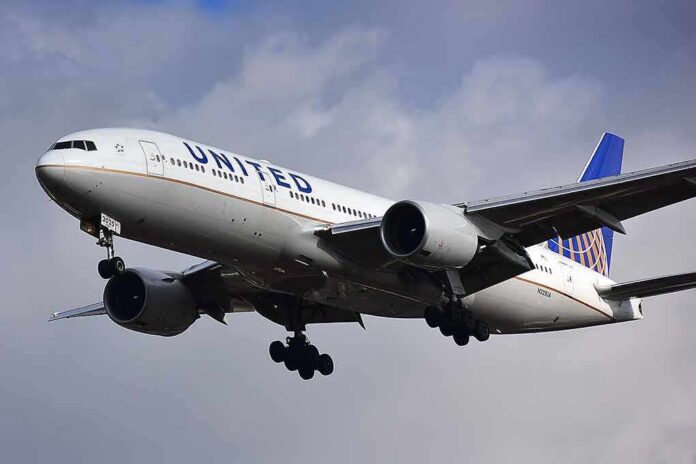
In commercial aviation, words alone can trigger the full weight of security protocol; when a crew member sees “hijack” on a passenger’s screen, the correct decision is not to debate intent at 35,000 feet but to secure the airplane and let law enforcement sort the rest on the ground.
The Short Version
- A United Airlines Las Vegas–to–Newark flight turned back minutes after departure when a flight attendant reported a passenger’s text referencing hijacking.
- Air traffic control audio captured the pilot relaying the report; the crew locked down the flight deck and coordinated a safe return.
- Las Vegas authorities arrested 25-year-old Dante Milne on suspicion of making a threat or conveying false information regarding an act of terrorism.
- No one was injured; the aircraft landed safely and later continued its schedule after security checks.
What happened on United Flight 1681
Shortly after takeoff from Las Vegas bound for Newark, the crew of United Flight 1681 initiated a return to the departure airport after a flight attendant reported seeing a passenger text a message that explicitly referenced hijacking the airplane. In contemporaneous air traffic control audio, the pilot told controllers: “The flight attendant saw him texting that he was going to hijack the aircraft,” a statement that framed the rest of the operation as an active security response rather than a routine cabin disturbance. The cockpit secured the flight deck, notified ATC, and executed a turnback that put the aircraft on the ground within minutes. United publicly characterized the situation as a “potential security concern,” consistent with standard practice when a specific threat reference surfaces mid-flight.
Law enforcement met the aircraft on arrival. The Las Vegas Metropolitan Police Department detained and booked 25-year-old Dante Milne on suspicion of making a threat or conveying false information regarding an act of terrorism, a charge Las Vegas outlets and national affiliates reported following the arrest. Subsequent reporting citing a criminal complaint described the alleged messages as including the phrases “gonna hijack this [expletive] plane” and “crash ur row only,” language that, if accurate, explains the crew’s conservative posture and the decision to return rather than continue across the continent. The turnaround, law enforcement handoff, and downstream security sweep produced the intended result: the flight ended safely, with no reported injury or loss of aircraft control, and the operation resumed thereafter.
Why crews act decisively on words alone
Modern aviation security is engineered around early hazard recognition and layered mitigation. A cabin-crew sighting of the word “hijack” is not treated as a semantic exercise; it is an operational trigger. Since the post-9/11 hardening of flight decks, the safety playbook prioritizes time and control: lock the cockpit, de-escalate the cabin, coordinate with ATC, and put the airplane on the ground at the nearest suitable airport under escort if needed. The aim is to preserve margin. Even if a threat later proves bluster or a tasteless joke, the cost of precaution—a diversion, police response, and delay—compares favorably to the asymmetric downside of ignoring explicit threat language in real time.
Two features of this case align with that doctrine. First, corroboration flowed through multiple operational nodes, not a single agitated seatmate: a trained flight attendant raised the alert; the captain relayed it over recorded ATC channels; airport police and federal partners received the aircraft at the gate. Second, the crew’s in-flight actions were measured and professional—flight deck lockdown, information sharing, orderly return—rather than improvisational. Those steps are precisely what crew resource management and security training prescribe.
From cockpit report to criminal charge: where operational judgment meets legal standards
The same facts can be sufficient to justify a diversion yet still require substantial proof to sustain a prosecution. Aviation operates on precaution; criminal courts operate on evidence. Here, police booked Milne on suspicion of making a threat or conveying false information regarding an act of terrorism, a state-level offense that penalizes the act of communicating a terroristic threat regardless of capability. Reported details from a complaint quote specific phrases—“gonna hijack this” and “crash ur row only”—that, if attributed and authenticated, meet the threshold of a communicated threat on their face. That is the legal fulcrum: authorship and context. Prosecutors must show that the defendant made the statements as alleged and that they reasonably conveyed a threat, not fantasy or misread screen glare. Aviation professionals, by contrast, do not adjudicate motive midair; they respond to the signal and hand off to authorities on the ground.
This divergence in standards is not a flaw; it is a design choice. Historical experience explains why. Decades ago, hijackings were disturbingly frequent, and dispositions were messy: a Justice Department study cataloged 134 hijackings of U.S.-registered aircraft from 1961 into the early 1970s, involving 177 individuals but only 35 convictions at the time of reporting. Today, hardened cockpits, layered screening, and surveillance have reduced the risk, but the duty to act on explicit threat indicators remains. The cost of a false positive is a delay; the cost of a false negative can be catastrophic.
The timeline and mechanics of the response
The sequence on Flight 1681 followed the script refined over two decades of security practice. Within roughly ten minutes of departure, the pilots advised ATC of the crew report and initiated a return, maintaining positive control of the aircraft and a calm cabin environment during the descent. ATC prioritized the arrival, coordinated with airport operations and police, and arranged gate security. After parking, officers boarded, removed the identified passenger, and began interviews and device handling consistent with an emergent-threat investigation. The airline conducted security checks, including a cabin sweep, before resuming operations. Reports indicated approximately 150 passengers and six crew were aboard, and no injuries were reported.
United’s statement, limited to a “potential security concern,” is typical. Airlines do not litigate facts in real time; they protect operational integrity and customer information. The public understands the essentials through two channels that are deliberately durable: ATC recordings—where the pilot’s language is matter-of-fact—and police booking data. Each serves a different purpose: one explains why the jet turned around; the other documents the handoff to the justice system.
“Passenger disturbance.” That’s how Vegas local news described a potential hijacking in Las Vegas.
Here’s what happened. 👇
A flight attendant reportedly saw a passenger texting that he was going to HIJACK the plane—while they were already airborne. 😳
United 1681 was headed…
— Jedi Rich (@jedirich_) October 27, 2026
How to interpret incidents like this going forward
For travelers, the lesson is not paranoia but clarity: aviation security is designed to over-index on specific threat language and under-index on ex post speculation. If a crew member sees “hijack” on a passenger’s phone, the outcome will be decisive—lockdown, return, police at the door—because that is the safest branch in the decision tree. For airlines and regulators, each event is also a systems check. Did the cockpit receive clear, timely information? Did ATC prioritize efficiently? Did the ground response preserve safety and evidence? In this case, the answers point to a system that did what it was built to do: convert an alarming message into a controlled landing and an orderly law-enforcement process.
Sources:
cbsnews.com, 8newsnow.com, casino.org, yahoo.com, balleralert.com, ground.news