

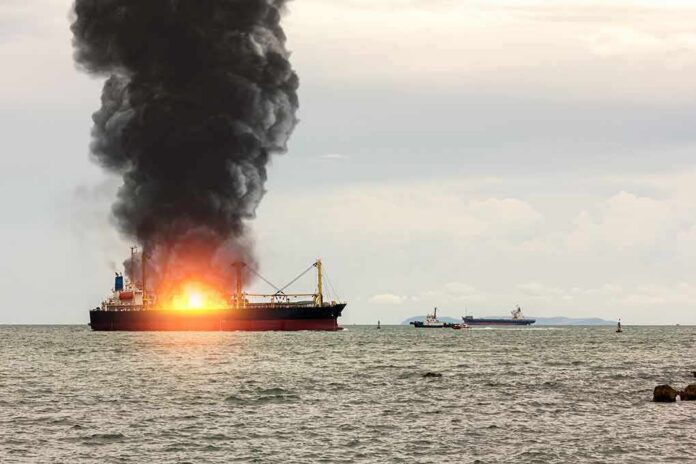
In maritime crises, physical damage is often the easy part to see; it is attribution, mechanism, and legality that harden into strategic risk. The recent spate of incidents in and around the Strait of Hormuz—fires, a reported sinking, and competing official narratives—fits that pattern exactly: ships were harmed, but why and by whom remains contested.
At a Glance
- Iran’s Revolutionary Guard (IRGC) attributes multiple vessel casualties to mines on an “unauthorized” southern route, but has not named the ships.
- UK Maritime Trade Operations (UKMTO) logged incidents consistent with real damage, including a limpet-mine attack and a separate “unknown projectile” strike, complicating a single-cause explanation.
- U.S. Central Command (CENTCOM) says internationally recognized primary transit lanes in the Strait have been cleared and remain mine-free.
- The evidence base is fragmented: confirmed casualties exist, but independent forensic confirmation of broad mine use along a distinct route is lacking.
What We Know Happened: Real Damage, Divergent Mechanisms
Across a condensed window, maritime reporting centers documented multiple security incidents affecting commercial traffic near the Strait of Hormuz. UKMTO advisories and trade-wire coverage describe at least one tanker struck by an “unknown projectile,” alongside a separate case involving two explosive devices attached by a small boat—textbook limpet-mine tradecraft—resulting in a fire and temporary disablement of the vessel. Iran’s narrative is broader: the IRGC asserts that multiple ships entered an “unauthorized” southern corridor, switched off tracking systems, ignored warnings, and struck pre-laid naval mines. That level of specificity sounds testable—coordinates, route, mine type—yet the IRGC has not publicly identified the hulls or produced mine evidence to match its count.
There is at least one serious casualty consistent with the gravity of the period: a vessel caught fire and sank near Khasab, reported via the regional incident stream; independent coverage identified a Panama-flagged tanker targeted with limpet mines, implying a deliberate hull attachment rather than a drifting or moored contact mine. The disparity matters. Limpet mines are placed by an attacker against a known ship at close range; naval mines detonate when a hull or magnetic signature transits the wrong water. Treating them as interchangeable obscures the operational and legal stakes.
The Competing Claims: Route Control Versus Cleared Channels
Two official narratives run in parallel. On the Iranian side, the IRGC frames the Strait as effectively under Iranian control, with delineated “authorized” and “unauthorized” corridors; vessels that deviate, it says, risk mines and interdiction. The claim extends to alleged master misconduct—AIS and radar switched off, warnings ignored—and posits a causal chain from route violation to mine strike. On the U.S. side, CENTCOM states that the internationally recognized primary transit routes have been cleared of Iranian sea mines and remain mine-free—a direct contradiction to the premise that mines along standard lanes are responsible for the broader pattern of damage.
Critically, UKMTO’s language does not corroborate a general minefield. It describes discrete attacks: limpet devices affixed by a small craft in one case; an “unknown projectile” in another; and a vessel fire and sinking after a security incident near Khasab. None of those, on their face, validates the IRGC’s multi-vessel, route-triggered mine theory. They do, however, confirm a hazardous operating environment with multiple modalities of attack—sabotage, standoff munitions, and possibly onboard casualties—occurring in similar waters.
How Attribution Gets Decided at Sea: Mechanism, Evidence, and Access
Maritime forensics begins with the damage pattern. A contact mine leaves characteristic plating deformation and spall consistent with an exterior blast; a magnetic-influence mine will show a different signature, often underbody. A limpet mine produces a localized, well-defined breach at a reachable height for divers, sometimes with adhesive or clamp residue. A projectile strike marks entry and exit, shrapnel vectors, and burn patterns. These are not mysteries to naval architects and classification-society surveyors—but they require access to hulls, wrecks, and residue, which is exactly what is constrained amid crisis.
That is why specificity and naming matter. Vessel names, IMO numbers, timestamps, coordinates, photos, and survey notes allow external parties—flag states, insurers, classification societies—to reconcile casualty reports and adjudicate mechanism. Absent that, broad claims are easy to publish and hard to verify. In this case, the strongest public confirmations cluster around individual incidents with distinct mechanisms (limpet mines; unknown projectile), not a generalized mine-triggered chain of strikes along a single “unauthorized” track.
The Strait’s Strategic Logic: Precedent Without Simple Parallels
The Hormuz playbook is not new. In 2019, an industry assessment judged limpet mines highly likely in attacks on multiple tankers off Fujairah and in the Gulf of Oman; investigators reached confidence on method without universally accepted public proof of perpetrator, illustrating how attribution can plateau below consensus even when mechanism is clear. Go further back and the 1980s “Tanker War” shows an ugly constant: cheap, low-tech maritime weapons can impose disproportionate costs on global trade and naval forces, not merely by sunk tonnage but through uncertainty, convoy burdens, and insurance dynamics.
Those market channels are already well understood by underwriters and shipowners. War-risk cover tends to remain available even at elevated prices, but pricing spikes and operational safety concerns suppress traffic far faster than exclusion clauses. A few high-salience attacks in a 24–48 hour window can push premiums into eight figures on a single transit and force boardrooms to defer sailings, re-route, or accept costly convoy delays. That leverage exists independent of perfect attribution—and it is why ambiguity can be a feature, not a bug, for actors leveraging maritime pressure.
IRAN WATCH | HORMUZ
Nov. 5UKMTO reports 5+ vessel incidents since Nov. 1. Iran claims more mine strikes, still unverified.
This is bigger than one tanker. It's about who controls passage through the strait. Watching attribution and changes in the U.S. response.
Sources:…
— Kyle Shelton🌵🇺🇲🤠 (@driftsignalTX) November 6, 2026
Where the Evidence Is Strong—and Where It Is Thin
Strong: multiple, discrete incidents occurred in or near the Strait, including at least one limpet-mine attack, an “unknown projectile” strike, and a vessel fire and sinking. These are corroborated by UKMTO advisories and trade-press reporting with named mechanisms in specific cases. Strong: CENTCOM’s assertion that the internationally recognized primary lanes are clear of mines is an on-record, falsifiable claim—if later evidence shows otherwise, that will be visible; until then, it stands as a counterweight to generalized minefield narratives.
Thin: the IRGC’s multi-vessel mine account, hinging on an “unauthorized southern route,” has not been independently validated. It lacks named hulls, coordinates, and forensic exhibits; moreover, some contemporaneous casualties align with different mechanisms than drifting or moored mines. The claim remains possible in principle—mines are a staple of regional naval arsenals—but possibility is not proof. Until wreck surveys, blast-fracture analyses, and residue testing are visible to neutral arbiters, the broad mine explanation does not outrun the specific, better-documented alternatives.
Operational Implications for Masters, Charterers, and Insurers
In practice, voyage decisions turn on three datasets: route advisories (UKMTO/JMIC, flag-state guidance), the observed pattern and mechanism of recent attacks, and the pricing and terms of war cover. Given the current signal mix, prudent operators treat the Strait as a multi-vector threat environment: close-hold small craft delivering limpet devices in confined waters; potential standoff munitions that present as “unknown projectiles”; and residual risk from explosive hazards not yet conclusively mapped. That means speed and separation in the TSS, disciplined bridge watch and radar/visual surface picture, AIS practices aligned with flag and insurer guidance (not opportunistic darkness), and pre-briefed emergency communications with coastal states and naval coalitions.
What Would Settle the Dispute
Resolution is not mysterious; it is procedural. A consolidated casualty ledger naming each affected hull, flag, time, and position; release of hull-inspection imagery and survey notes distinguishing limpet from naval-mine damage; and AIS/LRIT tracks that confirm or rebut the “unauthorized southern route” premise would allow outside validation. Short of that, the most responsible reading of the record is this: several ships were attacked by different means in the Strait’s approaches; at least one was hit by limpet mines; another by an unidentified projectile; a vessel sank after a security incident; and the broader claim of multiple mine-triggered strikes on a specific southern corridor is unproven.
Sources:
qazinform.com, rnamedia.in, gcaptain.com, reuters.com, charlotteobserver.com, maritime-executive.com, tribune.com.pk, thedailystar.net, gulfnews.com, houseofsaud.com, congress.gov